We read your photo as:

Find the general solution to Laplace's equation (∇²V = 0) for V(r) in spherical coordinates.

Physics

ScanSolve AI Answer

Answer

V(r)=C1r+C2\mathbf{V(r) = \frac{C_1}{r} + C_2}

V(r)=C1ln⁡(r)+C2\mathbf{V(r) = C_1 \ln(r) + C_2}

Step-by-step solution

8 steps

here's the solution to question 1:

We need to find the general solution to Laplace's equation (∇2V=0\nabla^2 V = 0) for two cases where the potential VV depends only on the radial coordinate rr.

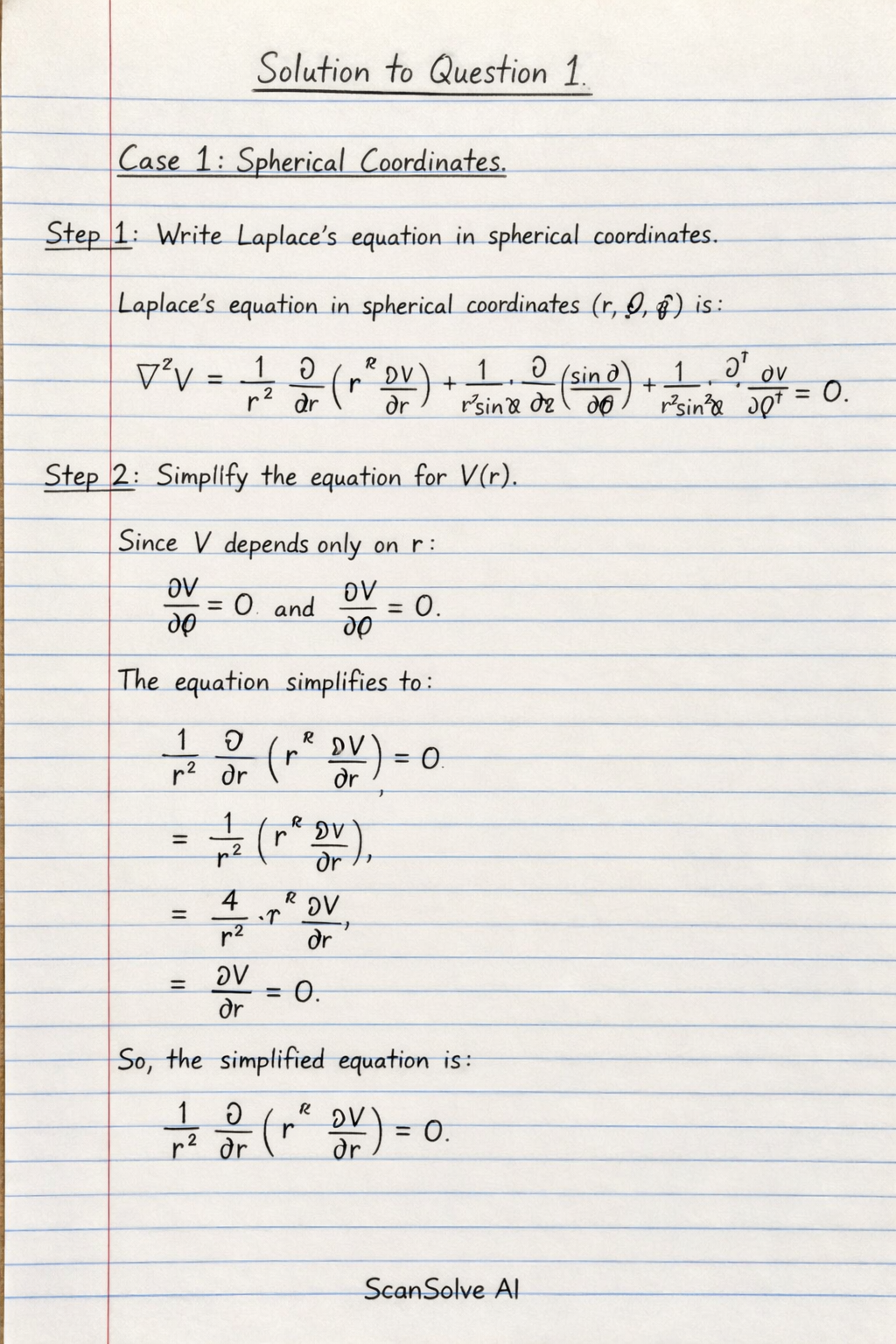
Case 1: Spherical Coordinates

  1. Write Laplace's equation in spherical coordinates.

    Laplace's equation in spherical coordinates (r,θ,ϕ)(r, \theta, \phi) is:

    ∇2V=1r2∂∂r(r2∂V∂r)+1r2sin⁡θ∂∂θ(sin⁡θ∂V∂θ)+1r2sin⁡2θ∂2V∂ϕ2=0\nabla^2 V = \frac{1}{r^2} \frac{\partial}{\partial r} \left( r^2 \frac{\partial V}{\partial r} \right) + \frac{1}{r^2 \sin\theta} \frac{\partial}{\partial \theta} \left( \sin\theta \frac{\partial V}{\partial \theta} \right) + \frac{1}{r^2 \sin^2\theta} \frac{\partial^2 V}{\partial \phi^2} = 0
  2. Simplify the equation for V(r)V(r).

    Given that VV depends only on rr, the partial derivatives with respect to θ\theta and ϕ\phi are zero (∂V∂θ=0\frac{\partial V}{\partial \theta} = 0 and ∂V∂ϕ=0\frac{\partial V}{\partial \phi} = 0). The equation simplifies to:

    1r2∂∂r(r2∂V∂r)=0\frac{1}{r^2} \frac{\partial}{\partial r} \left( r^2 \frac{\partial V}{\partial r} \right) = 0
  3. Integrate the simplified equation.

    Multiply by r2r^2 and integrate with respect to rr:

    ∂∂r(r2∂V∂r)=0\frac{\partial}{\partial r} \left( r^2 \frac{\partial V}{\partial r} \right) = 0 r2∂V∂r=Ar^2 \frac{\partial V}{\partial r} = A

    where AA is an integration constant.

  4. Integrate again to find V(r)V(r).

    ∂V∂r=Ar2\frac{\partial V}{\partial r} = \frac{A}{r^2} V(r)=∫Ar2dr=A∫r−2dr=A(−1r)+BV(r) = \int \frac{A}{r^2} dr = A \int r^{-2} dr = A \left( -\frac{1}{r} \right) + B

    Let C1=−AC_1 = -A and C2=BC_2 = B.
    The general solution in spherical coordinates for V(r)V(r) is:

    V(r)=C1r+C2\boxed{\mathbf{V(r) = \frac{C_1}{r} + C_2}}

    Case 2: Cylindrical Coordinates

  5. Write Laplace's equation in cylindrical coordinates.

    Laplace's equation in cylindrical coordinates (r,ϕ,z)(r, \phi, z) is:

    ∇2V=1r∂∂r(r∂V∂r)+1r2∂2V∂ϕ2+∂2V∂z2=0\nabla^2 V = \frac{1}{r} \frac{\partial}{\partial r} \left( r \frac{\partial V}{\partial r} \right) + \frac{1}{r^2} \frac{\partial^2 V}{\partial \phi^2} + \frac{\partial^2 V}{\partial z^2} = 0
  6. Simplify the equation for V(r)V(r).

    Given that VV depends only on rr, the partial derivatives with respect to ϕ\phi and zz are zero (∂V∂ϕ=0\frac{\partial V}{\partial \phi} = 0 and ∂V∂z=0\frac{\partial V}{\partial z} = 0). The equation simplifies to:

    1r∂∂r(r∂V∂r)=0\frac{1}{r} \frac{\partial}{\partial r} \left( r \frac{\partial V}{\partial r} \right) = 0
  7. Integrate the simplified equation.

    Multiply by rr and integrate with respect to rr:

    ∂∂r(r∂V∂r)=0\frac{\partial}{\partial r} \left( r \frac{\partial V}{\partial r} \right) = 0 r∂V∂r=Ar \frac{\partial V}{\partial r} = A

    where AA is an integration constant.

  8. Integrate again to find V(r)V(r).

    ∂V∂r=Ar\frac{\partial V}{\partial r} = \frac{A}{r} V(r)=∫Ardr=Aln⁡(r)+BV(r) = \int \frac{A}{r} dr = A \ln(r) + B

    Let C1=AC_1 = A and C2=BC_2 = B.
    The general solution in cylindrical coordinates for V(r)V(r) is:

    V(r)=C1ln⁡(r)+C2\boxed{\mathbf{V(r) = C_1 \ln(r) + C_2}}
Was this helpful?

Try one yourself

A new problem that tests the same skill.

Still stuck on this one?

Ask a follow-up, and the answer starts from this question.

Got a different question?Ask your own question
Handwritten step-by-step solution preview

Handwritten Step-by-Step Solution

Get this as a handwritten image on WhatsApp — like a tutor wrote it for you.

Try on WhatsApp