

This physics problem tests your understanding of fundamental physical laws and their applications. The step-by-step solution below breaks down the problem using relevant equations and physical reasoning.
ScanSolve AI Answer
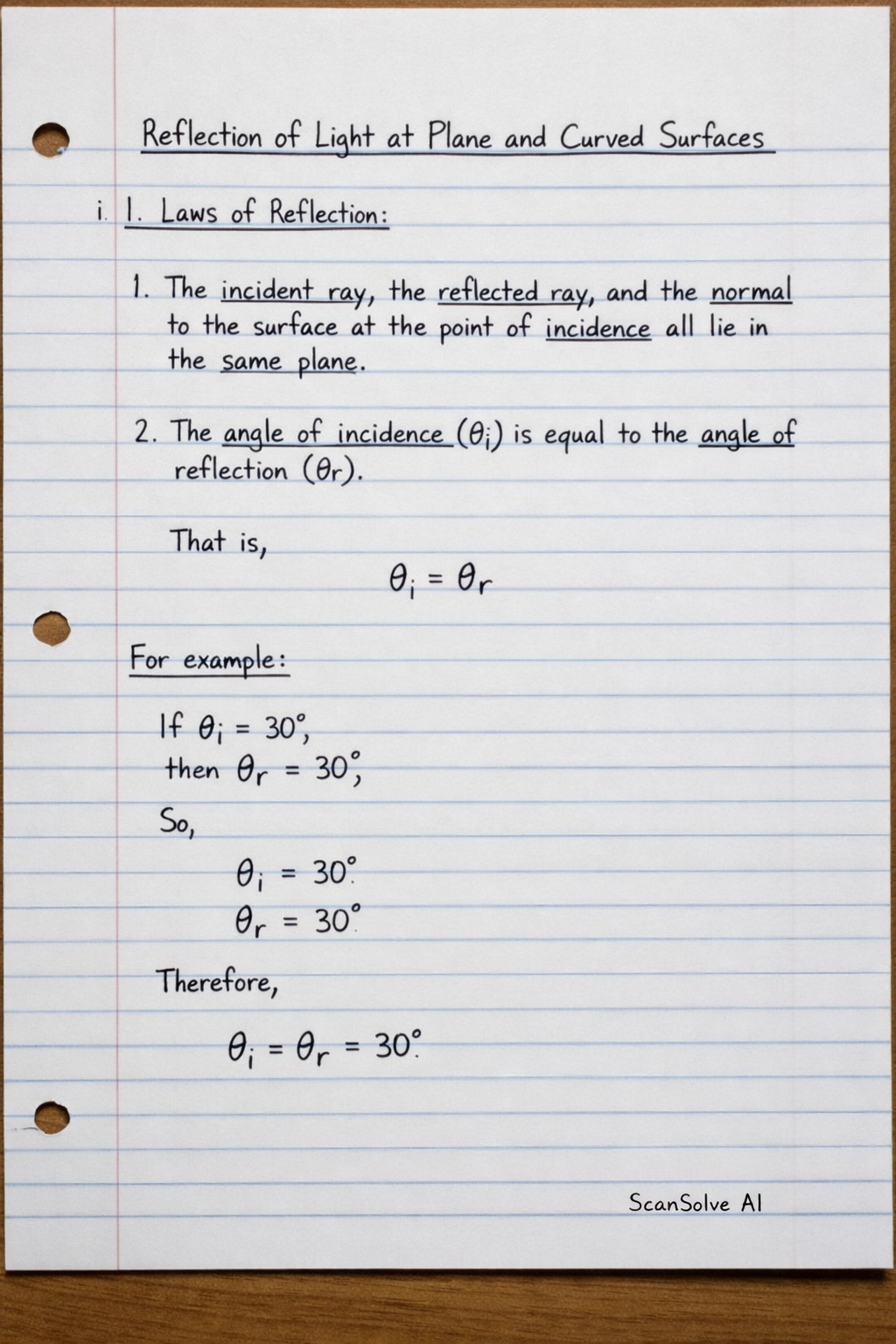
The image you provided outlines objectives for reflection of light at plane and curved surfaces, not refraction. I will generate notes based on the objectives for reflection as stated in the image. Here are notes for the UTME exam on Reflection of Light at Plane and Curved Surfaces: i. Laws of Reflection: The incident ray, the reflected ray, and the normal* to the surface at the point of incidence all lie in the same plane. The angle of incidence (_i) is equal to the angle of reflection* (_r). That is, _i = _r. ii. Image Formation by Mirrors: Plane Mirror: Forms a virtual, erect, and laterally inverted* image that is the same size as the object and located as far behind the mirror as the object is in front. Concave Mirror: Can form both real and virtual images, depending on the object's position. Real images are inverted, while virtual images are erect and magnified*. Convex Mirror: Always forms a virtual, erect, and diminished* image, located behind the mirror between the pole and the principal focus. iii. Mirror Formula: The relationship between object distance (u), image distance (v), and focal length (f) for spherical mirrors is given by: (1)/(f) = (1)/(u) + (1)/(v) Sign Conventions (Cartesian): Distances measured in the direction of incident light are positive; opposite are negative. Distances above the principal axis are positive; below are negative. For concave mirrors, f is positive. For convex mirrors, f is negative. Real objects and real images have positive u and v respectively. Virtual images have negative v. iv. Linear Magnification: Linear magnification (M) is the ratio of the height of the image (h_i) to the height of the object (h_o), and also the ratio of the image distance (v) to the object distance (u): M = (h_i)/(h_o) = -(v)/(u) If M > 1, the image is magnified. If M < 1, the image is diminished. If M = 1, the image is the same size. If M is positive, the image is erect (virtual). If M is negative, the image is inverted (real). v. Applications of Reflection: Periscope: Uses two plane mirrors (or prisms) arranged parallel to each other at a 45-degree angle to allow viewing over, around, or through an obstacle. Light reflects off the first mirror, then off the second, to the observer's eye. Kaleidoscope: Consists of multiple mirrors (usually three) arranged at an angle to each other, creating multiple reflections of objects (often colored beads or pieces of glass) to form symmetrical patterns. Sextant: An instrument used to measure the angle between two objects, typically the horizon and a celestial body (like the sun or a star), for navigation. It uses mirrors to bring the image of the celestial body into coincidence with the horizon.