This physics problem tests your understanding of fundamental physical laws and their applications. The step-by-step solution below breaks down the problem using relevant equations and physical reasoning.
ScanSolve AI Answer
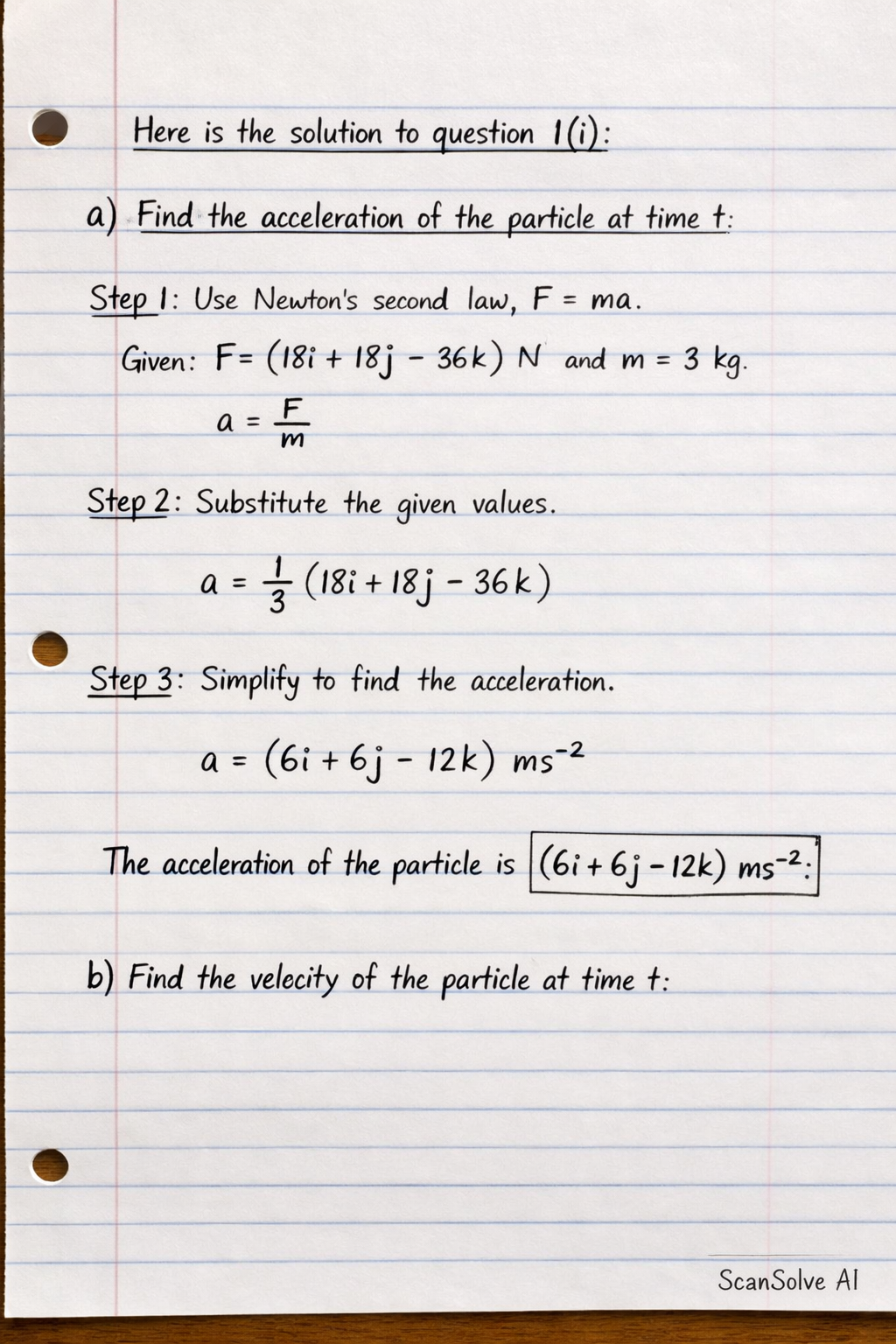
Here is the solution to question 1(i):
1(i) A force $\mathbf{F} = (18\mathbf{i} + 18\mathbf{j} - 36\mathbf{k})$ N acts at time $t$ seconds on a particle of mass 3kg. Initially, the particle is at the origin moving with velocity $(2\mathbf{i} - \mathbf{j} - 3\mathbf{k})$ ms$^{-1}$.
a) Find the acceleration of the particle at time $t$.
Step 1: Use Newton's second law, $\mathbf{F} = m\mathbf{a}$.
Given force $\mathbf{F} = (18\mathbf{i} + 18\mathbf{j} - 36\mathbf{k})$ N and mass $m = 3$ kg.
$$ \mathbf{a} = \frac{\mathbf{F}}{m} $$
Step 2: Substitute the given values.
$$ \mathbf{a} = \frac{1}{3}(18\mathbf{i} + 18\mathbf{j} - 36\mathbf{k}) $$
Step 3: Simplify to find the acceleration.
$$ \mathbf{a} = (6\mathbf{i} + 6\mathbf{j} - 12\mathbf{k})\, \text{ms}^{-2} $$
The acceleration of the particle is $\boxed{(6\mathbf{i} + 6\mathbf{j} - 12\mathbf{k})\, \text{ms}^{-2}}$.
b) Find the velocity of the particle at time $t$.
Step 1: Use the kinematic equation for velocity, $\mathbf{v} = \mathbf{u} + \mathbf{a}t$.
Given initial velocity $\mathbf{u} = (2\mathbf{i} - \mathbf{j} - 3\mathbf{k})$ ms$^{-1}$ and acceleration $\mathbf{a} = (6\mathbf{i} + 6\mathbf{j} - 12\mathbf{k})$ ms$^{-2}$ (from part a).
Step 2: Substitute the values into the equation.
$$ \mathbf{v} = (2\mathbf{i} - \mathbf{j} - 3\mathbf{k}) + (6\mathbf{i} + 6\mathbf{j} - 12\mathbf{k})t $$
Step 3: Group the components.
$$ \mathbf{v} = (2+6t)\mathbf{i} + (-1+6t)\mathbf{j} + (-3-12t)\mathbf{k}\, \text{ms}^{-1} $$
The velocity of the particle at time $t$ is $\boxed{(2+6t)\mathbf{i} + (-1+6t)\mathbf{j} + (-3-12t)\mathbf{k}\, \text{ms}^{-1}}$.
c) When $t=2$, find the kinetic energy of the particle.
Step 1: Find the velocity vector at $t=2$ s using the expression from part b.
$$ \mathbf{v}(2) = (2+6(2))\mathbf{i} + (-1+6(2))\mathbf{j} + (-3-12(2))\mathbf{k} $$
$$ \mathbf{v}(2) = (2+12)\mathbf{i} + (-1+12)\mathbf{j} + (-3-24)\mathbf{k} $$
$$ \mathbf{v}(2) = 14\mathbf{i} + 11\mathbf{j} - 27\mathbf{k}\, \text{ms}^{-1} $$
Step 2: Calculate the magnitude of the velocity vector, $|\mathbf{v}| = \sqrt{v_x^2 + v_y^2 + v_z^2}$.
$$ |\mathbf{v}(2)| = \sqrt{14^2 + 11^2 + (-27)^2} $$
$$ |\mathbf{v}(2)| = \sqrt{196 + 121 + 729} $$
$$ |\mathbf{v}(2)| = \sqrt{1046}\, \text{m/s} $$
Step 3: Calculate the kinetic energy using the formula $KE = \frac{1}{2}mv^2$.
Given mass $m = 3$ kg.
$$ KE = \frac{1}{2}(3)(\sqrt{1046})^2 $$
$$ KE = \frac{3}{2}(1046) $$
$$ KE = 3 \times 523 $$
$$ KE = 1569\, \text{J} $$
The kinetic energy of the particle at $t=2$ s is $\boxed{1569\, \text{J}}$.
d) A particle starts from rest and moves with an acceleration of $(2v^2+1)$ ms$^{-2}$ where $v$ is the speed of the particle. Find the distance taken by the particle to attain a speed of 3m/s.
Step 1: Relate acceleration to velocity and distance using $a = v\frac{dv}{dx}$.
Given acceleration $a = 2v^2+1$.
$$ v\frac{dv}{dx} = 2v^2+1 $$
Step 2: Separate variables and integrate.
$$ \frac{v}{2v^2+1}\,dv = dx $$
Integrate from initial conditions ($v=0$ at $x=0$) to final conditions ($v=3$ at $x$).
$$ \int_{0}^{3} \frac{v}{2v^2+1}\,dv = \int_{0}^{x} dx $$
Step 3: Evaluate the integral. For the left side, let $u = 2v^2+1$, so $du = 4v\,dv \implies v\,dv = \frac{1}{4}\,du$.
When $v=0$, $u = 2(0)^2+1 = 1$.
When $v=3$, $u = 2(3)^2+1 = 18+1 = 19$.
$$ \int_{1}^{19} \frac{1}{4u}\,du = [x]_{0}^{x} $$
$$ \frac{1}{4}[\ln|u|]_{1}^{19} = x $$
$$ \frac{
Given force F = (18i + 18j - 36k) N and mass m = 3 kg.
|Physics
Given force F = (18i + 18j - 36k) N and mass m = 3 kg.
ScanSolve AI Answer
Here is the solution to question 1(i):
1(i) A force F=(18i+18j−36k) N acts at time t seconds on a particle of mass 3kg. Initially, the particle is at the origin moving with velocity (2i−j−3k) ms−1.
a) Find the acceleration of the particle at time t.
Step 1: Use Newton's second law, F=ma.
Given force F=(18i+18j−36k) N and mass m=3 kg.
a=mF
Step 2: Substitute the given values.
a=31(18i+18j−36k)
Step 3: Simplify to find the acceleration.
a=(6i+6j−12k)ms−2
The acceleration of the particle is ∗(6i+6j−12k)ms−2∗.
b) Find the velocity of the particle at time t.
Step 1: Use the kinematic equation for velocity, v=u+at.
Given initial velocity u=(2i−j−3k) ms−1 and acceleration a=(6i+6j−12k) ms−2 (from part a).
Step 2: Substitute the values into the equation.
v=(2i−j−3k)+(6i+6j−12k)t
Step 3: Group the components.
v=(2+6t)i+(−1+6t)j+(−3−12t)kms−1
The velocity of the particle at time t is ∗(2+6t)i+(−1+6t)j+(−3−12t)kms−1∗.
c) When t=2, find the kinetic energy of the particle.
Step 1: Find the velocity vector at t=2 s using the expression from part b.
v(2)=(2+6(2))i+(−1+6(2))j+(−3−12(2))kv(2)=(2+12)i+(−1+12)j+(−3−24)kv(2)=14i+11j−27kms−1
Step 2: Calculate the magnitude of the velocity vector, ∣v∣=vx2+vy2+vz2.
∣v(2)∣=142+112+(−27)2∣v(2)∣=196+121+729∣v(2)∣=1046m/s
Step 3: Calculate the kinetic energy using the formula KE=21mv2.
Given mass m=3 kg.
KE=21(3)(1046)2KE=23(1046)KE=3×523KE=1569J
The kinetic energy of the particle at t=2 s is ∗1569J∗.
d) A particle starts from rest and moves with an acceleration of (2v2+1) ms−2 where v is the speed of the particle. Find the distance taken by the particle to attain a speed of 3m/s.
Step 1: Relate acceleration to velocity and distance using a=vdxdv.
Given acceleration a=2v2+1.
vdxdv=2v2+1
Step 2: Separate variables and integrate.
2v2+1vdv=dx
Integrate from initial conditions (v=0 at x=0) to final conditions (v=3 at x).
∫032v2+1vdv=∫0xdx
Step 3: Evaluate the integral. For the left side, let u=2v2+1, so du=4vdv⟹vdv=41du.
When v=0, u=2(0)2+1=1.
When v=3, u=2(3)2+1=18+1=19.
∫1194u1du=[x]0x41[ln∣u∣]119=x
Need help with your own homework?
Get instant step-by-step solutions to any question. Free to start.