
We read your photo as:
Given L=10.5mm, W=7.2mm, T=5.8mm, M=0.5g, V=0.4cm3 for an agricultural product, calculate its bulk density.
Physics
ScanSolve AI Answer
Answers
3 partsStep-by-step solution
9 stepsHere is the solution to Question 1d) from the exam paper:
Question 1d)
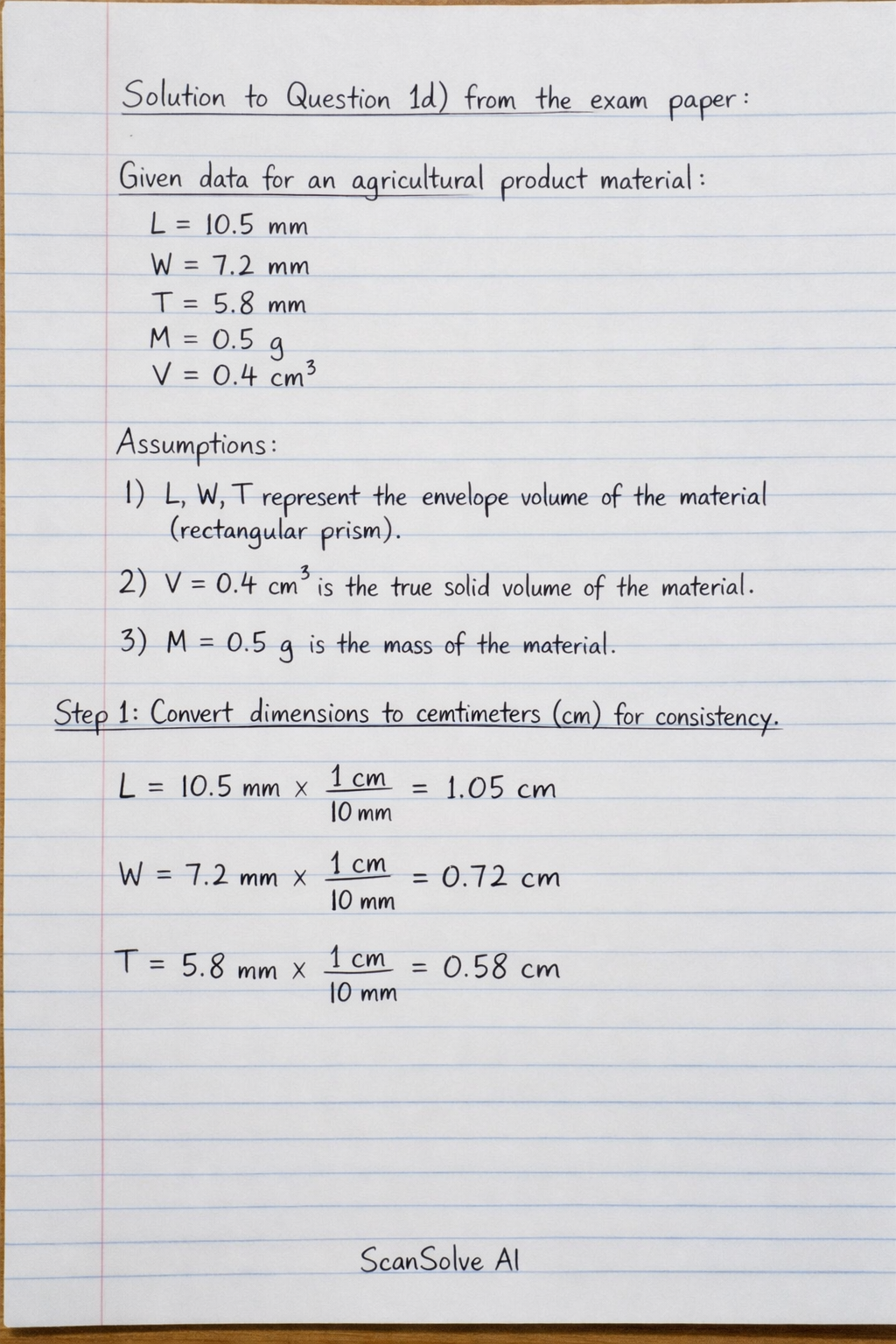
Given data for an agricultural product material:
- Length () =
- Width () =
- Thickness () =
- Mass () =
- Volume () =
Assumptions:
- The given dimensions () define the overall envelope volume of the single agricultural product material (i.e., the volume of the smallest rectangular prism enclosing it).
- The given Volume () represents the true solid volume of the material, excluding any internal voids or air spaces within its envelope.
- The given Mass () is the mass of this single material.
Step 1: Convert dimensions to centimeters (cm) for consistency.
Step 2: Calculate the envelope volume () of the particle.
This is the volume of the smallest rectangular prism enclosing the particle.
Part i· 3 steps
Bulk density ()
State the formula for bulk density, using the envelope volume for a single particle.
Substitute the values.
Calculate the bulk density.
The bulk density is:
Part ii
True density ()
State the formula for true density.
Substitute the values.
Calculate the true density.
The true density is:
Part iii
Porosity ()
State the formula for porosity for a single particle.
Substitute the values.
Calculate the porosity.
Expressed as a percentage:
The porosity is:
Was this helpful?
Try one yourself
A new problem that tests the same skill.
Still stuck on this one?
Ask a follow-up, and the answer starts from this question.
Got a different question?Ask your own question
More Physics Questions
QGiven data for an agricultural product material: Length (L) = 10.5 ext mm, Width (W) = 7.2 ext mm…QGiven density = 1.836 g/cm³.QCalculate the density of a block of mass 20g and volume 10cm Give your answer in S.I unit.QFormula to calculate densityQA mass of 120g half immersed in water displaced a volume of 20cm³. Calculate the density of the…
Handwritten Step-by-Step Solution
Get this as a handwritten image on WhatsApp — like a tutor wrote it for you.
Try on WhatsApp