
We read your photo as:
Given mass of electron (m) = 5.486 x 10⁻⁴ a.m.u.
Physics
ScanSolve AI Answer
Answer
Step-by-step solution
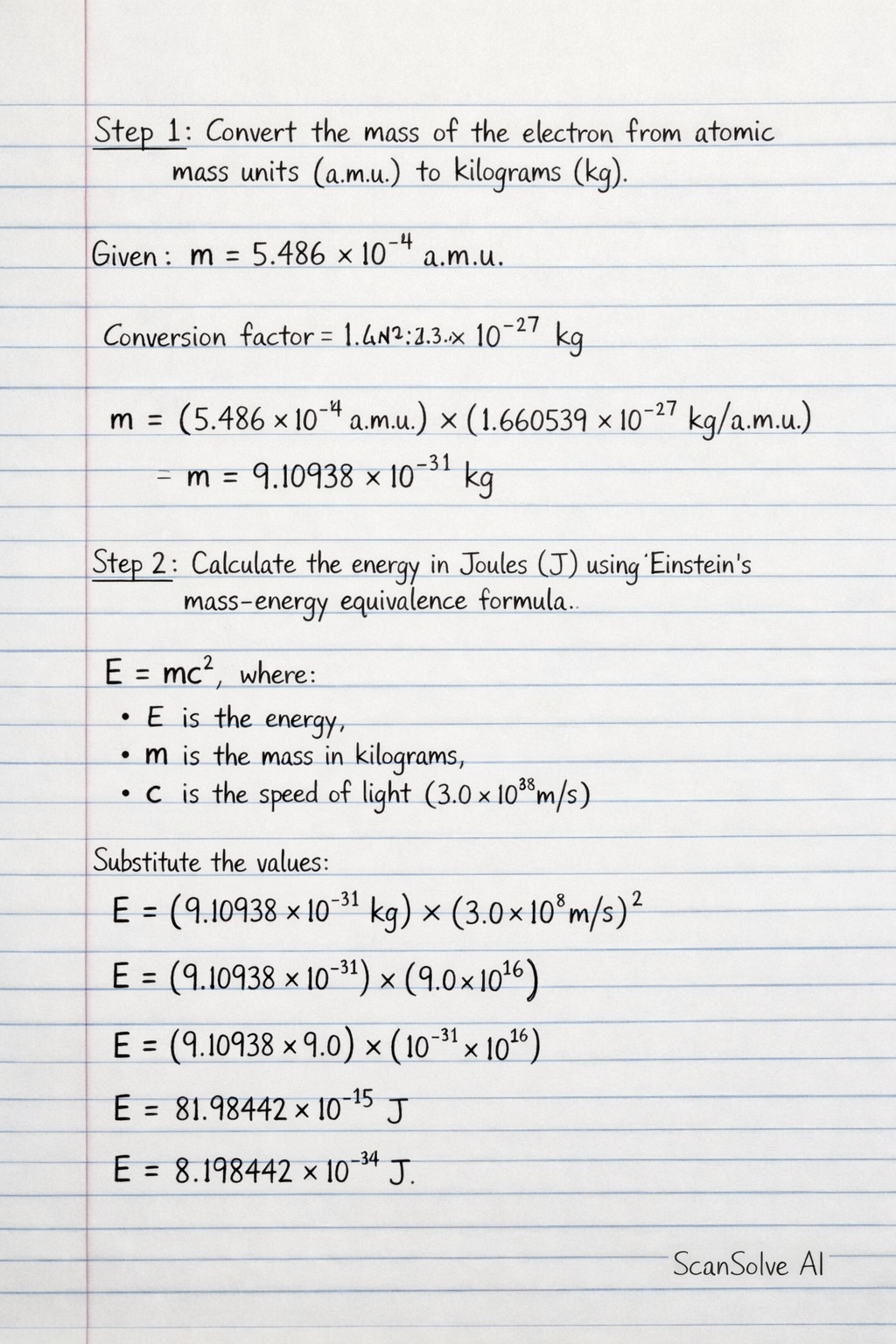
3 stepsConvert the mass of the electron from atomic mass units (a.m.u.) to kilograms (kg).
Given mass of electron () =
The standard conversion factor for a.m.u. to kg is .Calculate the energy in Joules (J) using Einstein's mass-energy equivalence formula.
The formula is , where:
- is the energy
- is the mass in kilograms
- is the speed of light in a vacuum ()
Substitute the values:
Convert the energy from Joules to Mega-electron Volts (MeV).
Given conversion factor: .
To convert Joules to MeV, divide by the conversion factor:Rounding to three significant figures (consistent with the given mass and speed of light):
The energy of the electron is .
Was this helpful?
Try one yourself
A new problem that tests the same skill.
Still stuck on this one?
Ask a follow-up, and the answer starts from this question.
Got a different question?Ask your own question
More Physics Questions
QGiven mass defect ( m_amu) = 0.05 a.m.u.QGiven: Planck's constant h = 6.626 × 10⁻³⁴ J s, mass of an electron m = 9.11 × 10⁻³¹ kg, and…QThe rest mass of an electron is 0.000 000 000 000 000 000 000 000 000 000 910 938 kg. What is this…QMass of the electron is calculated from charge and charge-to-mass ratio values of the electron.QThe mass of an electron is 9.1 × 10⁻³¹ kg. If its K.E. is 3.0 × 10⁻²⁵ J, calculate its wavelength.
Handwritten Step-by-Step Solution
Get this as a handwritten image on WhatsApp — like a tutor wrote it for you.
Try on WhatsApp