
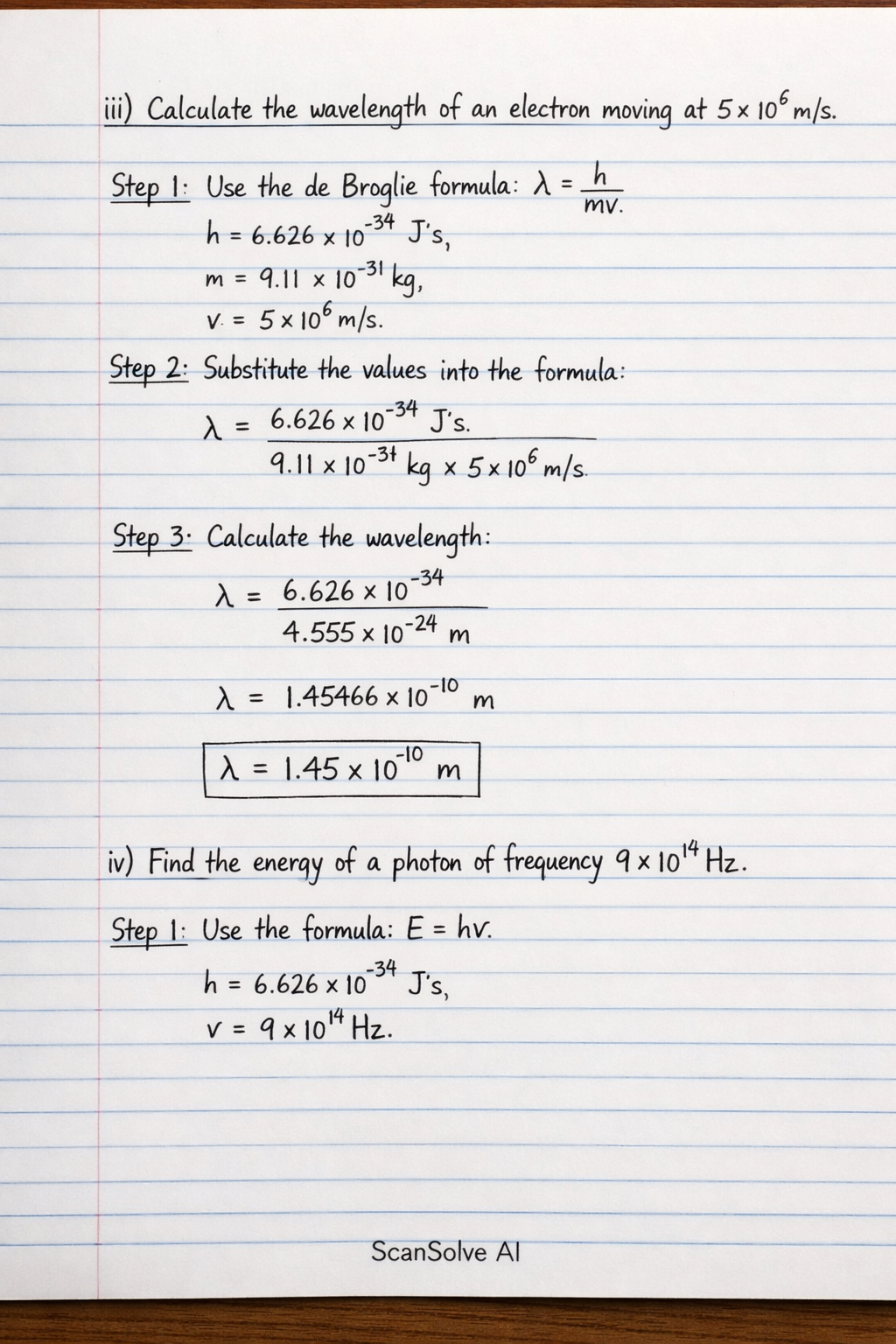
We read your photo as:
Given: Planck's constant h = 6.626 x 10⁻³⁴ J s, mass of an electron m = 9.11 x 10⁻³¹ kg, and velocity v = 5 x 10⁶ m/s.
ScanSolve AI Answer
Answers
3 partsStep-by-step solution
9 stepsHere are the solutions to the remaining questions from the image.
Part iii· 3 steps
Calculate the wavelength of an electron moving at m/s.
Use the de Broglie wavelength formula, .
Given: Planck's constant J s, mass of an electron kg, and velocity m/s.
Substitute the values into the formula.
Calculate the wavelength.
Part iv
Find the energy of a photon of frequency Hz.
Use the formula for the energy of a photon, .
Given: Planck's constant J s, and frequency Hz.
Substitute the values into the formula.
Calculate the energy.
Part v
Determine the wavelength of a proton moving at m/s.
Use the de Broglie wavelength formula, .
Given: Planck's constant J s, mass of a proton kg, and velocity m/s.
Substitute the values into the formula.
Calculate the wavelength.
Try one yourself
A new problem that tests the same skill.
Still stuck on this one?
Ask a follow-up, and the answer starts from this question.
More Physics Questions
Handwritten Step-by-Step Solution
Get this as a handwritten image on WhatsApp — like a tutor wrote it for you.
Try on WhatsApp