
We read your photo as:
Given that the systolic blood pressure is normally distributed with:
ScanSolve AI Answer
Answers
4 partsStep-by-step solution
9 stepsPart 2
Given that the systolic blood pressure is normally distributed with:
Mean () = 94 mmHg
Variance () = 121 mmHg
Standard deviation () = mmHg
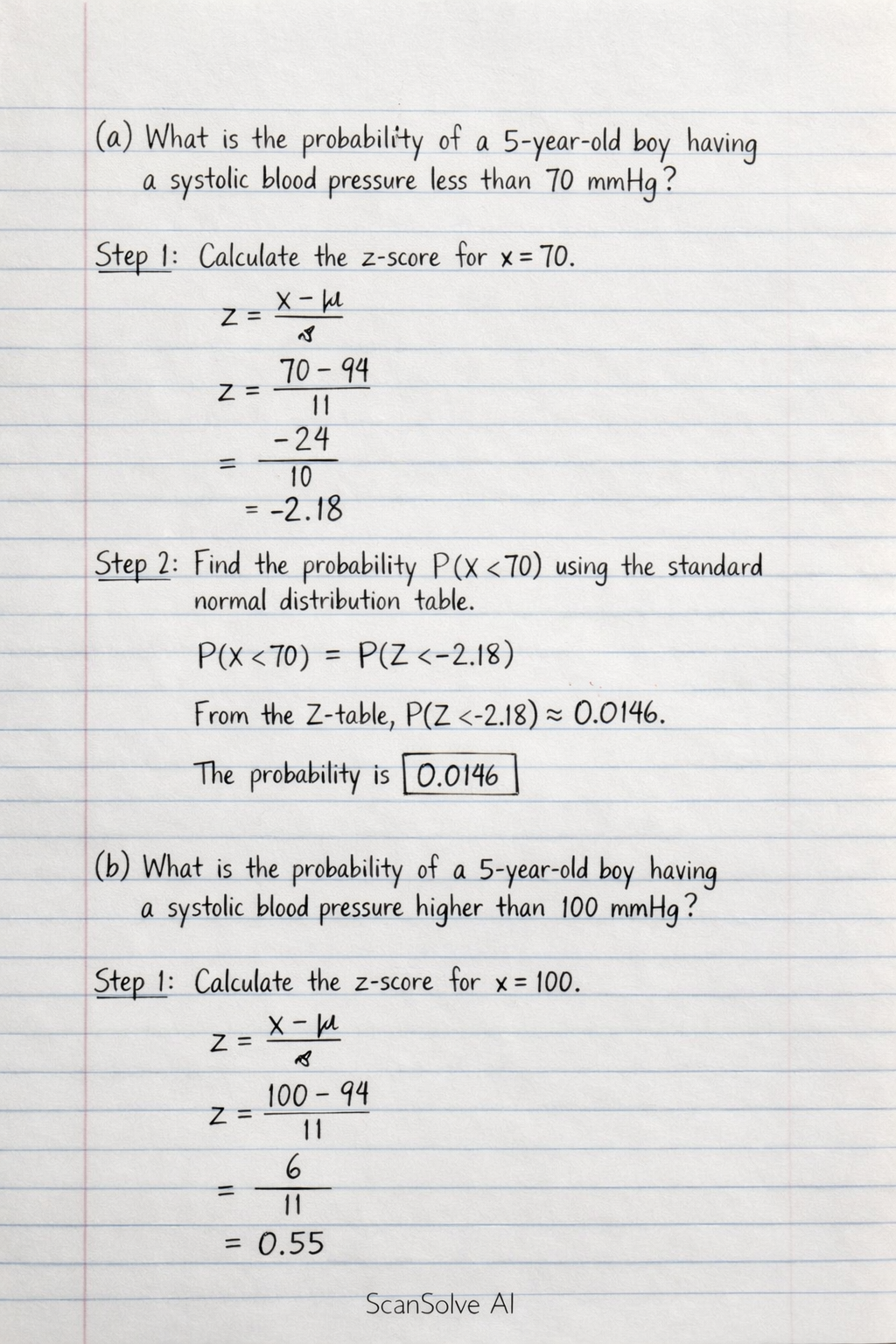
Part a0.0146
What is the probability of a 5-year-old boy having a systolic blood pressure less than 70 mmHg?
Calculate the z-score for .
Find the probability using the standard normal distribution table.
From the Z-table, .
The probability is .
Part b0.2912
What is the probability of a 5-year-old boy having a systolic blood pressure higher than 100 mmHg?
Calculate the z-score for .
Find the probability using the standard normal distribution table.
From the Z-table, .
The probability is .
Part c0.6068
What is the probability that the blood pressure of a 5-year-old boy will be between 80 and 100 mmHg?
Calculate the z-score for .
Calculate the z-score for .
Find the probability .
From the Z-table:
The probability is .
Part d
What systolic blood pressure is necessary to put someone in the bottom 10% of the distribution?
Find the z-score corresponding to the bottom 10% (i.e., ).
From the Z-table, the z-score that corresponds to a cumulative probability of 0.10 is approximately .
Use the z-score formula to solve for .
The systolic blood pressure is approximately .
Try one yourself
A new problem that tests the same skill.
Still stuck on this one?
Ask a follow-up, and the answer starts from this question.
More Physics Questions
Handwritten Step-by-Step Solution
Get this as a handwritten image on WhatsApp — like a tutor wrote it for you.
Try on WhatsApp