

This physics problem tests your understanding of fundamental physical laws and their applications. The step-by-step solution below breaks down the problem using relevant equations and physical reasoning.
ScanSolve AI Answer
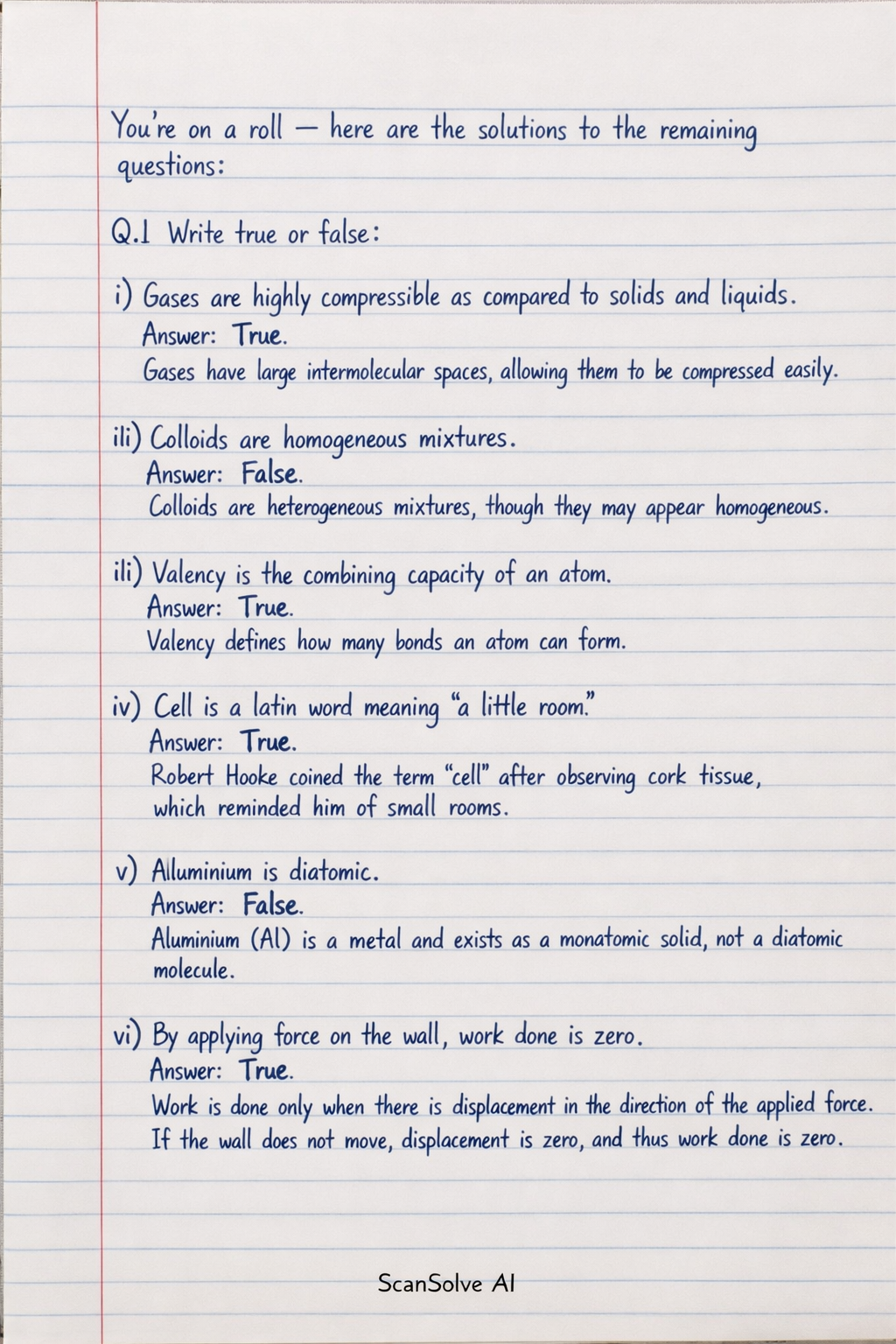
here are the solutions to the remaining questions: Q.1 Write true or false: i) Gases are highly compressible as compared to solids and liquids. Answer: True Gases have large intermolecular spaces, allowing them to be compressed easily. ii) Colloids are homogeneous mixtures. Answer: False Colloids are heterogeneous mixtures, though they may appear homogeneous. iii) Valency is the combining capacity of an atom. Answer: True Valency defines how many bonds an atom can form. iv) Cell is a latin word meaning 'a little room'. Answer: True Robert Hooke coined the term "cell" after observing cork tissue, which reminded him of small rooms. v) Aluminium is diatomic. Answer: False Aluminium (Al) is a metal and exists as a monatomic solid, not a diatomic molecule. vi) By applying force on the wall, work done is zero. Answer: True Work is done only when there is displacement in the direction of the applied force. If the wall does not move, displacement is zero, and thus work done is zero. Q.2 Write the answer in one word/sentence: i) Bos indicus is the scientific name of which animal? Answer: Cow (specifically, Zebu cattle) ii) What is the audible range of human ear? Answer: 20 Hz to 20,000 Hz iii) Who discovered cell? Answer: Robert Hooke iv) A body is moving with constant velocity. What will be the acceleration of that body? Answer: Zero Constant velocity means no change in speed or direction, hence no acceleration. v) Write the S.I. unit of force. Answer: Newton (N) vi) In poultry farm, which animal's breeds are developed? Answer: Chicken Q.5 Convert the following temperatures into Celsius scale. To convert Kelvin to Celsius, use the formula: ^ = K - 273.15 a) 300 K Step 1: Apply the conversion formula. ^ = 300 - 273.15 Step 2: Calculate the value. ^ = 26.85 Answer: 26.85 ^ b) 293 K Step 1: Apply the conversion formula. ^ = 293 - 273.15 Step 2: Calculate the value. ^ = 19.85 Answer: 19.85 ^ OR Convert the following temperatures into Kelvin scale. To convert Celsius to Kelvin, use the formula: K = ^ + 273.15 a) 25^C Step 1: Apply the conversion formula. K = 25 + 273.15 Step 2: Calculate the value. K = 298.15 Answer: 298.15 K b) 373^C Step 1: Apply the conversion formula. K = 373 + 273.15 Step 2: Calculate the value. K = 646.15 Answer: 646.15 K Q.6 Write any two properties of suspension. Properties of suspension: • A suspension is a heterogeneous mixture in which solid particles are dispersed in a liquid or gas. • The particles in a suspension are large enough to be seen with the naked eye and will settle down over time if left undisturbed. • The particles in a suspension scatter a beam of light passing through it (Tyndall effect). OR Differentiate between homogeneous and heterogeneous mixture. Homogeneous Mixture: • Has a uniform composition throughout. • Components are indistinguishable from each other. • Examples: Saltwater, air. Heterogeneous Mixture: • Has a non-uniform composition. • Components are visible and distinguishable from each other. • Examples: Sand and water, oil and water. Q.7 Calculate the molecular mass of NaHCO_3. Atomic masses: Na = 23 u H = 1 u C = 12 u O = 16 u Step 1: Identify the number of atoms for each element in NaHCO_3. Na: 1 atom H: 1 atom C: 1 atom O: 3 atoms Step 2: Calculate the total mass contributed by each element. Mass of Na = 1 × 23 u = 23 u Mass of H = 1 × 1 u = 1 u Mass of C = 1 × 12 u = 12 u Mass of O = 3 × 16 u = 48 u Step 3: Sum the masses to find the molecular mass. Molecular mass of NaHCO_3 = 23 + 1 + 12 + 48 = 84 u Answer: 84 u OR Define ion with the help of example. An ion is an atom or molecule that has gained or lost one or more electrons, resulting in it carrying a net electrical charge (either positive or negative). Example: A sodium atom (Na) loses one electron to become a positively charged sodium ion (Na^+). A chlorine atom (Cl) gains one electron to become a negatively charged chloride ion (Cl^-). Q.8 Write Thomson's atomic model. Thomson's atomic model (also known as the "plum pudding model") states: • An atom consists of a positively charged sphere. • The electrons are embedded within this sphere, like plums in a pudding. • The positive and negative charges are equal in magnitude, making the atom electrically neutral overall. OR If an atom contains one electron and one proton, will it carry any charge or not? Answer: No, it will not carry any net charge. A proton has a charge of +1 unit, and an electron has a charge of -1 unit. If an atom has one proton and one electron, their charges cancel each other out (+1 + (-1) = 0), resulting in a net charge of zero. Q.9 Difference between plant cell and animal cell. Plant Cell: • Has a rigid cell wall outside the cell membrane. • Contains chloroplasts for photosynthesis. • Usually has a large, central vacuole. • Typically has a fixed, rectangular shape. Animal Cell: • Lacks a cell wall. • Does not contain chloroplasts. • Has small, temporary vacuoles or no vacuoles. • Typically has an irregular or rounded shape. OR Where do the lipids and proteins constituting the cell membrane get synthesized? Synthesis of lipids and proteins for the cell membrane: • Proteins are primarily synthesized on ribosomes (some free, some attached to the endoplasmic reticulum) and then processed and modified in the endoplasmic reticulum (ER) and Golgi apparatus. • Lipids (like phospholipids) are mainly synthesized in the smooth endoplasmic reticulum (SER). Q.10 Write Archimedes principle and its applications. Archimedes' Principle: It states that when an object is wholly or partially immersed in a fluid, it experiences an upward buoyant force that is equal to the weight of the fluid displaced by the object. Applications: • Designing ships and submarines: It explains why ships float and how submarines control their buoyancy. • Hydrometers: Used to measure the density of liquids. • Hot air balloons: The principle applies to gases as well, explaining how balloons float. OR What do you mean by buoyant force? Buoyant force is the upward force exerted by a fluid (liquid or gas) that opposes the weight of an immersed object. This force is caused by the pressure difference between the top and bottom surfaces of the object submerged in the fluid. Q.11 If a person covers two rounds of circular ground of r radius. Write the distance and displacement covered by him. Given: Radius of circular ground = r Number of rounds = 2 Step 1: Calculate the distance covered in one round. The distance covered in one round is equal to the circumference of the circle. Circumference = 2 r Step 2: Calculate the total distance covered in two rounds. Total distance = Number of rounds × Circumference Total distance = 2 × (2 r) = 4 r Answer (Distance): 4 r Step 3: Calculate the total displacement. Displacement is the shortest distance between the initial and final positions. After completing two full rounds of a circular path, the person returns to their starting point. Initial position = Final position Answer (Displacement): 0 Got more? Send 'em!