
We read your photo as:
Given the expression I(R+a) = b, linearize it to plot a suitable graph, identify the variables for the axes, and determine the expressions for the gradient and y-intercept.
ScanSolve AI Answer
Answer
Step-by-step solution
5 stepsPart i· 3 steps
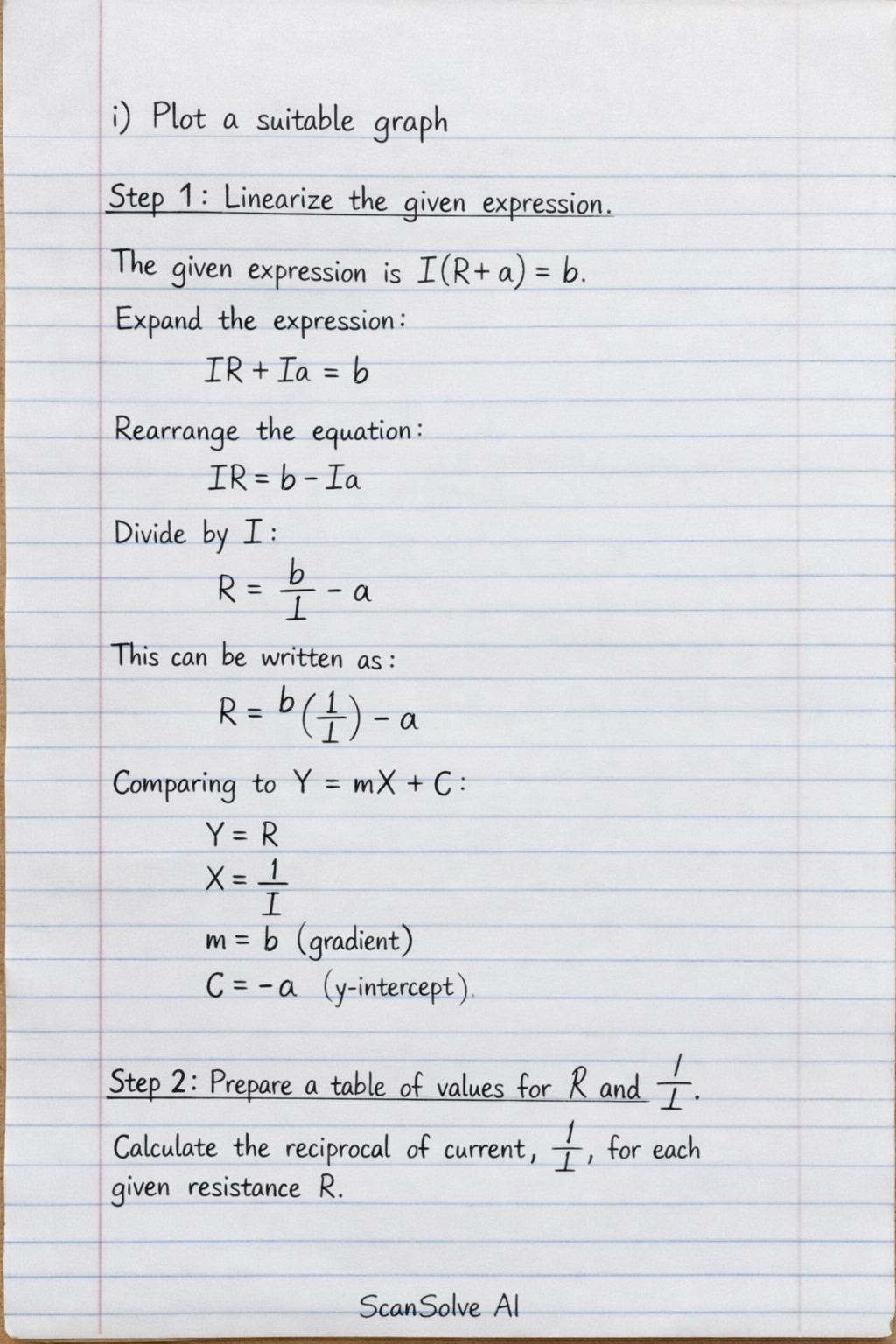
Plot a suitable graph
Linearize the given expression.
The given expression is .
Expand the expression:Rearrange the equation to match the linear form . We want to plot against .
Divide by :
This can be written as:
Comparing this to :
(gradient)
(y-intercept)Prepare a table of values for and .
Calculate the reciprocal of current, , for each given resistance .
10 0.200 5.00 20 0.150 6.67 30 0.120 8.33 40 0.100 10.00 50 0.086 11.63 60 0.075 13.33 80 0.060 16.67 90 0.055 18.18 100 0.050 20.00 130 0.040 25.00 Describe the graph to be plotted.
Plot a graph of (y-axis) against (x-axis). The graph should be a straight line.
The gradient of this straight line will give the value of .
The y-intercept (the value of when ) will give the value of .
Part ii
Obtain the values of and from the graph
Calculate the gradient () of the line.
The gradient . Using the first point and the last point from the table for the line of best fit:
Therefore, .
Calculate the y-intercept () of the line.
The y-intercept . Using the equation , which is , and one point, for example :
The values are:
Part iii
Physical significances of and
The expression is analogous to the electromotive force (e.m.f.) equation for a simple circuit: , where is the e.m.f. of the power source and is its internal resistance.
Try one yourself
A new problem that tests the same skill.
Still stuck on this one?
Ask a follow-up, and the answer starts from this question.
More Physics Questions
Handwritten Step-by-Step Solution
Get this as a handwritten image on WhatsApp — like a tutor wrote it for you.
Try on WhatsApp