We read your photo as:

Linearize the following equations to the form y=mx+c and identify the slope and y-intercept: a) F = Q2/(4πε₀r²); b) R = R₀(1+αθ); c) h−H = ut + ½gt² with u=0.

Physics

ScanSolve AI Answer

Step-by-step solution

10 steps

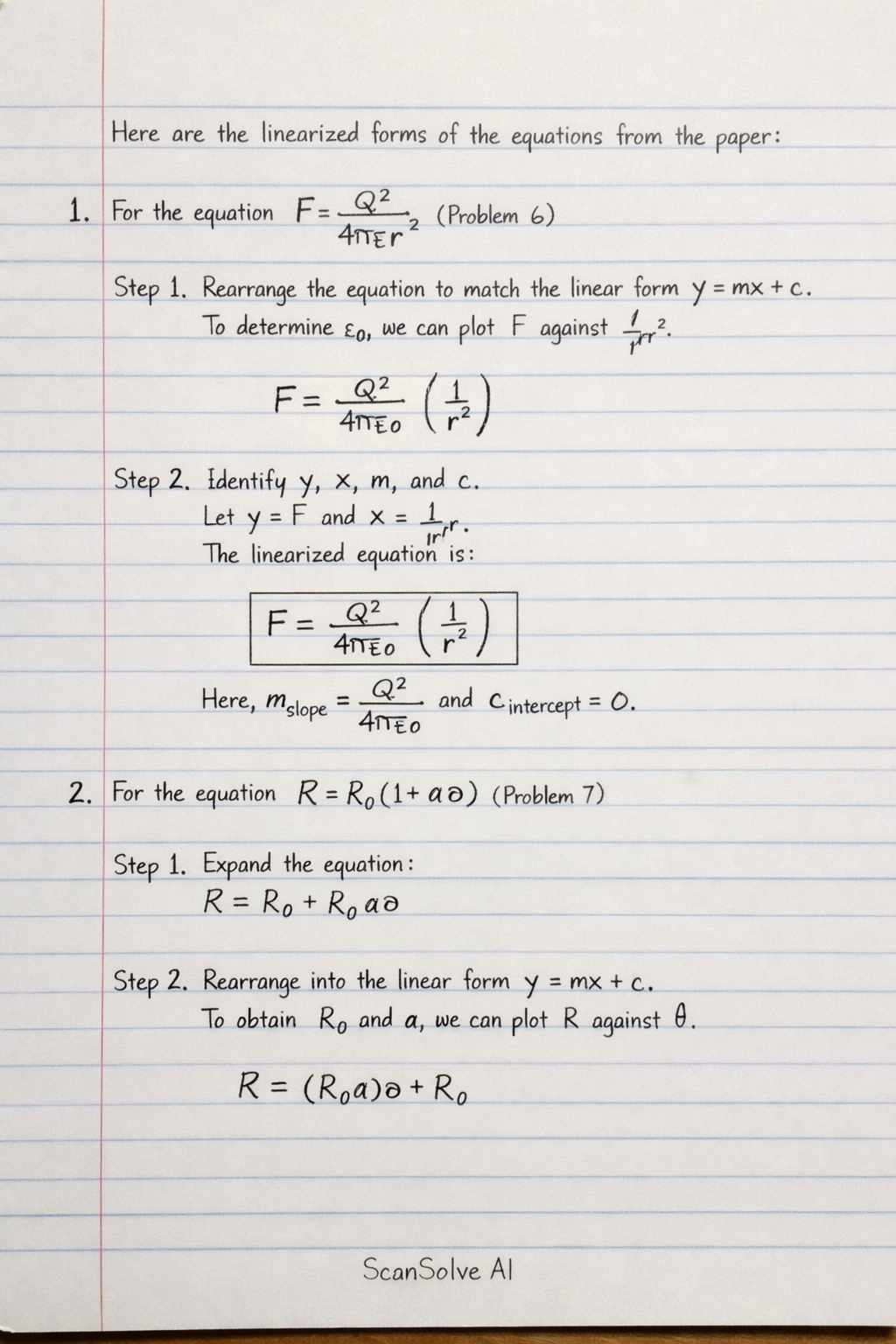
Here are the linearized forms of the equations from the paper:

1. For the equation F=Q24πϵ0r2F = \frac{Q^2}{4\pi \epsilon_0 r^2} ()

  1. Rearrange the equation to match the linear form y=mx+cy = mx + c.

    To determine ϵ0\epsilon_0, we can plot FF against 1r2\frac{1}{r^2}.

    F=(Q24πϵ0)(1r2)F = \left(\frac{Q^2}{4\pi \epsilon_0}\right) \left(\frac{1}{r^2}\right)
  2. Identify yy, xx, mm, and cc.

    Let y=Fy = F and x=1r2x = \frac{1}{r^2}.
    The linearized equation is:

    F=(Q24πϵ0)(1r2)\boxed{F = \left(\frac{Q^2}{4\pi \epsilon_0}\right)\left(\frac{1}{r^2}\right)}

    Here, the slope mslope=Q24πϵ0m_{slope} = \frac{Q^2}{4\pi \epsilon_0} and the y-intercept cintercept=0c_{intercept} = 0.

    2. For the equation R=R0(1+αθ)R = R_0(1 + \alpha \theta) ()

  3. Expand the equation.

    R=R0+R0αθR = R_0 + R_0 \alpha \theta
  4. Rearrange into the linear form y=mx+cy = mx + c.

    To obtain R0R_0 and α\alpha, we can plot RR against θ\theta.

    R=(R0α)θ+R0R = (R_0 \alpha)\theta + R_0
  5. Identify yy, xx, mm, and cc.

    Let y=Ry = R and x=θx = \theta.
    The linearized equation is:

    R=(R0α)θ+R0\boxed{R = (R_0 \alpha)\theta + R_0}

    Here, the slope mslope=R0αm_{slope} = R_0 \alpha and the y-intercept cintercept=R0c_{intercept} = R_0.

    3. For the equation h−H=ut+12gt2h - H = ut + \frac{1}{2}gt^2 with u=0u=0 ()

  6. Substitute u=0u=0 into the equation.

    h−H=(0)t+12gt2h - H = (0)t + \frac{1}{2}gt^2 h−H=12gt2h - H = \frac{1}{2}gt^2
  7. Rearrange into the linear form y=mx+cy = mx + c.

    To obtain HH and gg, we can plot hh against t2t^2.

    h=(12g)t2+Hh = \left(\frac{1}{2}g\right)t^2 + H
  8. Identify yy, xx, mm, and cc.

    Let y=hy = h and x=t2x = t^2.
    The linearized equation is:

    h=(12g)t2+H\boxed{h = \left(\frac{1}{2}g\right)t^2 + H}

    Here, the slope mslope=12gm_{slope} = \frac{1}{2}g and the y-intercept cintercept=Hc_{intercept} = H.

    4. For the equation PV=kPV = k ()

  9. Rearrange the equation to match the linear form y=mx+cy = mx + c.

    To determine kk, we can plot PP against 1V\frac{1}{V}.

    P=k(1V)P = k \left(\frac{1}{V}\right)
  10. Identify yy, xx, mm, and cc.

    Let y=Py = P and x=1Vx = \frac{1}{V}.
    The linearized equation is:

    P=k(1V)\boxed{P = k \left(\frac{1}{V}\right)}

    Here, the slope mslope=km_{slope} = k and the y-intercept cintercept=0c_{intercept} = 0.

Was this helpful?

Still stuck on this one?

Ask a follow-up, and the answer starts from this question.

Got a different question?Ask your own question
Handwritten step-by-step solution preview

Handwritten Step-by-Step Solution

Get this as a handwritten image on WhatsApp — like a tutor wrote it for you.

Try on WhatsApp