We read your photo as:

Linearize the following equations into the form y = mx + c: T = sqrt((m + m0/3)/(kg)), v = l/(4f) - c, P = P0e^(-kh)

Physics

ScanSolve AI Answer

Step-by-step solution

13 steps

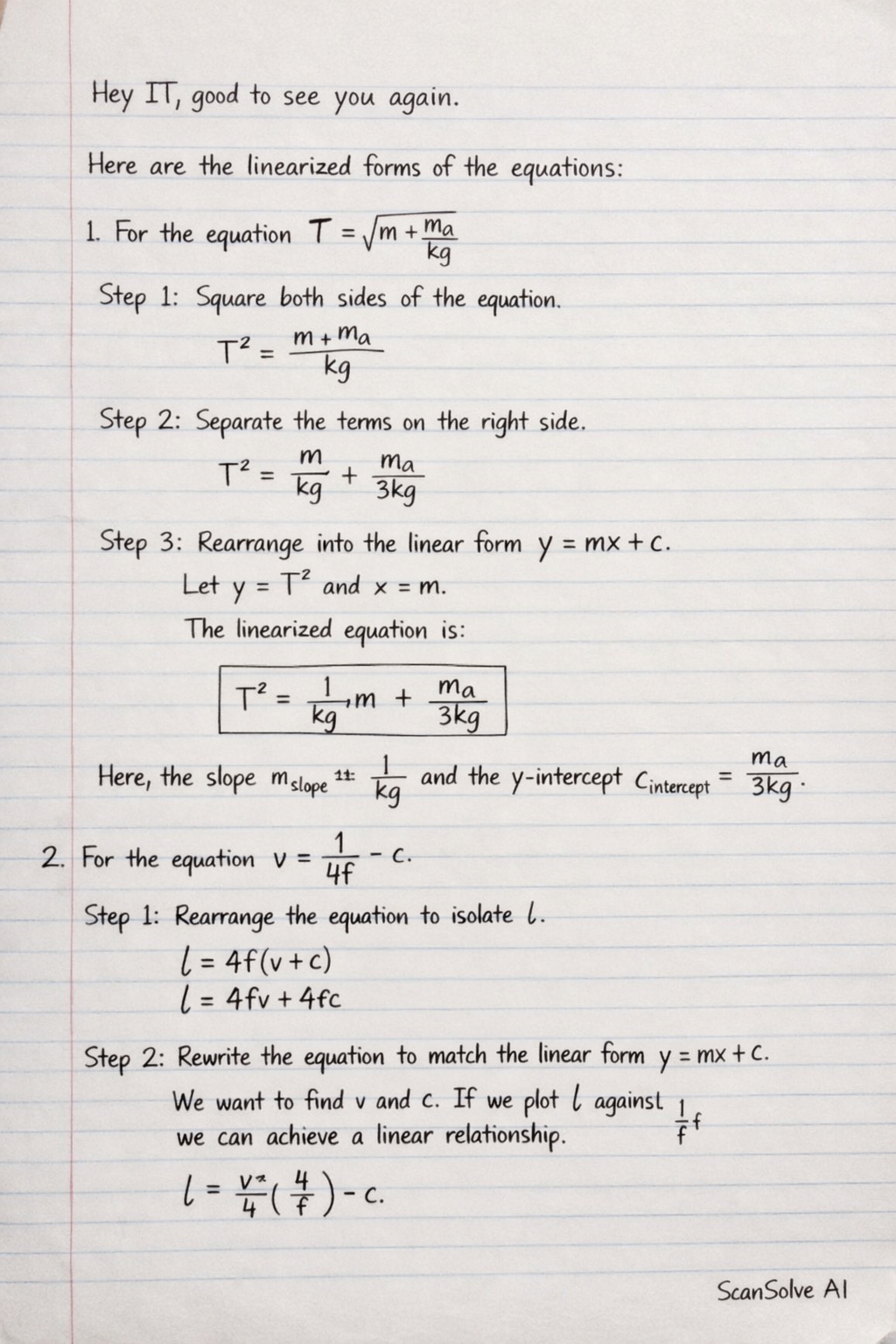
Here are the linearized forms of the equations:

1. For the equation T=m+m03kgT = \sqrt{\frac{m + \frac{m_0}{3}}{kg}}

  1. Square both sides of the equation.

    T2=m+m03kgT^2 = \frac{m + \frac{m_0}{3}}{kg}
  2. Separate the terms on the right side.

    T2=mkg+m03kgT^2 = \frac{m}{kg} + \frac{m_0}{3kg}
  3. Rearrange into the linear form y=mx+cy = mx + c.

    Let y=T2y = T^2 and x=mx = m.
    The linearized equation is:

    T2=(1kg)m+(m03kg)\boxed{T^2 = \left(\frac{1}{kg}\right)m + \left(\frac{m_0}{3kg}\right)}

    Here, the slope mslope=1kgm_{slope} = \frac{1}{kg} and the y-intercept cintercept=m03kgc_{intercept} = \frac{m_0}{3kg}.

    2. For the equation v=l4f−cv = \frac{l}{4f} - c

  4. Rearrange the equation to isolate ll.

    l=4f(v+c)l = 4f(v+c) l=4fv+4fcl = 4fv + 4fc
  5. Rewrite the equation to match the linear form y=mx+cy = mx + c.

    We want to find vv and cc. If we plot ll against 1f\frac{1}{f}, we can achieve a linear relationship.

    l=v4(1f)−cl = \frac{v}{4} \left(\frac{1}{f}\right) - c
  6. Identify yy, xx, mm, and cc.

    Let y=ly = l and x=1fx = \frac{1}{f}.
    The linearized equation is:

    l=(v4)(1f)−c\boxed{l = \left(\frac{v}{4}\right)\left(\frac{1}{f}\right) - c}

    Here, the slope mslope=v4m_{slope} = \frac{v}{4} and the y-intercept cintercept=−cc_{intercept} = -c.

    3. For the equation P=P0e−khP = P_0 e^{-kh}

  7. Take the natural logarithm (ln⁡\ln) of both sides of the equation.

    ln⁡(P)=ln⁡(P0e−kh)\ln(P) = \ln(P_0 e^{-kh})
  8. Use logarithm properties ln⁡(AB)=ln⁡(A)+ln⁡(B)\ln(AB) = \ln(A) + \ln(B) and ln⁡(ex)=x\ln(e^x) = x.

    ln⁡(P)=ln⁡(P0)+ln⁡(e−kh)\ln(P) = \ln(P_0) + \ln(e^{-kh}) ln⁡(P)=ln⁡(P0)−kh\ln(P) = \ln(P_0) - kh
  9. Rearrange into the linear form y=mx+cy = mx + c.

    Let y=ln⁡(P)y = \ln(P) and x=hx = h.
    The linearized equation is:

    ln⁡(P)=−kh+ln⁡(P0)\boxed{\ln(P) = -kh + \ln(P_0)}

    Here, the slope mslope=−km_{slope} = -k and the y-intercept cintercept=ln⁡(P0)c_{intercept} = \ln(P_0).

    4. For the equation λ2(η−β)=k\lambda^2 (\eta - \beta) = k

  10. Expand the left side of the equation.

    λ2η−λ2β=k\lambda^2 \eta - \lambda^2 \beta = k
  11. Isolate the term containing η\eta.

    λ2η=k+λ2β\lambda^2 \eta = k + \lambda^2 \beta
  12. Divide by λ2\lambda^2 to solve for η\eta.

    η=kλ2+λ2βλ2\eta = \frac{k}{\lambda^2} + \frac{\lambda^2 \beta}{\lambda^2} η=k(1λ2)+β\eta = k \left(\frac{1}{\lambda^2}\right) + \beta
  13. Identify yy, xx, mm, and cc.

    Let y=ηy = \eta and x=1λ2x = \frac{1}{\lambda^2}.
    The linearized equation is:

    η=k(1λ2)+β\boxed{\eta = k \left(\frac{1}{\lambda^2}\right) + \beta}

    Here, the slope mslope=km_{slope} = k and the y-intercept cintercept=βc_{intercept} = \beta.

Was this helpful?

Still stuck on this one?

Ask a follow-up, and the answer starts from this question.

Got a different question?Ask your own question
Handwritten step-by-step solution preview

Handwritten Step-by-Step Solution

Get this as a handwritten image on WhatsApp — like a tutor wrote it for you.

Try on WhatsApp