
This physics problem tests your understanding of fundamental physical laws and their applications. The step-by-step solution below breaks down the problem using relevant equations and physical reasoning.
ScanSolve AI Answer
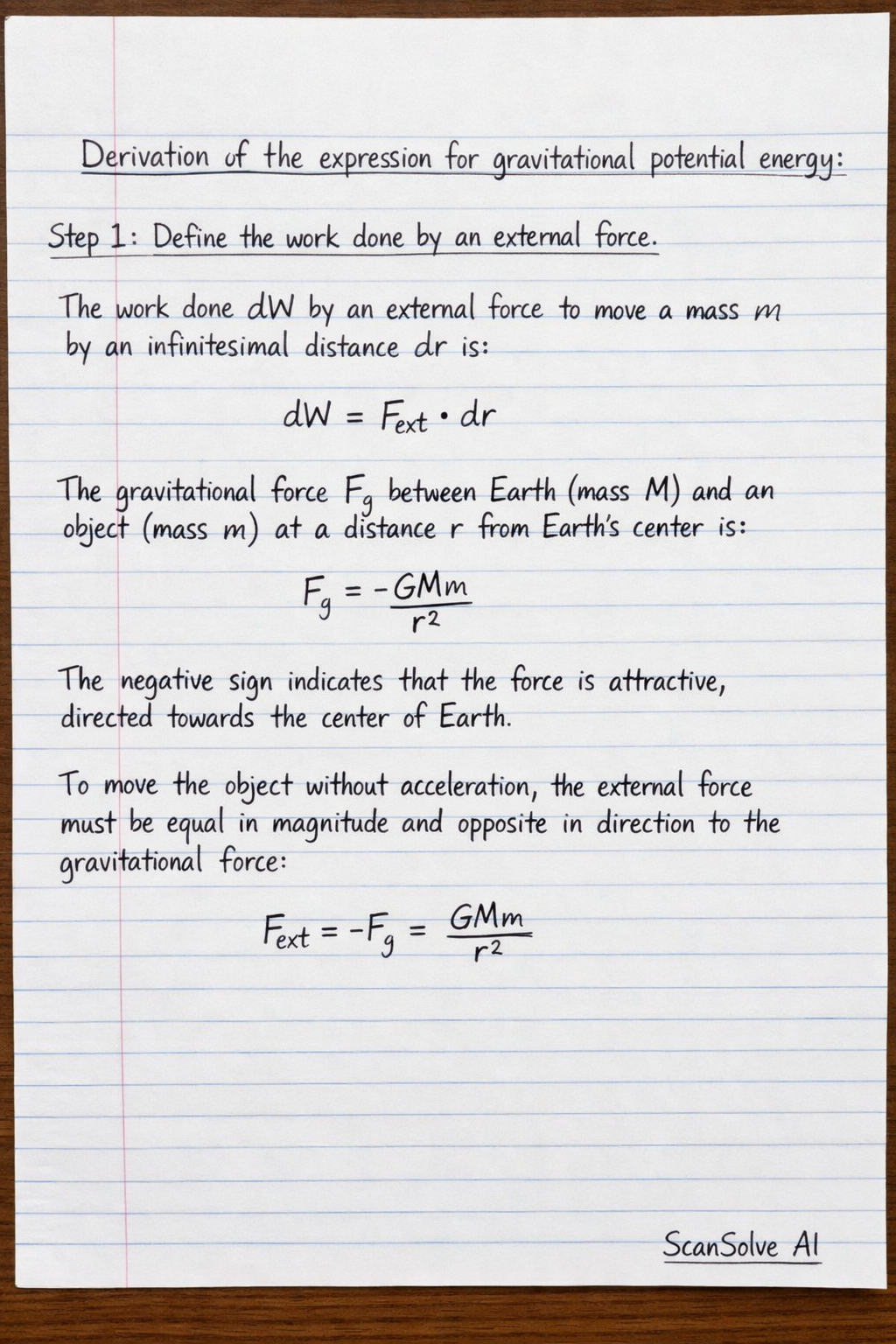
Gravitational potential energy is the energy an object possesses due to its position within a gravitational field. It is defined as the work done by an external force to move an object from a reference point (usually infinity) to a specific point in the gravitational field without accelerating it. Derivation of the expression for gravitational potential energy: Step 1: Define the work done by an external force. The work done dW by an external force to move a mass m by an infinitesimal distance dr against the gravitational force is given by: dW = F_ext · dr The gravitational force F_g between Earth (mass M) and an object (mass m) at a distance r from Earth's center is given by Newton's Law of Universal Gravitation: F_g = -(GMm)/(r^2) The negative sign indicates that the force is attractive, directed towards the center of Earth. To move the object without acceleration, the external force F_ext must be equal in magnitude and opposite in direction to the gravitational force: F_ext = -F_g = (GMm)/(r^2) Step 2: Calculate the total work done. The gravitational potential energy U(r) at a distance r from the center of Earth is the total work done to bring the mass m from infinity (where potential energy is conventionally zero) to the distance r. U(r) = _^r dW = _^r F_ext · dr Substitute the expression for F_ext: U(r) = _^r (GMm)/(r^2) dr Step 3: Perform the integration. U(r) = GMm _^r r^-2 dr U(r) = GMm [ r^-1-1 ]_^r U(r) = GMm [ -(1)/(r) ]_^r U(r) = GMm ( -(1)/(r) - (-(1)/()) ) Since (1)/() = 0: U(r) = GMm ( -(1)/(r) - 0 ) U(r) = -(GMm)/(r) The expression for gravitational potential energy at a distance r from the center of Earth is: U(r) = -(GMm)/(r)