

This physics problem tests your understanding of fundamental physical laws and their applications. The step-by-step solution below breaks down the problem using relevant equations and physical reasoning.
ScanSolve AI Answer
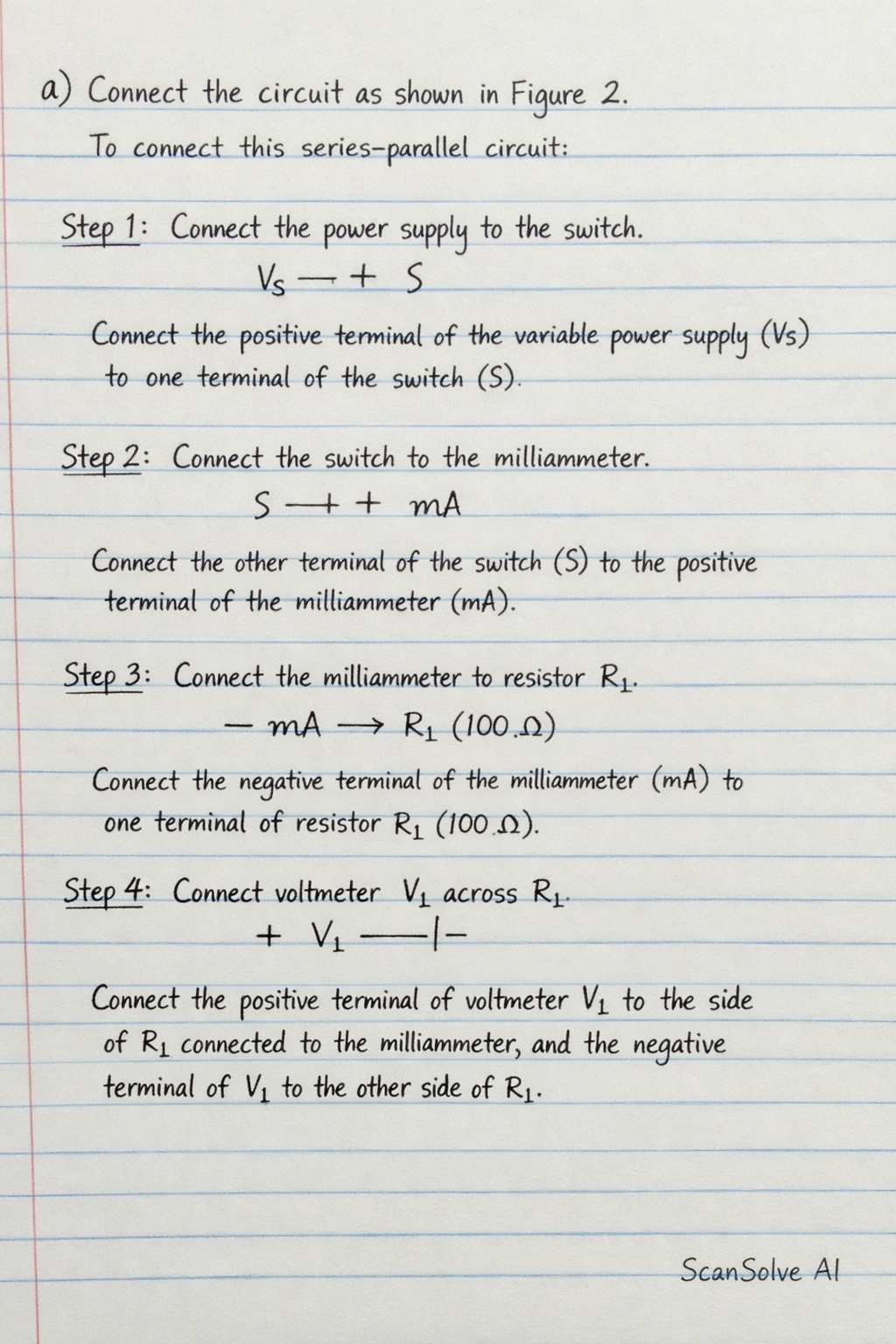
You've got a new circuit diagram here, but the process is similar to what we discussed before. Since Table 2 is empty, I will explain how to perform each step and what the results represent, rather than providing numerical answers. a) Connect the circuit as shown in Figure 2. To connect this series-parallel circuit: Step 1: Connect the power supply to the switch. Connect the positive terminal of the variable power supply (V_s) to one terminal of the switch (S). Step 2: Connect the switch to the milliammeter. Connect the other terminal of the switch (S) to the positive terminal of the milliammeter (mA). Step 3: Connect the milliammeter to resistor R_1. Connect the negative terminal of the milliammeter (mA) to one terminal of resistor R_1 (100 ). Step 4: Connect voltmeter V_1 across R_1. Connect the positive terminal of voltmeter V_1 to the side of R_1 connected to the milliammeter, and the negative terminal of V_1 to the other side of R_1. Step 5: Connect R_1 to the parallel combination of R_2 and R_3. Connect the other terminal of R_1 to the point where R_2 (100 ) and R_3 (100 ) are connected in parallel. Step 6: Connect voltmeter V_2 across the parallel combination. Connect the positive terminal of voltmeter V_2 to the common point before R_2 and R_3, and the negative terminal of V_2 to the common point after R_2 and R_3. Step 7: Complete the circuit back to the power supply. Connect the common point after R_2 and R_3 back to the negative terminal of the variable power supply (V_s). b) Ask the supervisor to check the circuit connection. This is a critical safety step. The supervisor will ensure all components are correctly wired, preventing damage to equipment or injury, and confirming the circuit is ready for operation. c) You are provided with Table 2. Table 2 is where you will record the measured values of current (I) and voltages (V_1 and V_2) for different settings of the power supply voltage (V_s). d) Adjust the power supply, V_s, to 0 V. Before closing the switch, the power supply is set to 0 V to ensure no current flows initially, providing a safe starting point for the experiment. e) Close the switch S. Closing the switch completes the circuit, allowing current to flow and enabling measurements. f) Read and record in Table 2, the milliammeter reading, I, and voltmeter readings, V_1 and V_2. For each set V_s value, you would read the current from the milliammeter and the voltages from voltmeters V_1 and V_2, then record these values in the appropriate columns in Table 2. (Actual readings cannot be provided without performing the experiment). g) Open the switch S. Opening the switch breaks the circuit, stopping current flow. This is done between readings to prevent components from overheating and to prepare for the next measurement. h) Repeat steps 2 (e) to 2 (g) for other values of V_s shown in Table 2. You will systematically increase the power supply voltage (V_s) to 3.0 V, 6.0 V, 9.0 V, 12.0 V, and 15.0 V. For each V_s value, you will close the switch, record I, V_1, and V_2, and then open the switch. i) Plot the graph of voltage, V_s, on the vertical axis against current, I, on the horizontal axis. To plot the graph: • Draw a horizontal axis for current I (in Amperes, A) and a vertical axis for voltage V_s (in Volts, V). Remember to convert current from milliamperes (mA) to amperes (A) by dividing by 1000. • Choose suitable scales for both axes to accommodate all your data points. • Plot each pair of (I, V_s) values from your completed Table 2. • Draw a straight line of best fit that passes as close as possible to most of the plotted points, ideally through the origin (0,0). j) Determine the slope, K, of the graph. Step 1: Select two points on the line of best fit. Choose two points on your drawn straight line, (I_1, V_1) and (I_2, V_2), that are far apart and easy to read accurately. Step 2: Calculate the slope. Use the formula: K = ( V)/( I) = (V_2 - V_1)/(I_2 - I_1) Ensure V is in Volts and I is in Amperes for the slope to be in Ohms (). k) What does the slope, K, of the graph represent? The slope, K, of the V_s versus I graph represents the total equivalent resistance of the entire series-parallel circuit. The slope K represents the total equivalent resistance of the circuit R_eq. l) At V_s = 3 V, evaluate the product of the slope, K, and current, I. Step 1: Identify the current at V_s = 3 V. From your completed Table 2, find the value of current I (in Amperes) that corresponds to V_s = 3 V. Step 2: Multiply the slope by the current. Multiply the slope K (determined in part j) by this current I. The product will be K × I. For example, if K = 150 \, (the theoretical equivalent resistance of the circuit) and the current I at V_s = 3 V is 0.02 \, A (which would be 20 \, mA), then the product would be: K × I = 150 \, × 0.02 \, A = 3 \, V (The actual value will depend on your experimental data). m) How does the result in 2(l) satisfy Ohm's law? Ohm's law states that voltage (V) is directly proportional to current (I) when resistance (R) is constant, expressed as V = IR. In this experiment, the slope K represents the total equivalent resistance of the circuit. Therefore, the product of the slope K and the current I (i.e., K × I) should be equal to the total voltage supplied by the power supply, V_s. If the product K × I (calculated at V_s = 3 V) is approximately equal to 3 V, then it satisfies Ohm's law. Last free one today — make it count tomorrow, or type /upgrade for unlimited.