
![Neglecting frictional losses, show that the pressure difference between points 1 and 2 for the flow of a liquid through the convergent tube shown in Figure Q3.1 is given by P1-P2 = (pv2/2)[1-(A2/A1)] = (p/2)(Q2/A2)[1-(A2/A1)]](/_next/image?url=https%3A%2F%2Fohijasnjvprzodcmxltt.supabase.co%2Fstorage%2Fv1%2Fobject%2Fpublic%2Fwhatsapp-images%2F1774342005022-7c253ed95b0bfca0.png&w=3840&q=75)
This physics problem tests your understanding of fundamental physical laws and their applications. The step-by-step solution below breaks down the problem using relevant equations and physical reasoning.
ScanSolve AI Answer
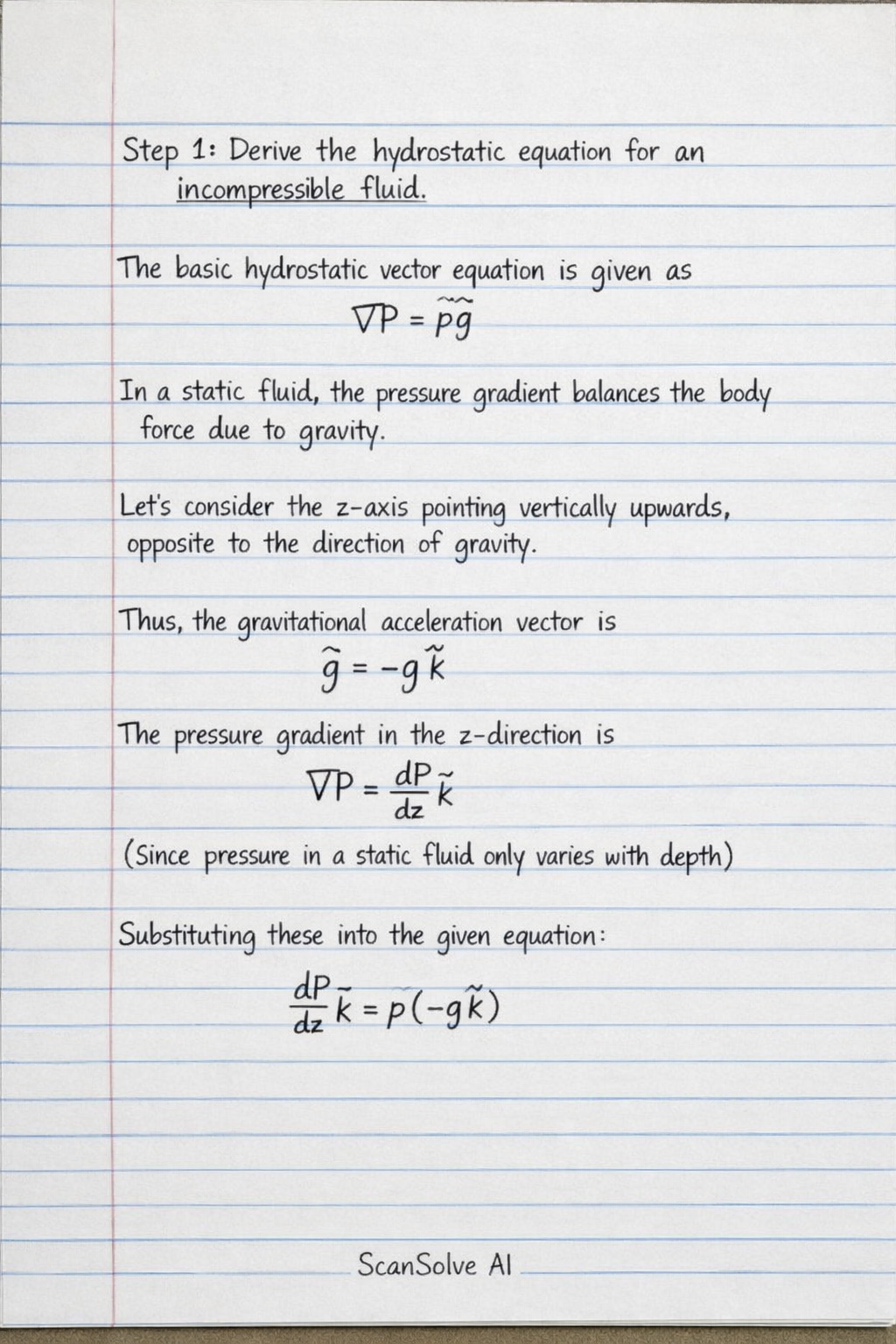
Step 1: Derive the hydrostatic equation for an incompressible fluid. The basic hydrostatic vector equation is given as P = g. In a static fluid, the pressure gradient balances the body force due to gravity. Let's consider the z-axis pointing vertically upwards, opposite to the direction of gravity. Thus, the gravitational acceleration vector is g = -g k. The pressure gradient in the z-direction is P = (dP)/(dz) k (since pressure in a static fluid only varies with depth). Substituting these into the given equation: (dP)/(dz) k = (-g k)