Physics: i) Osmoregulation is the active regulation of the osmotic pressure of an organis... — Step-by-Step Solution | ScanSolve
i) Osmoregulation is the active regulation of the osmotic pressure of an organism's fluids to maintain the homeostasis of the organism's water content. It involves controlling the amount of wate
This physics problem tests your understanding of fundamental physical laws and their applications. The step-by-step solution below breaks down the problem using relevant equations and physical reasoning.
ScanSolve AI Answer
a)
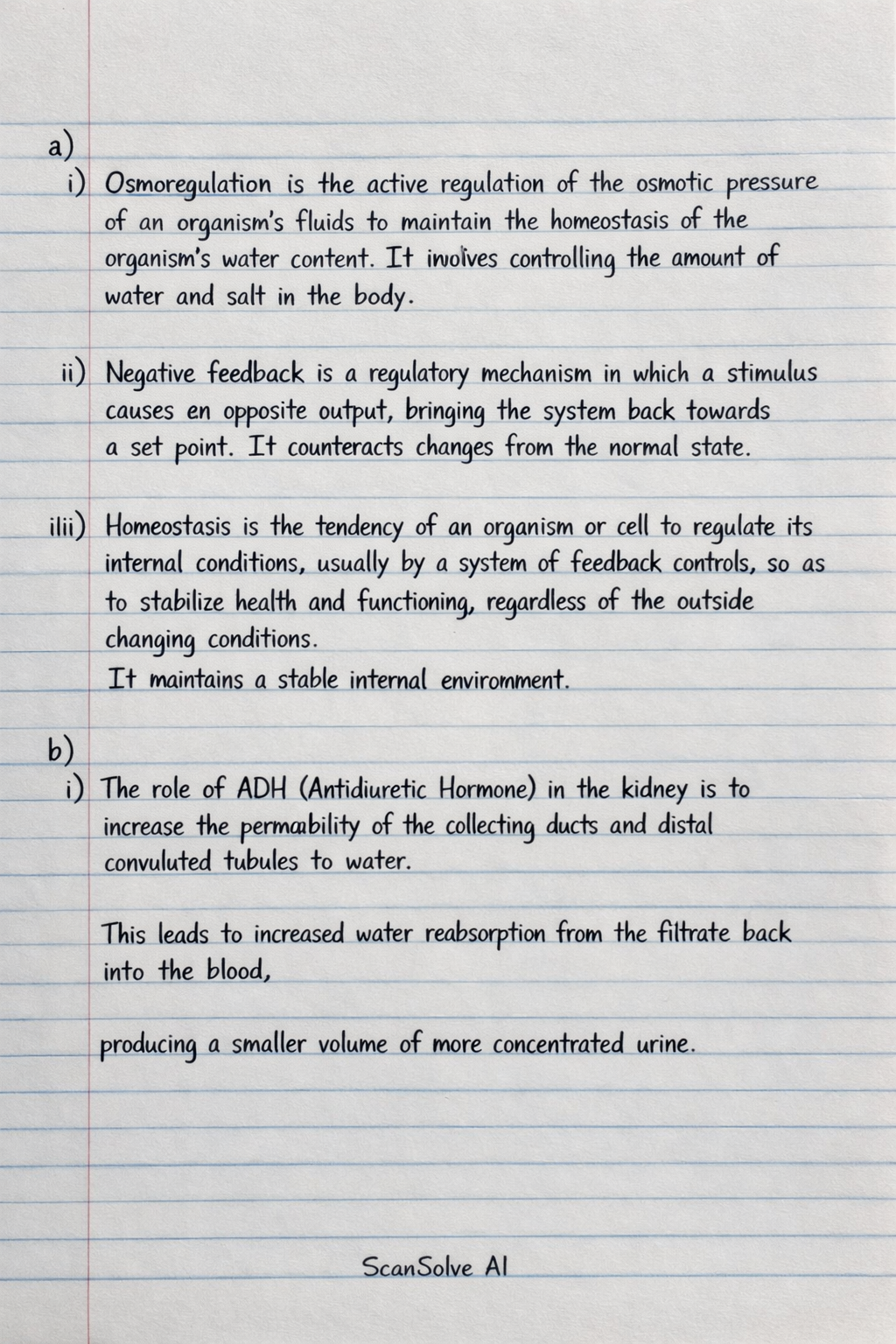
i) Osmoregulation is the active regulation of the osmotic pressure of an organism's fluids to maintain the homeostasis of the organism's water content. It involves controlling the amount of water and salt in the body.
ii) Negative feedback is a regulatory mechanism in which a stimulus causes an opposite output, bringing the system back towards a set point. It counteracts changes from the normal state.
iii) Homeostasis is the tendency of an organism or cell to regulate its internal conditions, usually by a system of feedback controls, so as to stabilize health and functioning, regardless of the outside changing conditions. It maintains a stable internal environment.
b)
i) The role of ADH (Antidiuretic Hormone) in the kidney is to increase the permeability of the collecting ducts and distal convoluted tubules to water. This leads to increased water reabsorption from the filtrate back into the blood, producing a smaller volume of more concentrated urine.
ii)
Dehydration leads to increased blood osmolarity (decreased blood water potential).
$$ \text{Increased blood osmolarity} \xrightarrow{\text{stimulates}} \text{Osmoreceptors in hypothalamus} \xrightarrow{\text{activates}} \text{Posterior pituitary} $$
$$ \text{Posterior pituitary} \xrightarrow{\text{releases}} \text{More ADH into blood} \xrightarrow{\text{targets}} \text{Kidney collecting ducts and DCTs} $$
$$ \text{Kidney collecting ducts and DCTs} \xrightarrow{\text{effect}} \text{Increased water reabsorption} \xrightarrow{\text{results in}} \text{Increased blood water potential} $$
$$ \text{Increased blood water potential} \xrightarrow{\text{inhibits}} \text{Osmoreceptors in hypothalamus} \xrightarrow{\text{reduces}} \text{ADH release} $$
This negative feedback loop restores blood water potential to its normal range.
c)
The hypothalamus contains osmoreceptors that detect changes in blood osmolarity. When water intake increases, blood osmolarity decreases, which inhibits the osmoreceptors. This inhibition reduces the production of ADH by the neurosecretory cells in the hypothalamus. Consequently, less ADH is released from the posterior pituitary gland into the bloodstream. With less ADH, the collecting ducts and distal convoluted tubules in the kidneys become less permeable to water, leading to decreased water reabsorption and the production of a larger volume of more dilute urine, as observed by the student. This mechanism is vital for survival in flood-prone areas because it allows the body to excrete excess water efficiently, preventing overhydration and maintaining a stable internal fluid balance despite the abundance of water.
Send me the next one 📸
i) Osmoregulation is the active regulation of the osmotic pressure of an organism's fluids to maintain the homeostasis of the organism's water content. It involves controlling the amount of wate
|Physics
i) Osmoregulation is the active regulation of the osmotic pressure of an organism's fluids to maintain the homeostasis of the organism's water content. It involves controlling the amount of wate
ScanSolve AI Answer
a)i)Osmoregulation is the active regulation of the osmotic pressure of an organism's fluids to maintain the homeostasis of the organism's water content. It involves controlling the amount of water and salt in the body.
ii)Negative feedback is a regulatory mechanism in which a stimulus causes an opposite output, bringing the system back towards a set point. It counteracts changes from the normal state.
iii)Homeostasis is the tendency of an organism or cell to regulate its internal conditions, usually by a system of feedback controls, so as to stabilize health and functioning, regardless of the outside changing conditions. It maintains a stable internal environment.
b)i) The role of ADH (Antidiuretic Hormone) in the kidney is to increase the permeability of the collecting ducts and distal convoluted tubules to water. This leads to increased water reabsorption from the filtrate back into the blood, producing a smaller volume of more concentrated urine.
ii)
Dehydration leads to increased blood osmolarity (decreased blood water potential).
IncreasedbloodosmolaritystimulatesOsmoreceptorsinhypothalamusactivatesPosteriorpituitaryPosteriorpituitaryreleasesMoreADHintobloodtargetsKidneycollectingductsandDCTsKidneycollectingductsandDCTseffectIncreasedwaterreabsorptionresultsinIncreasedbloodwaterpotentialIncreasedbloodwaterpotentialinhibitsOsmoreceptorsinhypothalamusreducesADHrelease
This negative feedback loop restores blood water potential to its normal range.
c)
The hypothalamus contains osmoreceptors that detect changes in blood osmolarity. When water intake increases, blood osmolarity decreases, which inhibits the osmoreceptors. This inhibition reduces the production of ADH by the neurosecretory cells in the hypothalamus. Consequently, less ADH is released from the posterior pituitary gland into the bloodstream. With less ADH, the collecting ducts and distal convoluted tubules in the kidneys become less permeable to water, leading to decreased water reabsorption and the production of a larger volume of more dilute urine, as observed by the student. This mechanism is vital for survival in flood-prone areas because it allows the body to excrete excess water efficiently, preventing overhydration and maintaining a stable internal fluid balance despite the abundance of water.
Send me the next one 📸
Need help with your own homework?
Get instant step-by-step solutions to any question. Free to start.