
We read your photo as:
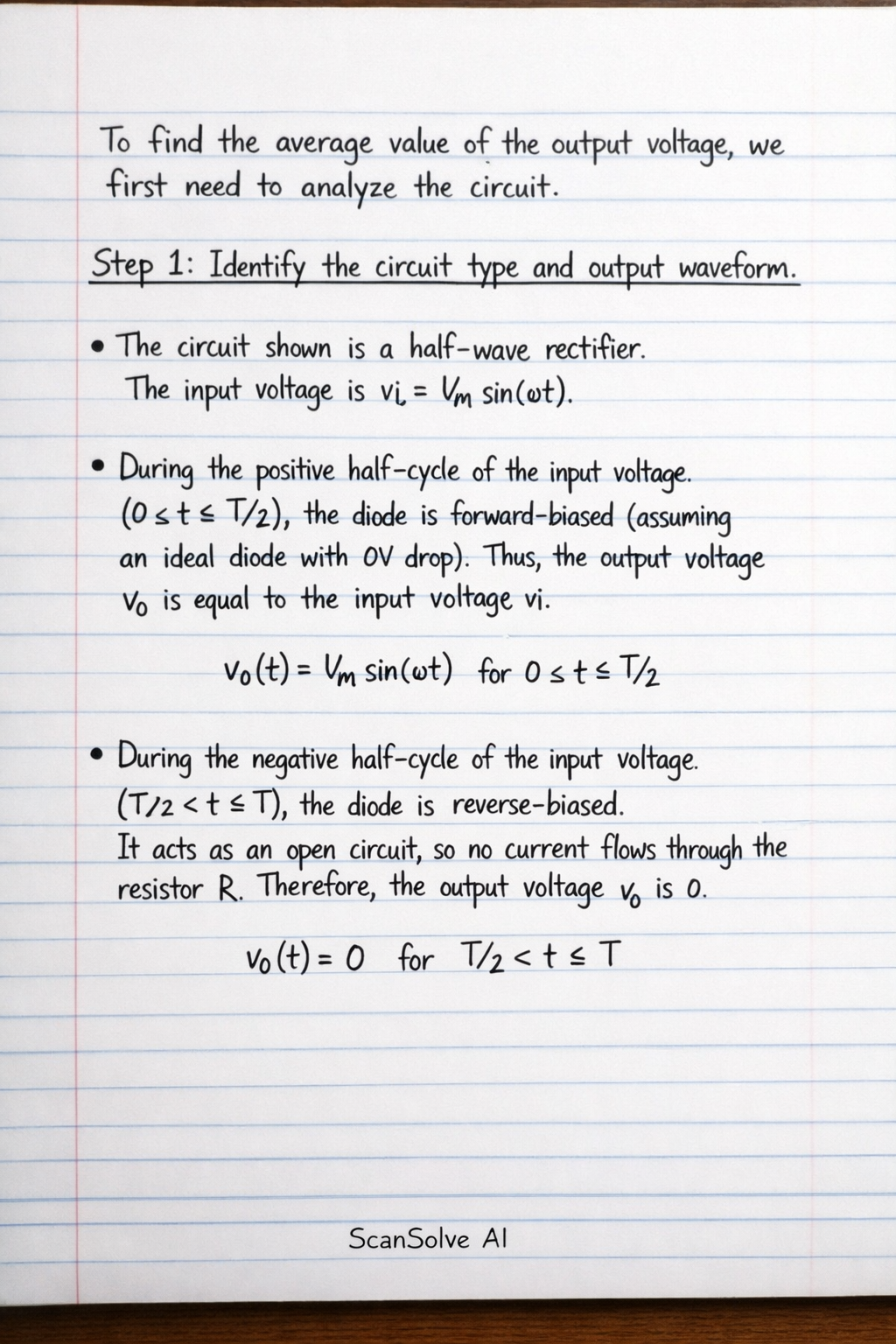
Identify the circuit type and output waveform.
Physics
ScanSolve AI Answer
Step-by-step solution
4 stepsTo find the average value of the output voltage, we first need to analyze the circuit.
Identify the circuit type and output waveform.
The circuit shown is a half-wave rectifier. The input voltage is .
- During the positive half-cycle of the input voltage (), the diode is forward-biased (assuming an ideal diode with 0V drop). Thus, the output voltage is equal to the input voltage .
- During the negative half-cycle of the input voltage (), the diode is reverse-biased. It acts as an open circuit, so no current flows through the resistor . Therefore, the output voltage is 0.
Calculate the average value of the output voltage.
The average value of a periodic waveform over one period is given by the formula:
Substitute the output voltage waveform into the integral:
Perform the integration.
We know that .
Substitute :
Convert to decimal value.
Using the approximation :
Comparing this result with the given options:
A)
B)
C)
D)The calculated average value matches option C.
The final answer is .
Was this helpful?
Still stuck on this one?
Ask a follow-up, and the answer starts from this question.
Got a different question?Ask your own question
More Physics Questions
QIdentify the type of circuit.QIdentify the circuit configuration.QIdentify the type of tube and the wave pattern.QIdentify the circuit components and their values.QIdentify the bridge circuit.
Browse by topic:Electrical Engineering
Handwritten Step-by-Step Solution
Get this as a handwritten image on WhatsApp — like a tutor wrote it for you.
Try on WhatsApp