ScanSolve logoScanSolve
Toggle sidebar
  • Homework
  • Tutor
  • Humanizer
  • AI Detector
  • Questions
  • Blog
  • History
  • Mobile App

  • Homework
  • Tutor
  • Humanizer
  • AI Detector

  • Questions
  • Math homework helpMath
    Physics homework helpPhysics
    Chemistry homework helpChemistry
    Biology homework helpBiology
    Computer Science homework helpComputer Science
    History homework helpHistory
    More homework helpMore
  • Blog
  • History

  • Mobile App
ScanSolvePLUS
  • Unlimited answers
  • ScanSolve AI Pro
Start Free Trial →
Try on WhatsApp
Physics: Identify the type of tube and the wave pattern. — Step-by-Step Solution | ScanSolve
Home > Physics Homework Help > Solution

Identify the type of tube and the wave pattern.

Asked on March 27, 2026|Physics

This physics problem tests your understanding of fundamental physical laws and their applications. The step-by-step solution below breaks down the problem using relevant equations and physical reasoning.

ScanSolve AI AnswerAnswered on March 27, 2026
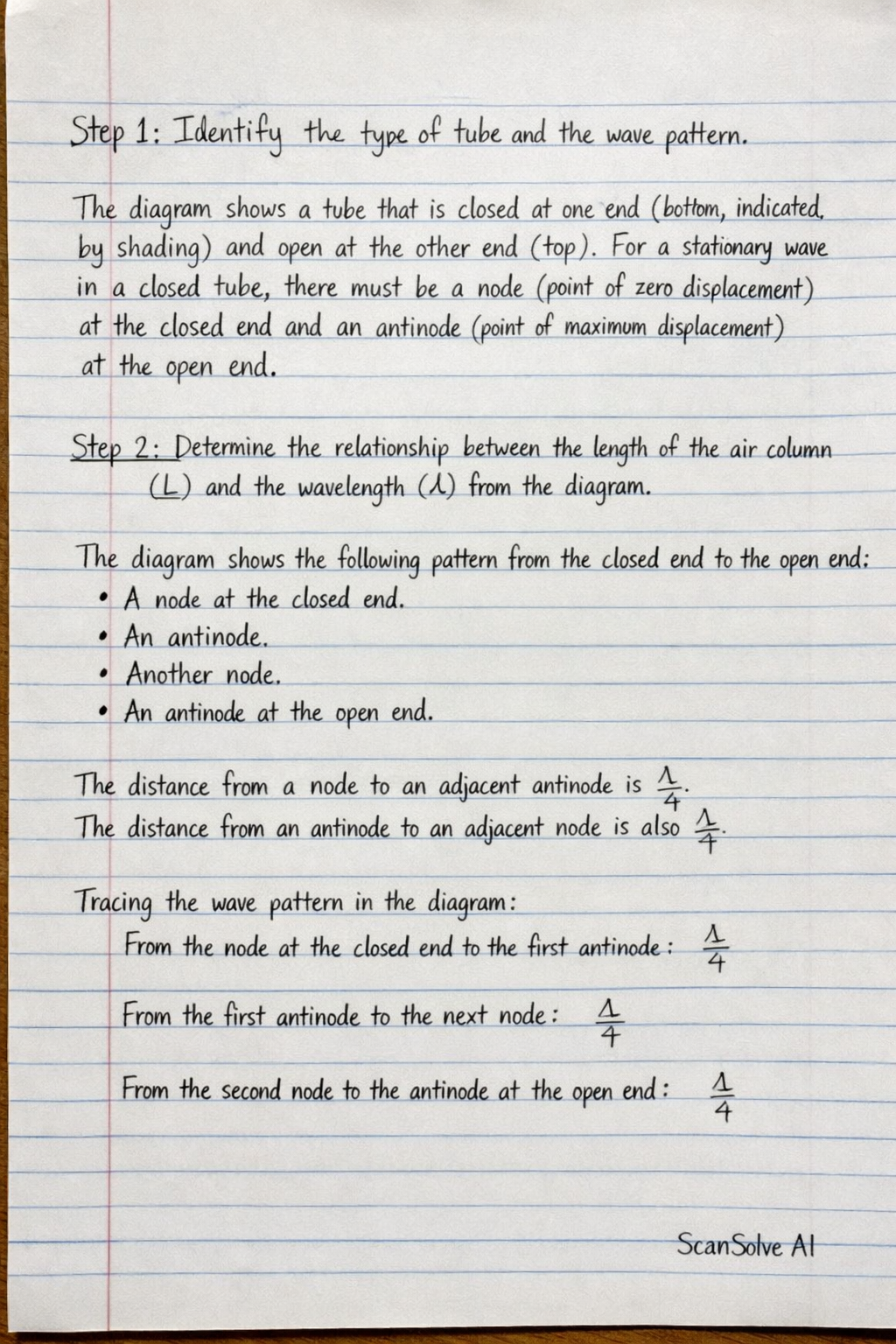
Step 1: Identify the type of tube and the wave pattern. The diagram shows a tube that is closed at one end (bottom, indicated by shading) and open at the other end (top). For a stationary wave in a closed tube, there must be a node (point of zero displacement) at the closed end and an antinode (point of maximum displacement) at the open end. Step 2: Determine the relationship between the length of the air column ($L$) and the wavelength ($\lambda$) from the diagram. The diagram shows the following pattern from the closed end to the open end: A node at the closed end. An antinode. Another node. An antinode at the open end. The distance from a node to an adjacent antinode is $\frac{\lambda}{4}$. The distance from an antinode to an adjacent node is also $\frac{\lambda}{4}$. Tracing the wave pattern in the diagram: From the node at the closed end to the first antinode: $\frac{\lambda}{4}$ From the first antinode to the next node: $\frac{\lambda}{4}$ From the second node to the antinode at the open end: $\frac{\lambda}{4}$ Therefore, the total length $L$ of the resonating air column is the sum of these segments: $$L = \frac{\lambda}{4} + \frac{\lambda}{4} + \frac{\lambda}{4} = \frac{3\lambda}{4}$$ This corresponds to the first overtone (or third harmonic) for a closed tube. Step 3: Substitute the given wavelength and calculate $L$. The wavelength is given as $\lambda = 40 \, cm$. $$L = \frac{3 \times 40 \, cm}{4}$$ $$L = 3 \times 10 \, cm$$ $$L = 30 \, cm$$ Step 4: Compare the result with the given options. The calculated length $L = 30 \, cm$ matches option (d). The final answer is $\boxed{\text{D. 30cm}}$.

Related Physics Questions

  • Calculate the speed of the 1.5 kg trolley at point P using the principle of conservation of mechanical energy.
  • Identify the circuit configuration when K is closed.
  • If a device that draws 8A is used in a circuit with a 5A fuse, the current will exceed the fuse's rating. The fuse wire...
  • 151. All components of the electromagnetic spectrum in vacuum have the same
  • Define variables for their current ages.
  • What is 1+1?
See all Physics questions

This step-by-step solution was generated by ScanSolve AI. Need help with more physics problems? Browse Physics solutions or ask your own question.

Home›Physics Homework Help›Identify the type of tube and the wave pattern.
Q

Identify the type of tube and the wave pattern.

March 27, 2026|Physics
Identify the type of tube and the wave pattern.

Identify the type of tube and the wave pattern.

ScanSolve AI

ScanSolve AI Answer

Answered on March 27, 2026

Step 1: Identify the type of tube and the wave pattern. The diagram shows a tube that is closed at one end (bottom, indicated by shading) and open at the other end (top). For a stationary wave in a closed tube, there must be a node (point of zero displacement) at the closed end and an antinode (point of maximum displacement) at the open end.

Step 2: Determine the relationship between the length of the air column (LLL) and the wavelength (λ\lambdaλ) from the diagram. The diagram shows the following pattern from the closed end to the open end:

  • A node at the closed end.
  • An antinode.
  • Another node.
  • An antinode at the open end.

The distance from a node to an adjacent antinode is λ4\frac{\lambda}{4}4λ​. The distance from an antinode to an adjacent node is also λ4\frac{\lambda}{4}4λ​. Tracing the wave pattern in the diagram:

  • From the node at the closed end to the first antinode: λ4\frac{\lambda}{4}4λ​
  • From the first antinode to the next node: λ4\frac{\lambda}{4}4λ​
  • From the second node to the antinode at the open end: λ4\frac{\lambda}{4}4λ​

Therefore, the total length LLL of the resonating air column is the sum of these segments: L=λ4+λ4+λ4=3λ4L = \frac{\lambda}{4} + \frac{\lambda}{4} + \frac{\lambda}{4} = \frac{3\lambda}{4}L=4λ​+4λ​+4λ​=43λ​ This corresponds to the first overtone (or third harmonic) for a closed tube.

Step 3: Substitute the given wavelength and calculate LLL. The wavelength is given as λ=40 cm\lambda = 40 \, cmλ=40cm. L=3×40 cm4L = \frac{3 \times 40 \, cm}{4}L=43×40cm​ L=3×10 cmL = 3 \times 10 \, cmL=3×10cm L=30 cmL = 30 \, cmL=30cm

Step 4: Compare the result with the given options. The calculated length L=30 cmL = 30 \, cmL=30cm matches option (d).

The final answer is D.30cm\boxed{D. 30cm}D.30cm​.

Need help with your own homework?

Get instant step-by-step solutions to any question. Free to start.

Ask Your Question
Handwritten step-by-step solution

Handwritten Step-by-Step Solution

Get this solution as a handwritten image on WhatsApp — just like a tutor wrote it for you.

Try on WhatsApp

More Physics Questions

Calculate the speed of the 1.5 kg trolley at point P using the principle of conservation of mechanic…Identify the circuit configuration when K is closed.If a device that draws 8A is used in a circuit with a 5A fuse, the current will exceed the fuse's ra…151. All components of the electromagnetic spectrum in vacuum have the sameDefine variables for their current ages.What is 1+1?
See all Physicsquestions →