

This physics problem tests your understanding of fundamental physical laws and their applications. The step-by-step solution below breaks down the problem using relevant equations and physical reasoning.
ScanSolve AI Answer
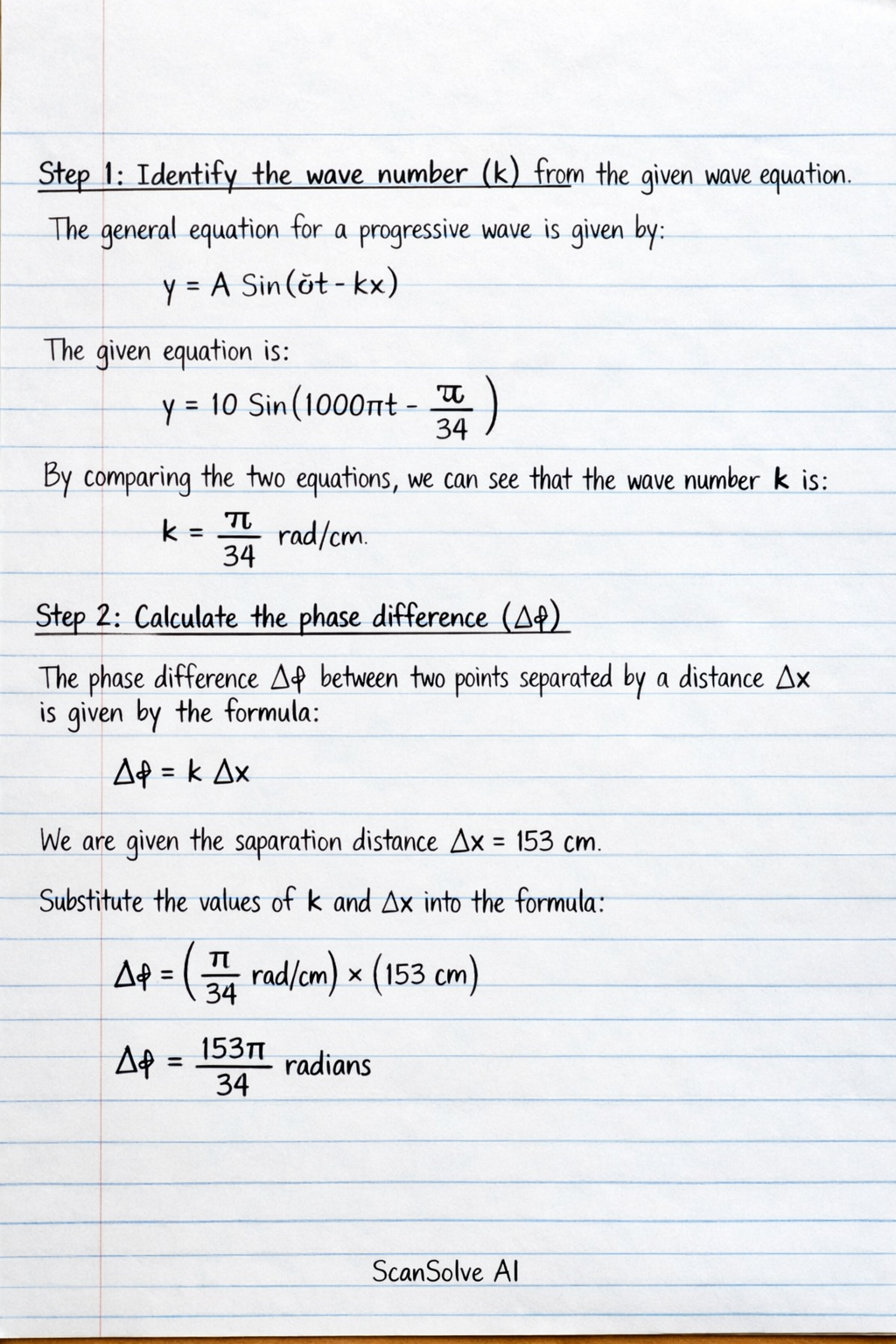
To find the phase difference between two layers of the wave, we first need to identify the wave number from the given equation and then use the formula for phase difference. Step 1: Identify the wave number (k) from the given wave equation. The general equation for a progressive wave is given by: y = ASin( t - kx) The given equation is: y = 10Sin(1000 t - ( x)/(34)) By comparing the two equations, we can see that the wave number k is: k = ()/(34) rad/cm Step 2: Calculate the phase difference ( ). The phase difference between two points separated by a distance x is given by the formula: = k x We are given the separation distance x = 153 cm. Substitute the values of k and x into the formula: = (()/(34) rad/cm) × (153 cm) = (153)/(34) radians Step 3: Convert the phase difference from radians to degrees. We know that radians = 180^. So, to convert to degrees, we multiply by (180^)/( radians): = (153)/(34) × (180^)/() = (153 × 180^)/(34) Now, perform the multiplication and division: = (27540^)/(34) = 810^ Step 4: Find the equivalent phase difference within 0^ to 360^. A phase difference of 810^ means the wave has completed multiple cycles. To find the equivalent angle within a single cycle (0^ to 360^), we subtract multiples of 360^: 810^ = 2 × 360^ + 90^ So, the phase difference is equivalent to 90^. Comparing this result with the given options: A. 270^ B. 45^ C. 90^ D. 180^ E. No Correct Option The calculated equivalent phase difference matches option C. The final answer is C. 90^0.