

This physics problem tests your understanding of fundamental physical laws and their applications. The step-by-step solution below breaks down the problem using relevant equations and physical reasoning.
ScanSolve AI Answer
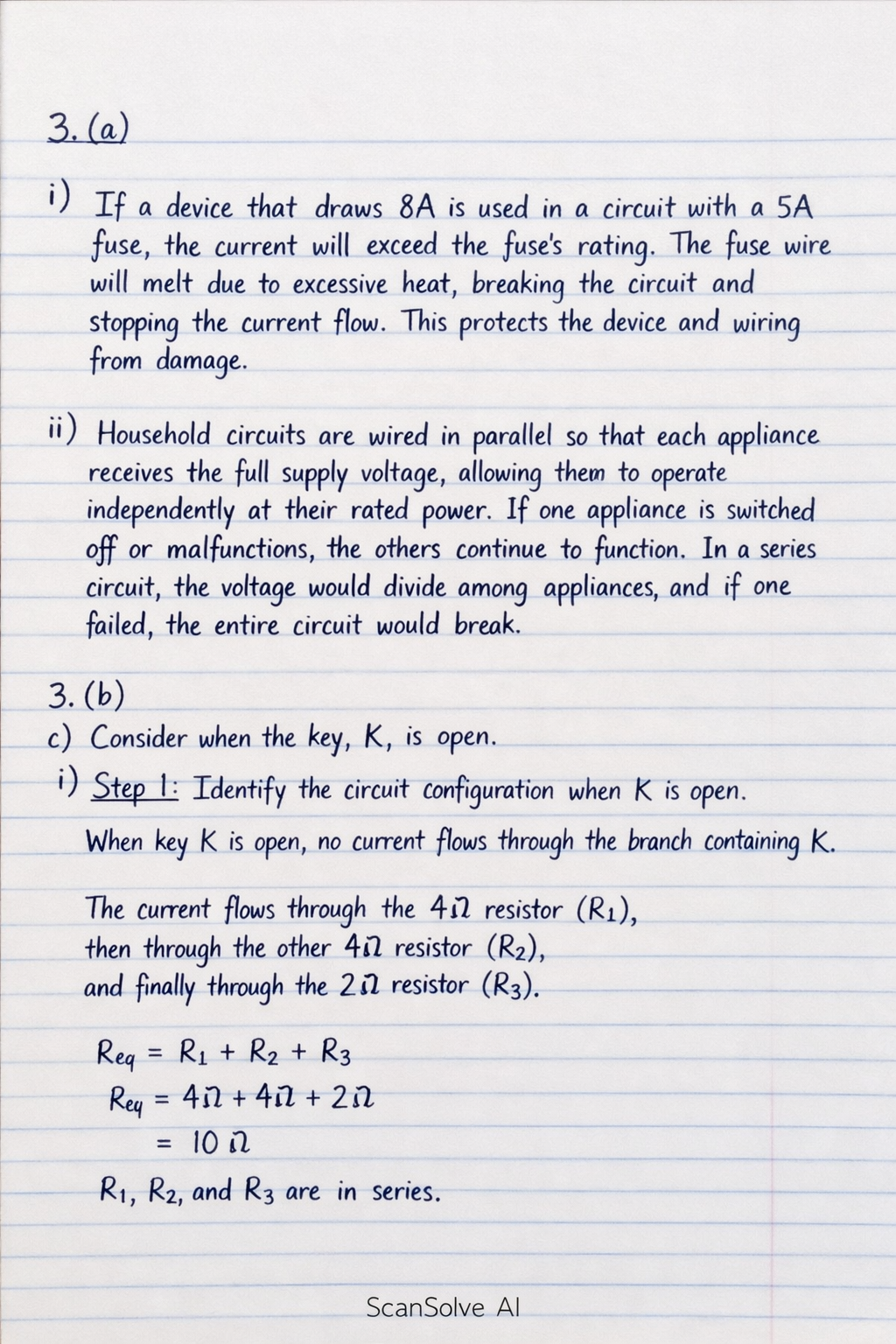
3. (a) i) If a device that draws 8A is used in a circuit with a 5A fuse, the current will exceed the fuse's rating. The fuse wire will melt due to excessive heat, breaking the circuit and stopping the current flow. This protects the device and wiring from damage. ii) Household circuits are wired in parallel so that each appliance receives the full supply voltage, allowing them to operate independently at their rated power. If one appliance is switched off or malfunctions, the others continue to function. In a series circuit, the voltage would divide among appliances, and if one failed, the entire circuit would break. 3. (b) c) Consider when the key, K is open. i) Step 1: Identify the circuit configuration when K is open. When key K is open, no current flows through the branch containing K. The current flows through the 4\, resistor (R1), then through the other 4\, resistor (R2), and finally through the 2\, resistor (R3). Thus, R1, R2, and R3 are in series. Step 2: Calculate the total resistance of the circuit. R_total = R1 + R2 + R3 R_total = 4\, + 4\, + 2\, R_total = 10\, Step 3: Calculate the ammeter reading (total current). Using Ohm's Law, I = (V)/(R_total). I = 12\,V10\, I = 1.2\,A The ammeter reading will be 1.2 A. ii) Step 1: Identify the component across which the voltmeter is connected. The voltmeter is connected across the 2\, resistor (R3). Step 2: Calculate the voltage across the 2\, resistor. Using Ohm's Law, V_3 = I × R3. V_3 = 1.2\,A × 2\,