
We read your photo as:
Describe how you would help Jamal determine the mass of his bottle using the available materials and help Jamal find out whether his bottle qualifies for sale.
ScanSolve AI Answer
Step-by-step solution
10 stepsHere is the solution for Item 3:
Item 3
Part a· 6 steps
To determine the mass of Jamal's bottle using the available materials, you would set up a simple lever system based on the principle of moments.
Balance the metre rule on the knife edge at its center of gravity (typically the 50 cm mark) to ensure it is horizontally level.
Suspend the known 100g mass from one side of the metre rule using one piece of thread.
Suspend Jamal's bottle from the other side of the metre rule using the second piece of thread.
Adjust the positions of both the 100g mass and the bottle along the metre rule until the rule balances horizontally on the knife edge.
Measure the distance from the knife edge to the point where the 100g mass is suspended () and the distance from the knife edge to the point where the bottle is suspended ().
Apply the principle of moments
The clockwise moment must equal the anticlockwise moment.
where is the known mass (100g), is its distance from the pivot, is the unknown mass of the bottle, and is its distance from the pivot. You can then calculate .
Part b· 4 steps
State the principle of moments.
The principle of moments states that for an object to be in rotational equilibrium, the sum of the clockwise moments about a pivot must equal the sum of the anticlockwise moments about the same pivot.
Here, is the known mass, is its distance from the knife edge, is the mass of the bottle, and is its distance from the knife edge.
Substitute the given values into the equation.
Given:
Solve for the mass of the bottle ().
Determine if the bottle qualifies for sale.
The entrepreneur buys bottles that weigh more than 30g.
Since , and , Jamal's bottle qualifies for sale.
Still stuck on this one?
Ask a follow-up, and the answer starts from this question.
More Physics Questions
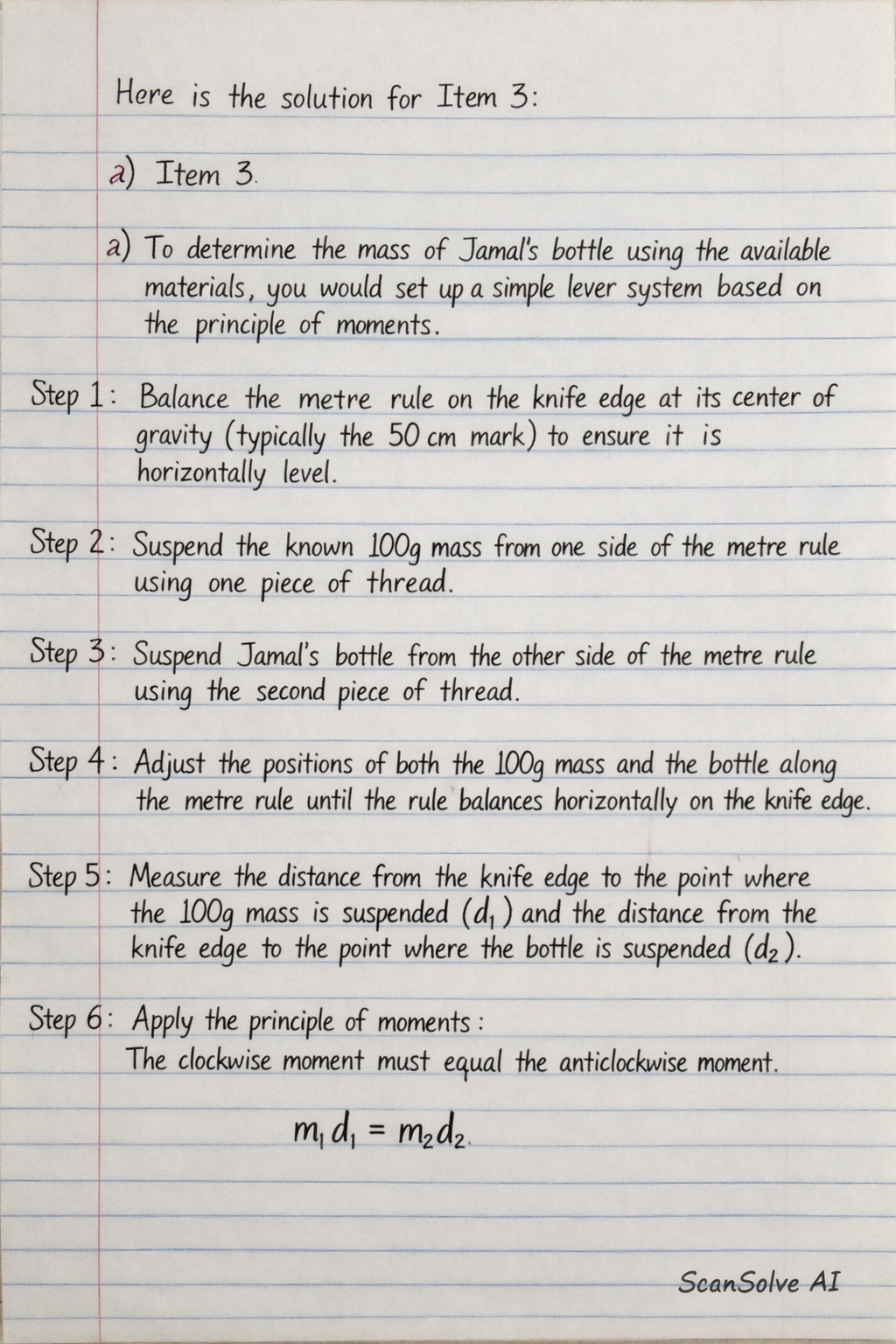
Handwritten Step-by-Step Solution
Get this as a handwritten image on WhatsApp — like a tutor wrote it for you.
Try on WhatsApp