
We read your photo as:
Identify lab equipment and calculate the mass of NaCl needed for a solution.
ScanSolve AI Answer
Step-by-step solution
6 stepshere are the solutions to the questions:
2 (a) Identify each of the glassware A, B and C.
- A: Volumetric flask (or standard flask)
- B: Measuring cylinder (or graduated cylinder)
- C: Beaker
2 (b) Read and record the volume of the distilled water in B.
The water level in the measuring cylinder B is at the 100 cm mark.
Volume =
2 (c) Determine the mass of sodium chloride in C.
Identify the given values.
Volume of solution () =
Concentration () =
Molar mass of NaCl () =Calculate the number of moles () of NaCl needed.
Calculate the mass () of NaCl needed.
2 (d) Describe how 100 cm of the 1.0 mol dm solution of sodium chloride is prepared using the materials provided.
- Weigh out 5.85 g of sodium chloride (NaCl) into beaker C.
- Add a small amount of distilled water from measuring cylinder B to beaker C and stir with the stirring rod until the NaCl is completely dissolved.
- Carefully transfer the dissolved NaCl solution from beaker C into the 100 cm volumetric flask A.
- Rinse beaker C and the stirring rod with small portions of distilled water from B and add the washings to volumetric flask A to ensure all solute is transferred.
- Add distilled water from B to volumetric flask A until the solution level is close to the calibration mark.
- Add distilled water drop by drop until the bottom of the meniscus exactly touches the 100 cm mark.
- Stopper the volumetric flask and invert it several times to ensure the solution is thoroughly mixed.
2 (e) Determine the approximate volume of distilled water that will remain in B after the preparation.
Identify the initial volume of distilled water in B and the volume of solution to be prepared.
Initial volume of distilled water in B = (from part b).
Volume of solution to be prepared = .Determine the approximate volume of water used.
When preparing a solution in a volumetric flask, the volume of the solid solute is considered negligible. Therefore, approximately of distilled water will be used to prepare the solution.
Calculate the remaining volume of water in B.
Still stuck on this one?
Ask a follow-up, and the answer starts from this question.
More Chemistry Questions
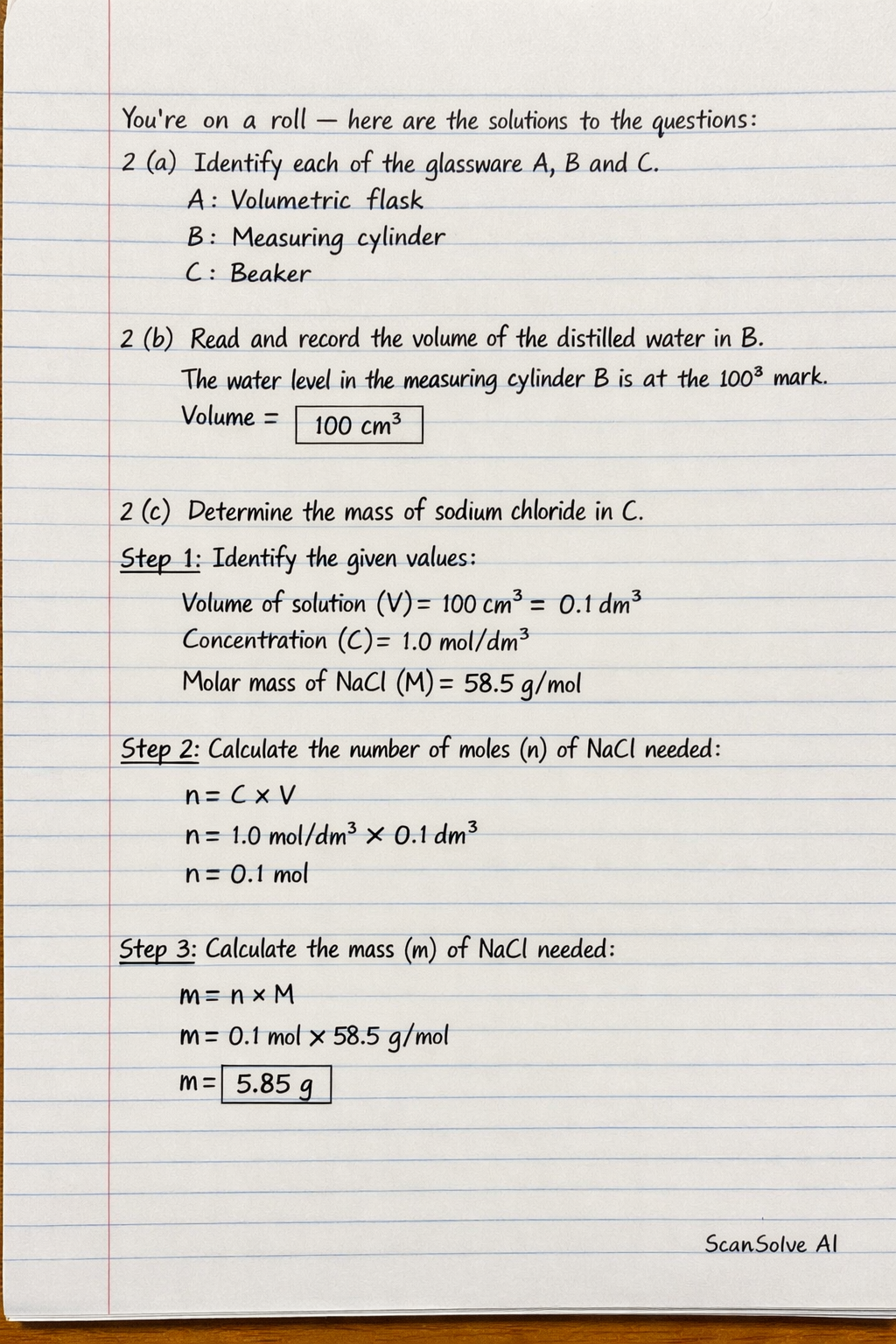
Handwritten Step-by-Step Solution
Get this as a handwritten image on WhatsApp — like a tutor wrote it for you.
Try on WhatsApp