
We read your photo as:
Outline 3 key steps to prepare a standard solution of sodium carbonate, state a precaution, identify the apparatus, and calculate the mass of sodium carbonate needed for a 0.1 M solution in a 250 cm³
ScanSolve AI Answer
Step-by-step solution
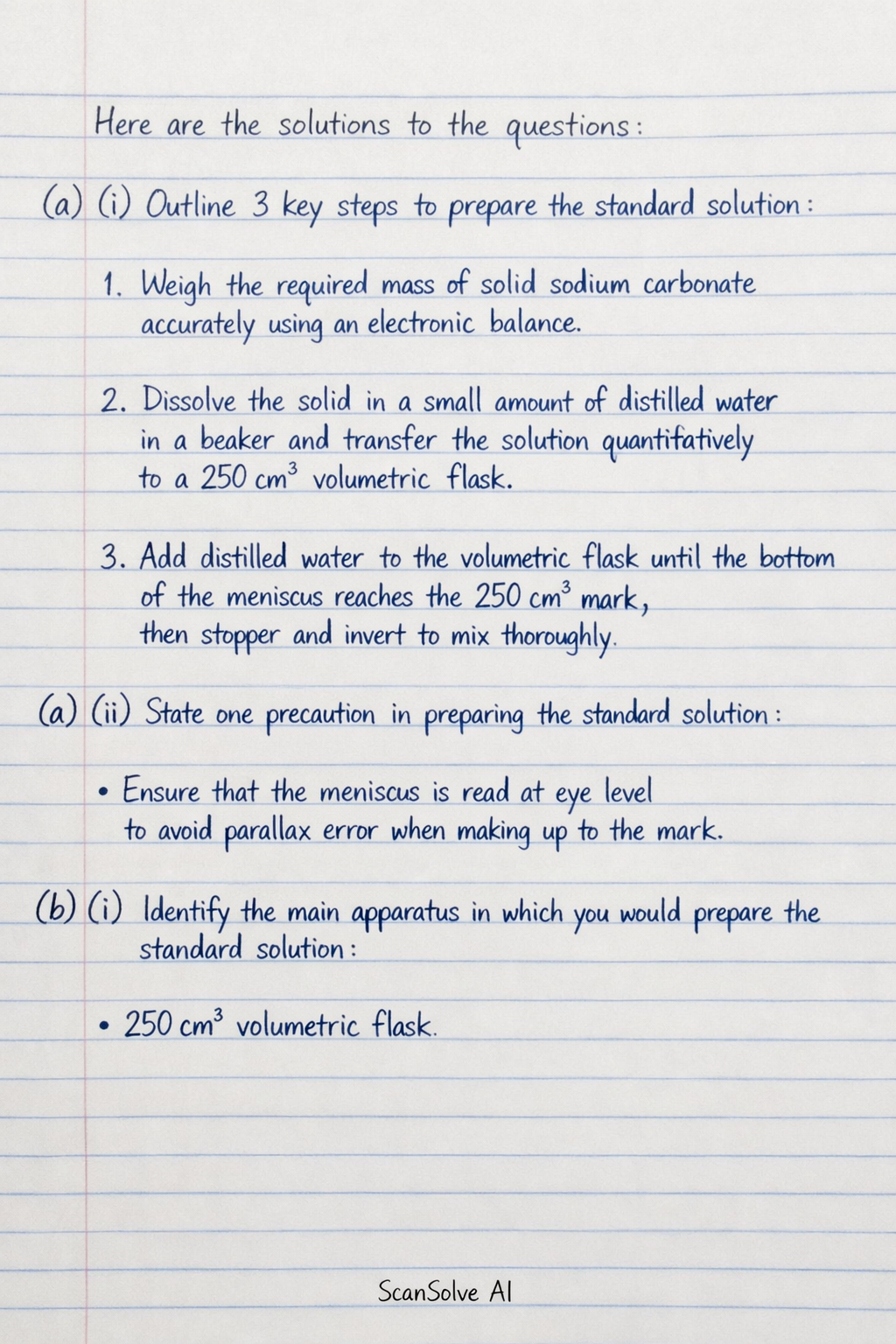
5 stepsHere are the solutions to the questions:
a) (i) Outline 3 key steps to prepare the standard solution.
- Weigh the required mass of solid sodium carbonate accurately using an electronic balance.
- Dissolve the solid in a small amount of distilled water in a beaker and transfer the solution quantitatively to a 250 cm³ volumetric flask.
- Add distilled water to the volumetric flask until the bottom of the meniscus reaches the 250 cm³ mark, then stopper and invert to mix thoroughly.
a) (ii) State one precaution in preparing the standard solution.
- Ensure that the meniscus is read at eye level to avoid parallax error when making up to the mark.
b) (i) Identify the main apparatus in which you would prepare the standard solution.
- 250 cm³ volumetric flask
b) (ii) Calculate the mass of solid sodium carbonate that you would use to prepare the 0.1 M . (Molar mass of sodium carbonate is 106 g/mol)
Calculate the number of moles of needed.
Calculate the mass of .
b) (iii) Suggest a piece of equipment, not given above, that is used to weigh the solid sodium carbonate.
- Electronic balance
c) (i) Name the technique used to determine the concentration of dilute sulphuric acid using the standard solution.
- Titration
c) (ii) Explain why it is better to place the dilute sulphuric in the burette.
- The dilute sulphuric acid is the analyte (solution of unknown concentration) and is typically placed in the burette to be added dropwise, allowing for precise measurement of the volume required to neutralize the known volume of standard solution.
c) (iii) Suggest an appropriate cleaning procedure for the:
- Burette: Rinse with distilled water, then rinse with the dilute sulphuric acid it will contain.
- Pipette: Rinse with distilled water, then rinse with the sodium carbonate solution it will contain.
d) Determine the concentration of the acid in mol/dm³.
Given:
Concentration of () = 0.1 M
Volume of () = 25 cm³ = 0.025 dm³
Volume of () = 20 cm³ = 0.020 dm³
Balanced equation:
The mole ratio of is .Calculate the moles of used.
Determine the moles of reacted.
Since the mole ratio is ,
Calculate the concentration of .
Still stuck on this one?
Ask a follow-up, and the answer starts from this question.
More Chemistry Questions
Handwritten Step-by-Step Solution
Get this as a handwritten image on WhatsApp — like a tutor wrote it for you.
Try on WhatsApp