We read your photo as:

What is a standard solution? What mass of sodium carbonate (Na2CO3) is needed to prepare 500 cm3 of 0.2 moldm-3 solution?

Chemistry

ScanSolve AI Answer

Step-by-step solution

11 steps

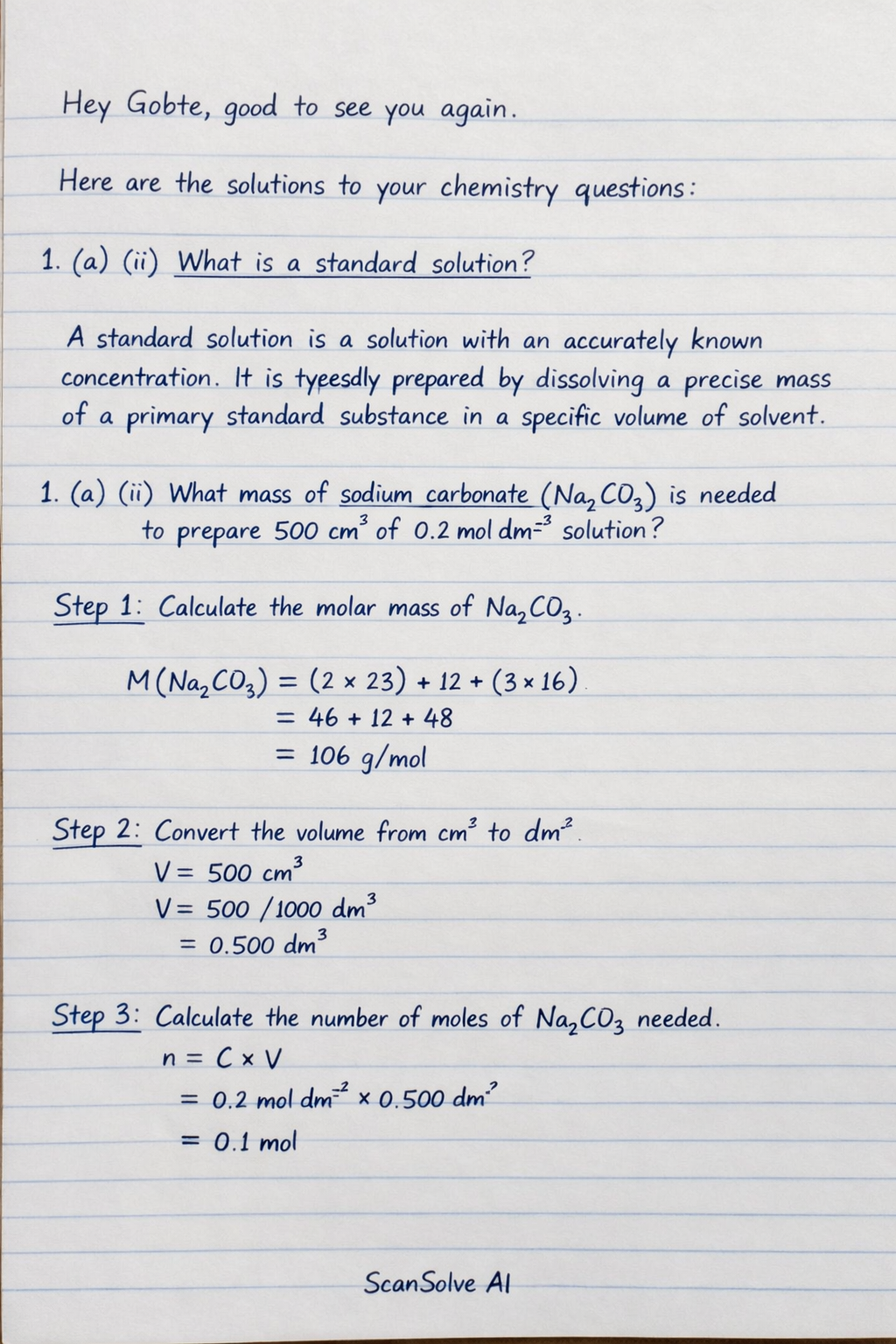
Here are the solutions to your chemistry questions:

1. (a) (i) What is a standard solution?
A standard solution is a solution with an accurately known concentration. It is typically prepared by dissolving a precise mass of a primary standard substance in a specific volume of solvent.

1. (a) (ii) What mass of sodium carbonate (Na2CO3\text{Na}_2\text{CO}_3) is needed to prepare 500 cm3\text{cm}^3 of 0.2 moldm−3\text{moldm}^{-3} solution?

  1. Calculate the molar mass of Na2CO3\text{Na}_2\text{CO}_3.

    Using the given atomic masses: Na=23\text{Na} = 23, C=12\text{C} = 12, O=16\text{O} = 16.

    M(Na2CO3)=(2×23)+12+(3×16)=46+12+48=106 g/molM(\text{Na}_2\text{CO}_3) = (2 \times 23) + 12 + (3 \times 16) = 46 + 12 + 48 = 106 \text{ g/mol}
  2. Convert the volume from cm3\text{cm}^3 to dm3\text{dm}^3.

    V=500 cm3=5001000 dm3=0.500 dm3V = 500 \text{ cm}^3 = \frac{500}{1000} \text{ dm}^3 = 0.500 \text{ dm}^3
  3. Calculate the number of moles of Na2CO3\text{Na}_2\text{CO}_3 needed.

    Moles(n)=Concentration(C)×Volume(V)\text{Moles} (n) = \text{Concentration} (C) \times \text{Volume} (V) n=0.2 moldm−3×0.500 dm3=0.1 moln = 0.2 \text{ moldm}^{-3} \times 0.500 \text{ dm}^3 = 0.1 \text{ mol}
  4. Calculate the mass of Na2CO3\text{Na}_2\text{CO}_3 needed.

    Mass(m)=Moles(n)×Molar mass(M)\text{Mass} (m) = \text{Moles} (n) \times \text{Molar mass} (M) m=0.1 mol×106 g/mol=10.6 gm = 0.1 \text{ mol} \times 106 \text{ g/mol} = 10.6 \text{ g}

    The mass of sodium carbonate needed is 10.6 g\boxed{\text{10.6 g}}.

    1. (a) (iii) How much water is needed to dilute the solution in a (ii) to 0.04 moldm−3\text{moldm}^{-3}?

  5. Identify the initial concentration and volume.

    From part (ii), the initial concentration C1=0.2 moldm−3C_1 = 0.2 \text{ moldm}^{-3} and initial volume V1=500 cm3V_1 = 500 \text{ cm}^3.
    The final concentration C2=0.04 moldm−3C_2 = 0.04 \text{ moldm}^{-3}.

  6. Use the dilution formula C1V1=C2V2C_1V_1 = C_2V_2 to find the final volume (V2V_2).

    0.2 moldm−3×500 cm3=0.04 moldm−3×V20.2 \text{ moldm}^{-3} \times 500 \text{ cm}^3 = 0.04 \text{ moldm}^{-3} \times V_2 100=0.04×V2100 = 0.04 \times V_2 V2=1000.04=2500 cm3V_2 = \frac{100}{0.04} = 2500 \text{ cm}^3
  7. Calculate the volume of water needed to be added.

    Volume of water added=V2−V1\text{Volume of water added} = V_2 - V_1 Volume of water added=2500 cm3−500 cm3=2000 cm3\text{Volume of water added} = 2500 \text{ cm}^3 - 500 \text{ cm}^3 = 2000 \text{ cm}^3

    The volume of water needed is 2000 cm3\boxed{\text{2000 cm}^3}.

    1. (b) In a titration experiment, 25 cm3\text{cm}^3 of sodium chloride solution completely reacted with 20 cm3\text{cm}^3 of a 0.1 moldm−3\text{moldm}^{-3} solution of silver nitrate.

    1. (b) (i) Which indicator is suitable for this titration?
    For the titration of sodium chloride with silver nitrate (argentometric titration), potassium chromate (K2CrO4\text{K}_2\text{CrO}_4) is a suitable indicator (Mohr's method). It forms a red-brown precipitate of silver chromate at the endpoint.
    The suitable indicator is Potassium chromate\boxed{\text{Potassium chromate}}.

    1. (b) (ii) Calculate the molarity of the sodium chloride solution.

  8. Write the balanced chemical equation for the reaction.

    NaCl(aq)+AgNO3(aq)→AgCl(s)+NaNO3(aq)\text{NaCl}(aq) + \text{AgNO}_3(aq) \to \text{AgCl}(s) + \text{NaNO}_3(aq)

    The mole ratio of NaCl\text{NaCl} to AgNO3\text{AgNO}_3 is 1:1.

  9. Calculate the number of moles of AgNO3\text{AgNO}_3 used.

    Moles of AgNO3=Concentration×Volume\text{Moles of AgNO}_3 = \text{Concentration} \times \text{Volume} VAgNO3=20 cm3=0.020 dm3V_{\text{AgNO}_3} = 20 \text{ cm}^3 = 0.020 \text{ dm}^3 nAgNO3=0.1 moldm−3×0.020 dm3=0.002 moln_{\text{AgNO}_3} = 0.1 \text{ moldm}^{-3} \times 0.020 \text{ dm}^3 = 0.002 \text{ mol}
  10. Determine the number of moles of NaCl\text{NaCl} reacted.

    From the 1:1 mole ratio,

    nNaCl=nAgNO3=0.002 moln_{\text{NaCl}} = n_{\text{AgNO}_3} = 0.002 \text{ mol}
  11. Calculate the molarity of the sodium chloride solution.

    VNaCl=25 cm3=0.025 dm3V_{\text{NaCl}} = 25 \text{ cm}^3 = 0.025 \text{ dm}^3 Molarity of NaCl=Moles of NaClVolume of NaCl\text{Molarity of NaCl} = \frac{\text{Moles of NaCl}}{\text{Volume of NaCl}} CNaCl=0.002 mol0.025 dm3=0.08 moldm−3C_{\text{NaCl}} = \frac{0.002 \text{ mol}}{0.025 \text{ dm}^3} = 0.08 \text{ moldm}^{-3}

    The molarity of the sodium chloride solution is 0.08 moldm−3\boxed{\text{0.08 moldm}^{-3}}.

    1. (c) Complete the table below by filling in the coordination number and the number of particles present for the unit cells mentioned.

    Type of unit cellCoordination numberNumber of particles per unit cell
    Cubic close pack or face centered cubic124
Was this helpful?

Still stuck on this one?

Ask a follow-up, and the answer starts from this question.

Got a different question?Ask your own question
Handwritten step-by-step solution preview

Handwritten Step-by-Step Solution

Get this as a handwritten image on WhatsApp — like a tutor wrote it for you.

Try on WhatsApp