We read your photo as:

Define a standard solution. (i) How would you prepare 500 cm³ of 0.2 mol/dm³ sodium carbonate solution from solid sodium carbonate? (ii) How would you dilute 500 cm³ of 0.2 mol/dm³ sodium carbonate so

Chemistry

ScanSolve AI Answer

Step-by-step solution

10 steps

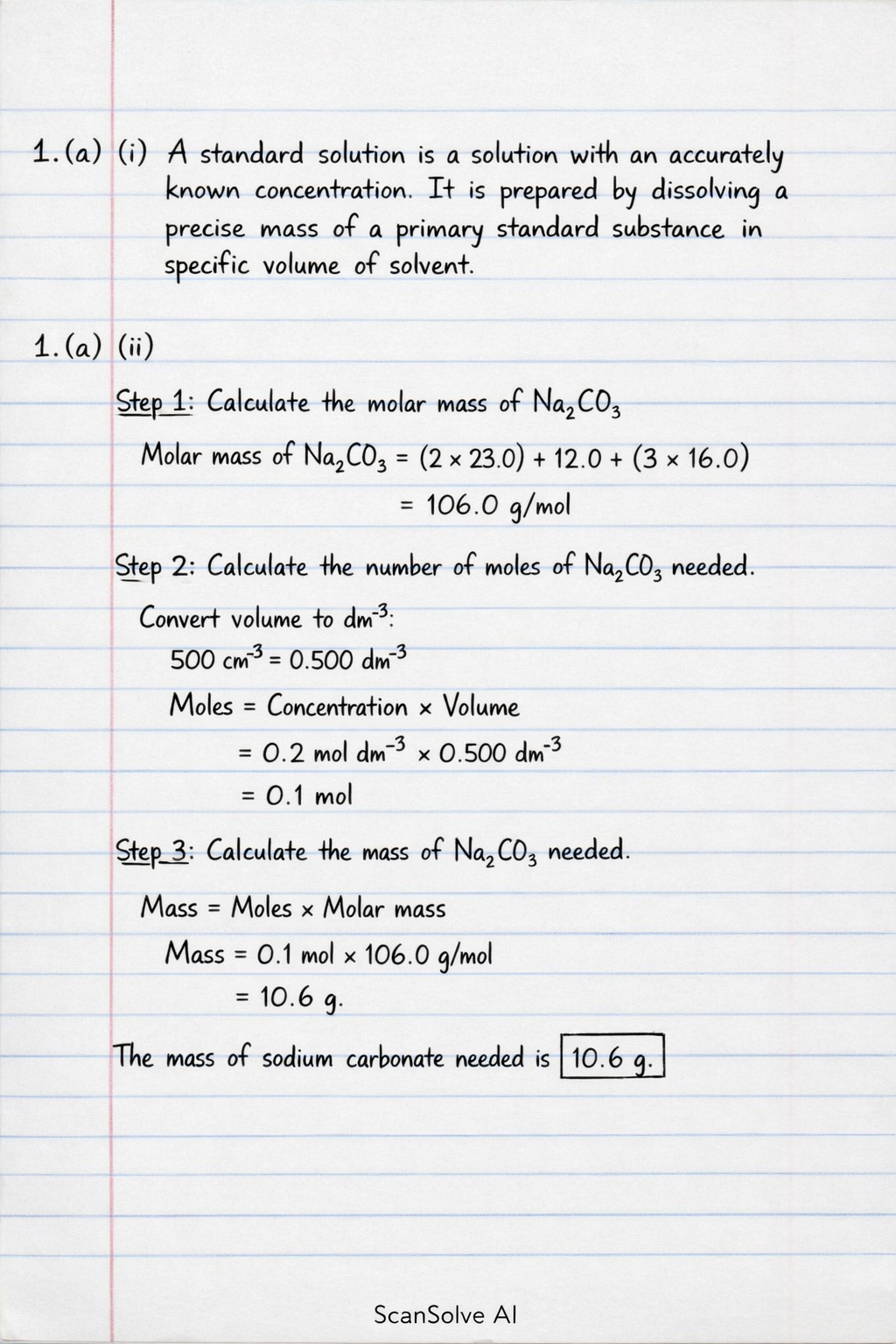
1. (a) (i) A standard solution is a solution with an accurately known concentration. It is prepared by dissolving a precise mass of a primary standard substance in a specific volume of solvent.

1. (a) (ii)

  1. Calculate the molar mass of Na2CO3\text{Na}_2\text{CO}_3.

    Molar mass of Na2CO3=(2×23.0)+12.0+(3×16.0)=106.0 g/mol\text{Molar mass of } \text{Na}_2\text{CO}_3 = (2 \times 23.0) + 12.0 + (3 \times 16.0) = 106.0 \text{ g/mol}
  2. Calculate the number of moles of Na2CO3\text{Na}_2\text{CO}_3 needed.

    Convert volume to dm3\text{dm}^3:

    500 cm3=0.500 dm3500 \text{ cm}^3 = 0.500 \text{ dm}^3

    Use the formula Moles=Concentration×Volume\text{Moles} = \text{Concentration} \times \text{Volume}:

    Moles=0.2 moldm−3×0.500 dm3=0.1 mol\text{Moles} = 0.2 \text{ moldm}^{-3} \times 0.500 \text{ dm}^3 = 0.1 \text{ mol}
  3. Calculate the mass of Na2CO3\text{Na}_2\text{CO}_3 needed.

    Use the formula Mass=Moles×Molar mass\text{Mass} = \text{Moles} \times \text{Molar mass}:

    Mass=0.1 mol×106.0 g/mol=10.6 g\text{Mass} = 0.1 \text{ mol} \times 106.0 \text{ g/mol} = 10.6 \text{ g}

    The mass of sodium carbonate needed is 10.6 g\boxed{\text{10.6 g}}.

    1. (a) (iii)

  4. Use the dilution formula M1V1=M2V2M_1V_1 = M_2V_2.

    Given:
    M1=0.2 moldm−3M_1 = 0.2 \text{ moldm}^{-3}
    V1=500 cm3V_1 = 500 \text{ cm}^3
    M2=0.04 moldm−3M_2 = 0.04 \text{ moldm}^{-3}

  5. Calculate the final volume V2V_2.

    V2=M1V1M2=0.2 moldm−3×500 cm30.04 moldm−3=2500 cm3V_2 = \frac{M_1V_1}{M_2} = \frac{0.2 \text{ moldm}^{-3} \times 500 \text{ cm}^3}{0.04 \text{ moldm}^{-3}} = 2500 \text{ cm}^3
  6. Calculate the volume of water to be added.

    Volume of water added=V2−V1=2500 cm3−500 cm3=2000 cm3\text{Volume of water added} = V_2 - V_1 = 2500 \text{ cm}^3 - 500 \text{ cm}^3 = 2000 \text{ cm}^3

    The volume of water needed is 2000 cm3\boxed{\text{2000 cm}^3}.

    1. (b) (i) The titration involves NaCl\text{NaCl} and AgNO3\text{AgNO}_3, which forms AgCl\text{AgCl} precipitate. This is a precipitation titration.
    The suitable indicator is Potassium chromate (K2CrO4\text{K}_2\text{CrO}_4).

    1. (b) (ii)

  7. Write the balanced chemical equation.

    NaCl(aq)+AgNO3(aq)→AgCl(s)+NaNO3(aq)\text{NaCl(aq)} + \text{AgNO}_3\text{(aq)} \rightarrow \text{AgCl(s)} + \text{NaNO}_3\text{(aq)}

    The mole ratio of NaCl\text{NaCl} to AgNO3\text{AgNO}_3 is 1:1.

  8. Calculate the moles of AgNO3\text{AgNO}_3 reacted.

    Convert volume to dm3\text{dm}^3:

    20 cm3=0.020 dm320 \text{ cm}^3 = 0.020 \text{ dm}^3 Moles of AgNO3=Concentration×Volume=0.1 moldm−3×0.020 dm3=0.002 mol\text{Moles of } \text{AgNO}_3 = \text{Concentration} \times \text{Volume} = 0.1 \text{ moldm}^{-3} \times 0.020 \text{ dm}^3 = 0.002 \text{ mol}
  9. Determine the moles of NaCl\text{NaCl} reacted.

    From the 1:1 mole ratio:

    Moles of NaCl=0.002 mol\text{Moles of } \text{NaCl} = 0.002 \text{ mol}
  10. Calculate the molarity of the NaCl\text{NaCl} solution.

    Convert volume to dm3\text{dm}^3:

    25 cm3=0.025 dm325 \text{ cm}^3 = 0.025 \text{ dm}^3 Molarity of NaCl=Moles of NaClVolume of NaCl solution=0.002 mol0.025 dm3=0.08 moldm−3\text{Molarity of } \text{NaCl} = \frac{\text{Moles of NaCl}}{\text{Volume of NaCl solution}} = \frac{0.002 \text{ mol}}{0.025 \text{ dm}^3} = 0.08 \text{ moldm}^{-3}

    The molarity of the sodium chloride solution is 0.08 moldm−3\boxed{\text{0.08 moldm}^{-3}}.

    1. (c)

    Type of unit cellCoordination numberNumber of particles per unit cell
    Cubic close pack or face centered cubic124
    Body centered cubic82

    1. (d) (i) Lattice energy is the energy change that occurs when one mole of an ionic compound is formed from its gaseous ions under standard conditions. It represents the strength of the electrostatic forces between ions in a crystal lattice.

Was this helpful?

Still stuck on this one?

Ask a follow-up, and the answer starts from this question.

Got a different question?Ask your own question
Handwritten step-by-step solution preview

Handwritten Step-by-Step Solution

Get this as a handwritten image on WhatsApp — like a tutor wrote it for you.

Try on WhatsApp