

This chemistry question involves key chemical concepts and calculations. The detailed solution below walks through each step, from identifying the reaction type to computing the final answer.
ScanSolve AI Answer
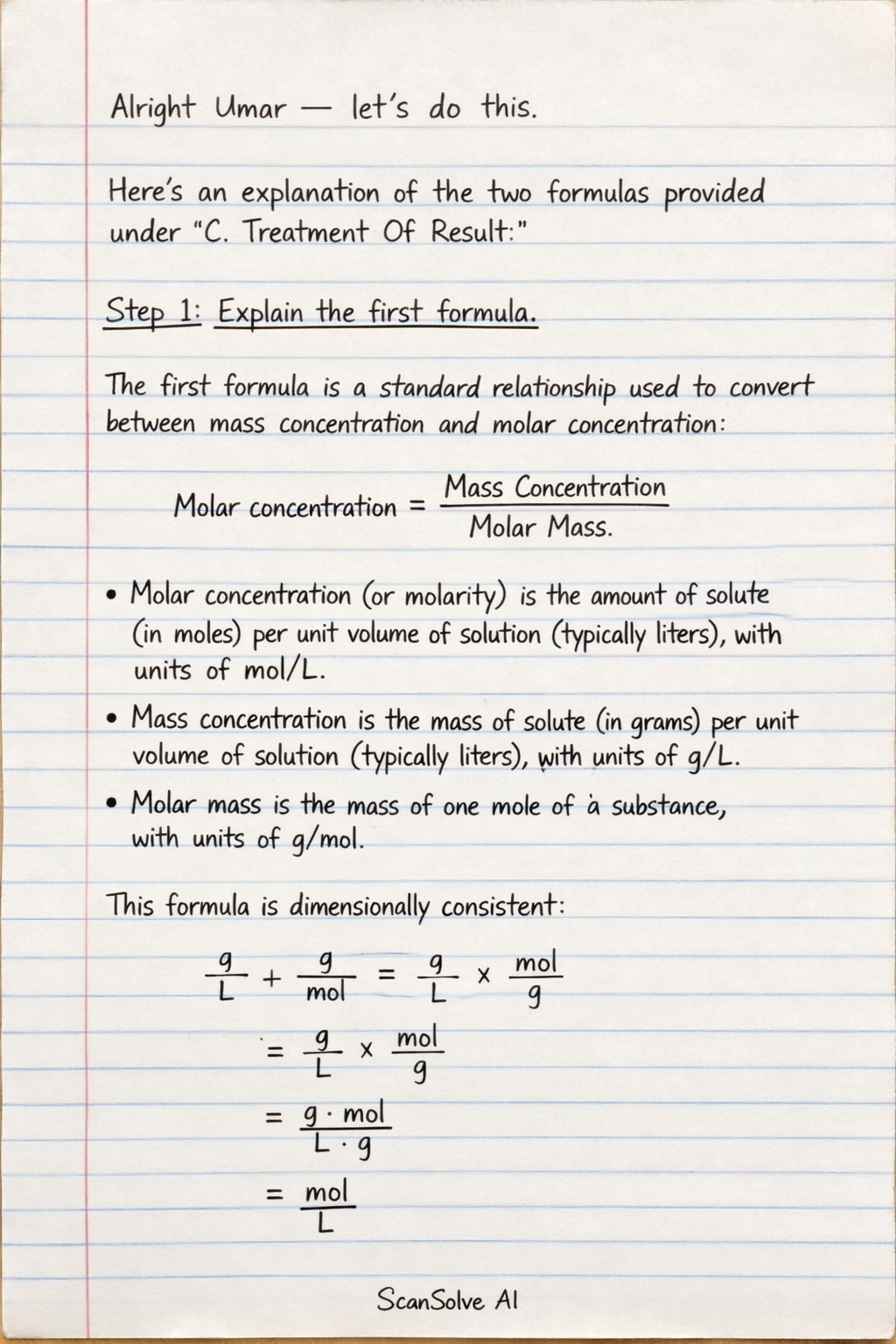
Here's an explanation of the two formulas provided under "C. Treatment Of Result": Step 1: Explain the first formula. The first formula is a standard relationship used to convert between mass concentration and molar concentration: Molar concentration = Mass ConcentrationMolar Mass • Molar concentration (or molarity) is the amount of solute (in moles) per unit volume of solution (typically liters), with units of mol/L. • Mass concentration is the mass of solute (in grams) per unit volume of solution (typically liters), with units of g/L. • Molar mass is the mass of one mole of a substance, with units of g/mol. This formula is dimensionally consistent: g/Lg/mol = g/L × molg = mol/L. Step 2: Analyze the second formula. The second formula is given as: Mass Concentration of Anhydrous/Molar Mass Anhydrous / Molar Mass of Hydrated = Molar Concentration of hydrated Let's represent this mathematically: Mass Concentration of AnhydrousMolar Mass AnhydrousMolar Mass of Hydrated = Molar Concentration of hydrated This simplifies to: Mass Concentration of AnhydrousMolar Mass Anhydrous × Molar Mass of Hydrated = Molar Concentration of hydrated Let's check the units for this expression: g/Lg/mol × g/mol = gL × mol^2g^2 = mol^2L · g This unit (mol^2/(L · g)) is not equivalent to mol/L, which is the unit for molar concentration. Therefore, the formula as written is dimensionally incorrect. Step 3: Provide the correct interpretation. The term Mass Concentration of AnhydrousMolar Mass Anhydrous correctly calculates the molar concentration of the anhydrous component (e.g., Na_2CO_3) in the solution. Since one mole of a hydrated salt (Na_2CO_3 · xH_2O) contains one mole of its anhydrous component (Na_2CO_3), the molar concentration of the hydrated salt is equal to the molar concentration of its anhydrous component. Thus, the correct formula to calculate the molar concentration of the hydrated salt from the mass concentration of its anhydrous component would be: Molar Concentration of hydrated = Mass Concentration of AnhydrousMolar Mass Anhydrous The additional division by "Molar Mass of Hydrated" in the provided formula is incorrect.