
We read your photo as:
Identify lab equipment A-F and describe how to prepare 250 cm³ of 1.0 M sodium chloride solution.
ScanSolve AI Answer
Answers
2 partsStep-by-step solution
10 stepsHere are the answers to the questions:
Part a
Identify each of the apparatus A, B, C, D, E and F
- A: Volumetric flask
- B: Measuring cylinder
- C: Beaker
- D: Wash bottle
- E: Filter funnel
- F: Stirring rod
Part b
What is the volume of the distilled water in B?
The water level in the measuring cylinder (B) is at the 200 cm³ mark.
The volume of distilled water in B is .
Part c· 7 steps
Describe how 250 cm³ of 1.0 M sodium chloride solution is prepared using the materials above.
Calculate the mass of sodium chloride (NaCl) needed.
Weigh out 14.625 g of sodium chloride using an electronic balance (not shown).
Transfer the weighed sodium chloride into a beaker (C).
Add a small amount of distilled water from the wash bottle (D) to the beaker and stir with a stirring rod (F) until the sodium chloride completely dissolves.
Carefully transfer the solution from the beaker into the 250 cm³ volumetric flask (A) using a filter funnel (E).
Rinse the beaker and the funnel several times with small amounts of distilled water from the wash bottle (D), adding the rinsings to the volumetric flask to ensure all solute is transferred.
Add distilled water to the volumetric flask until the bottom of the meniscus reaches the 250 cm³ calibration mark.
Stopper the volumetric flask and invert it several times to ensure the solution is thoroughly mixed.
Part d
Determine the volume of the distilled water that will remain in B after the preparation.
Identify the initial volume of distilled water in apparatus B.
The initial volume of distilled water in B is 200 cm³.
Consider the total volume of solution to be prepared.
The total volume of the sodium chloride solution to be prepared is 250 cm³. This means approximately 250 cm³ of distilled water will be used in total to dissolve the solute and make up the final volume.
Compare the available water in B with the required water.
Since the preparation requires approximately 250 cm³ of distilled water and apparatus B only contains 200 cm³, all the distilled water from B will be used, and additional distilled water will be needed from another source (e.g., the wash bottle D) to reach the final volume.
The volume of distilled water that will remain in B is .
Try one yourself
A new problem that tests the same skill.
Still stuck on this one?
Ask a follow-up, and the answer starts from this question.
More Chemistry Questions
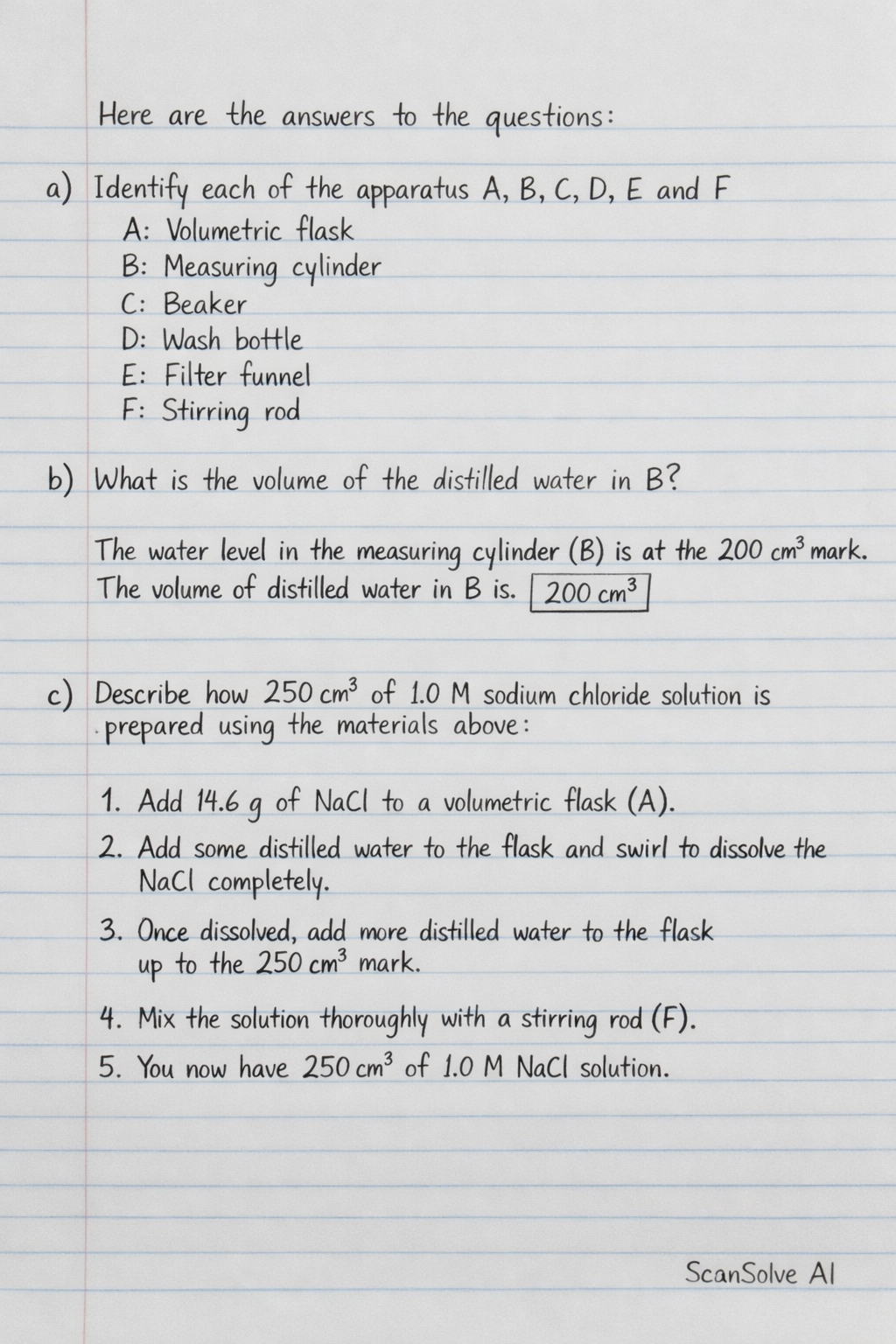
Handwritten Step-by-Step Solution
Get this as a handwritten image on WhatsApp — like a tutor wrote it for you.
Try on WhatsApp