
We read your photo as:
If n resistors, each of resistance r ohms, are connected in parallel, the equivalent resistance is R. What would be the equivalent resistance if they were connected in series?
ScanSolve AI Answer
Answer
Step-by-step solution
3 stepsDetermine the relationship between , , and for the parallel connection.
When resistors, each of resistance , are connected in parallel, the equivalent resistance is given by the formula:
From this equation, we can express in terms of and :
Calculate the equivalent resistance if the resistors were connected in series.
If the same resistors, each of resistance , were connected in series, the equivalent resistance would be:
Substitute the value of from Step 1 into the series resistance formula.
Substitute into the equation for :
The equivalent resistance of the combination if connected in series would be .
Comparing this with the given options:
[A]
[B]
[C]
[D]The calculated resistance matches option [A].
The final answer is .
Try one yourself
A new problem that tests the same skill.
Still stuck on this one?
Ask a follow-up, and the answer starts from this question.
More Physics Questions
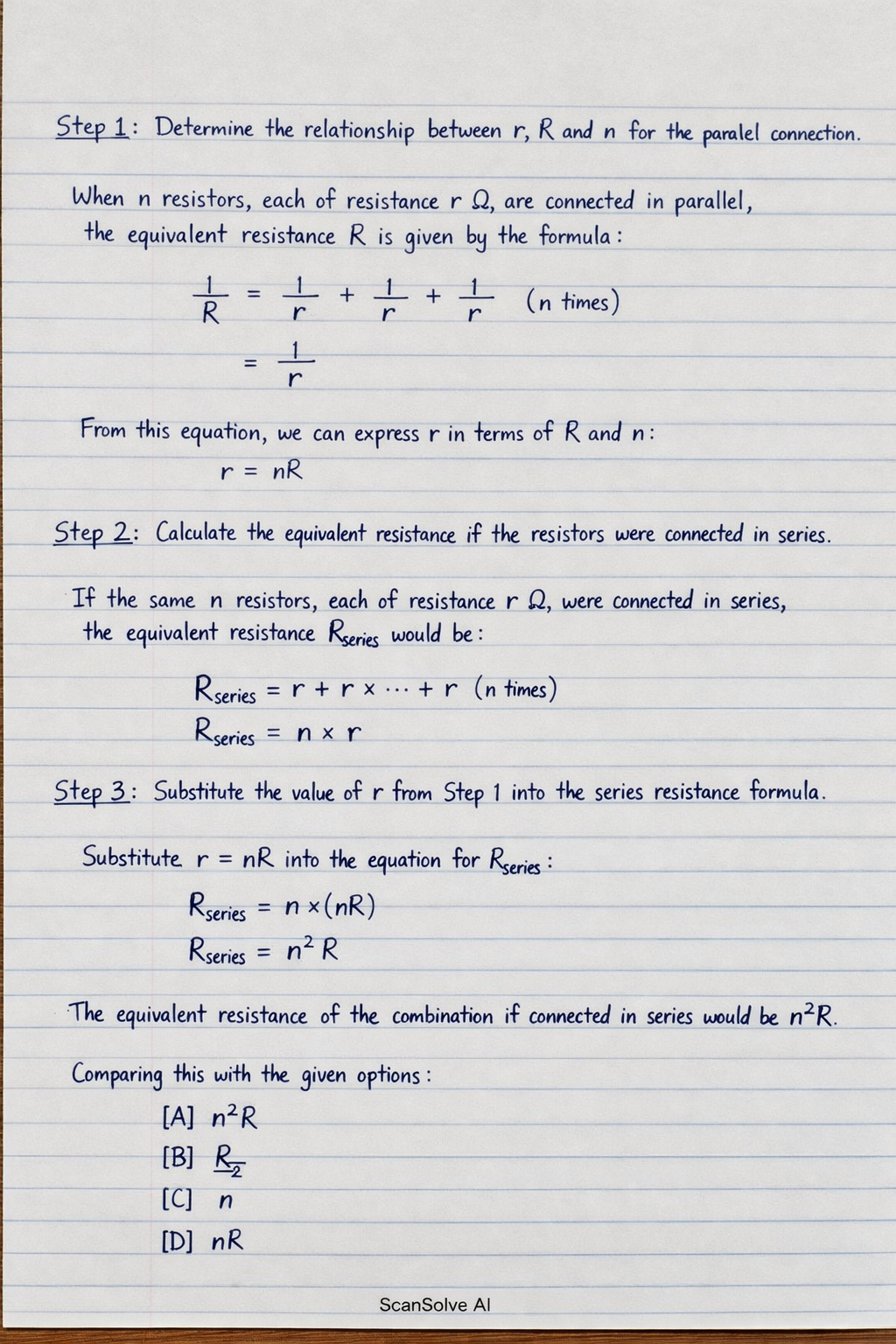
Handwritten Step-by-Step Solution
Get this as a handwritten image on WhatsApp — like a tutor wrote it for you.
Try on WhatsApp