
We read your photo as:
If the length of a simple pendulum is increased by a factor of 4, by what factor does its period of oscillation increase?
ScanSolve AI Answer
Answers
2 partsStep-by-step solution
7 stepsPart 10· 3 steps
Period of a simple pendulum
Recall the formula for the period of a simple pendulum.
The period () of a simple pendulum is given by:
Where is the length of the pendulum and is the acceleration due to gravity.
Analyze the relationship between the period and length.
From the formula, the period is directly proportional to the square root of the length :
Determine the change in period when the length is increased by a factor of 4.
Let the original length be and the original period be .
Where is a constant.
If the length is increased by a factor of 4, the new length .
The new period will be:The new period is twice the original period, meaning it is increased by a factor of 2.
The period will be .
Part 11
Value of external resistance R
Identify the given information.
Internal resistance of the cell, .
The terminal voltage () is reduced to of its nominal value (EMF, ). So, .Recall the formula for terminal voltage.
The terminal voltage () across an external resistance () connected to a cell with EMF () and internal resistance () is given by:
Substitute the given values into the formula.
We have and .
Solve for R.
Divide both sides by (assuming ):
Cross-multiply:
Subtract from both sides:
Divide by 2:
The value of R is .
Try one yourself
A new problem that tests the same skill.
Still stuck on this one?
Ask a follow-up, and the answer starts from this question.
More Physics Questions
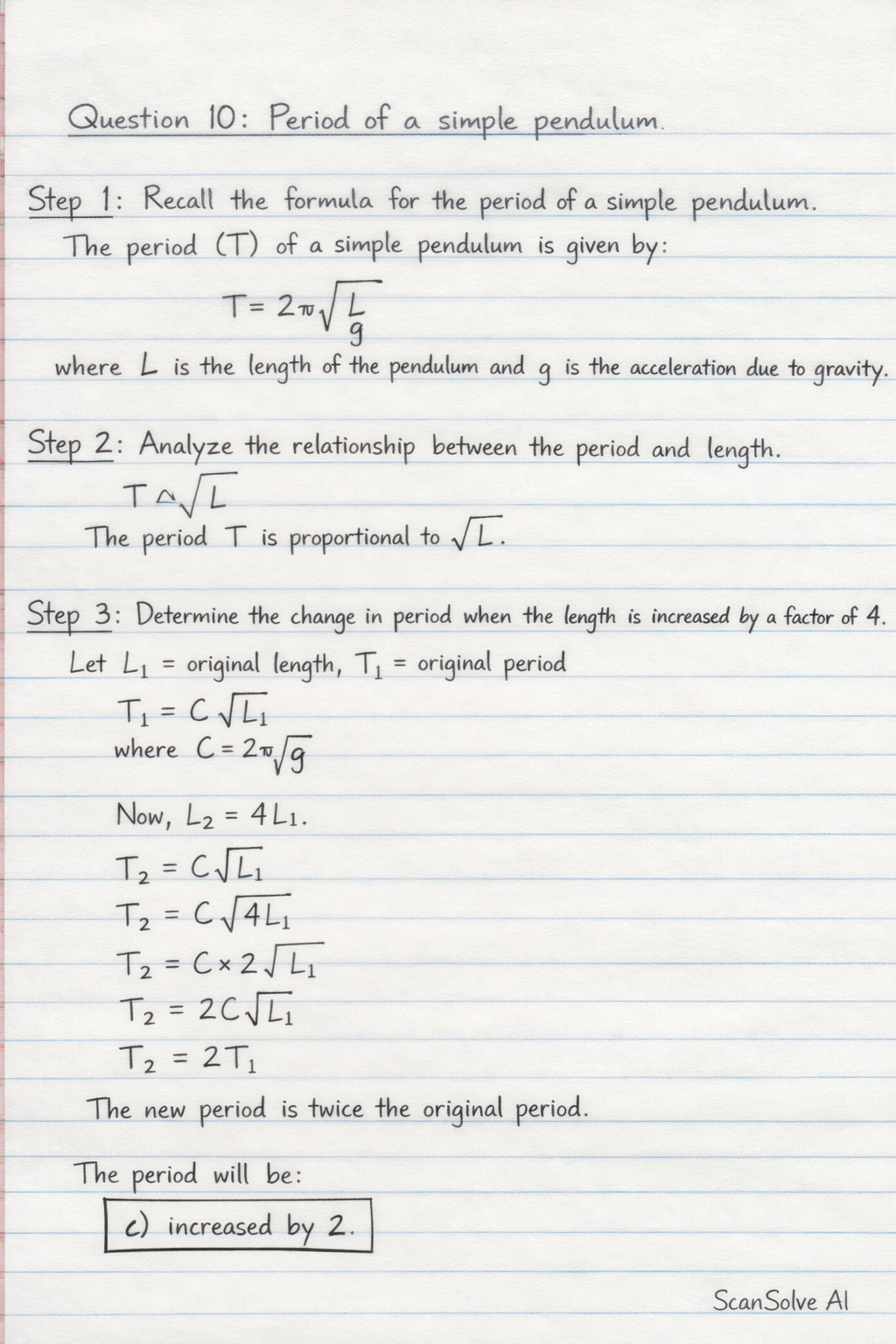
Handwritten Step-by-Step Solution
Get this as a handwritten image on WhatsApp — like a tutor wrote it for you.
Try on WhatsApp