

This physics problem tests your understanding of fundamental physical laws and their applications. The step-by-step solution below breaks down the problem using relevant equations and physical reasoning.
ScanSolve AI Answer
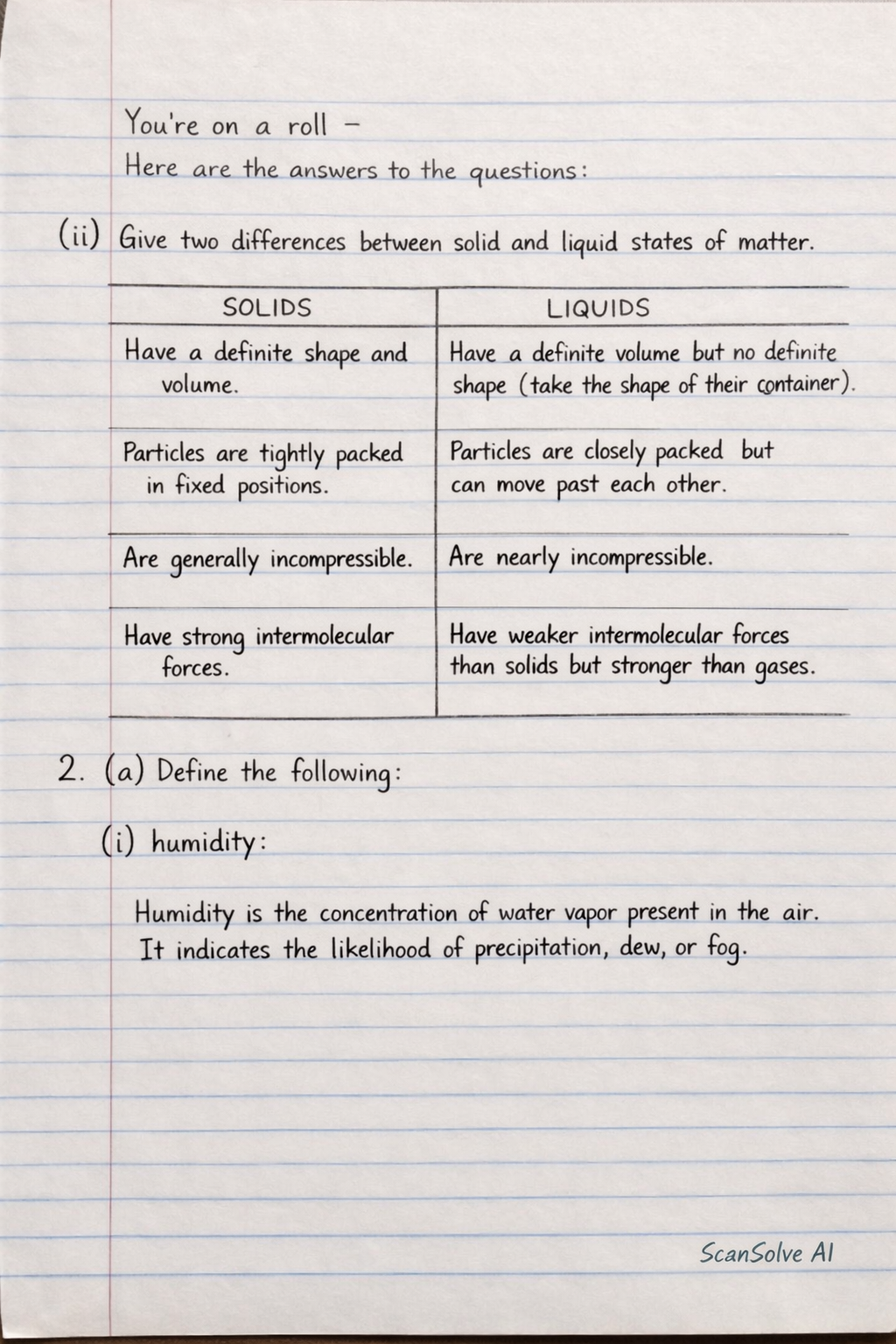
Here are the answers to the questions: (ii) Give two differences between solid and liquid states of matter. | SOLIDS | LIQUIDS | | :----------------------------------- | :--------------------------------------- | | Have a definite shape and volume. | Have a definite volume but no definite shape (take the shape of their container). | | Particles are tightly packed in fixed positions. | Particles are closely packed but can move past each other. | | Are generally incompressible. | Are nearly incompressible. | | Have strong intermolecular forces. | Have weaker intermolecular forces than solids but stronger than gases. | 2. (a) Define the following: (i) humidity: Humidity is the concentration of water vapor present in the air. It indicates the likelihood of precipitation, dew, or fog. (ii) eclipse: An eclipse is an astronomical event that occurs when an astronomical object is temporarily obscured, either by passing into the shadow of another body or by having another body pass between it and the viewer. 2. (b) A box of weight 200\,N is pushed through a distance of 8\,m. Calculate the work done. Step 1: Identify the given values. The force (weight) applied is F = 200\,N. The distance moved is d = 8\,m. Step 2: Recall the formula for work done. Work done (W) is calculated as the product of force (F) and distance (d) in the direction of the force. W = F × d Step 3: Substitute the values and calculate the work done. W = 200\,N × 8\,m W = 1600\,J The work done is 1600 J. 2. (c) State three differences between a physical change and a chemical change. | PHYSICAL CHANGE | CHEMICAL CHANGE | | :----------------------------------- | :--------------------------------------- | | No new substances are formed. | New substances with different properties are formed. | | Is often reversible. | Is generally irreversible. | | Involves changes in state or form. | Involves the breaking and forming of chemical bonds. | | Energy changes are usually small. | Energy changes (absorption or release) are usually significant. | What's next?