
We read your photo as:
Explain image formation in a plane mirror and how to read Vernier calipers with an example.
ScanSolve AI Answer
Step-by-step solution
4 stepsHere are the solutions to your questions:
-
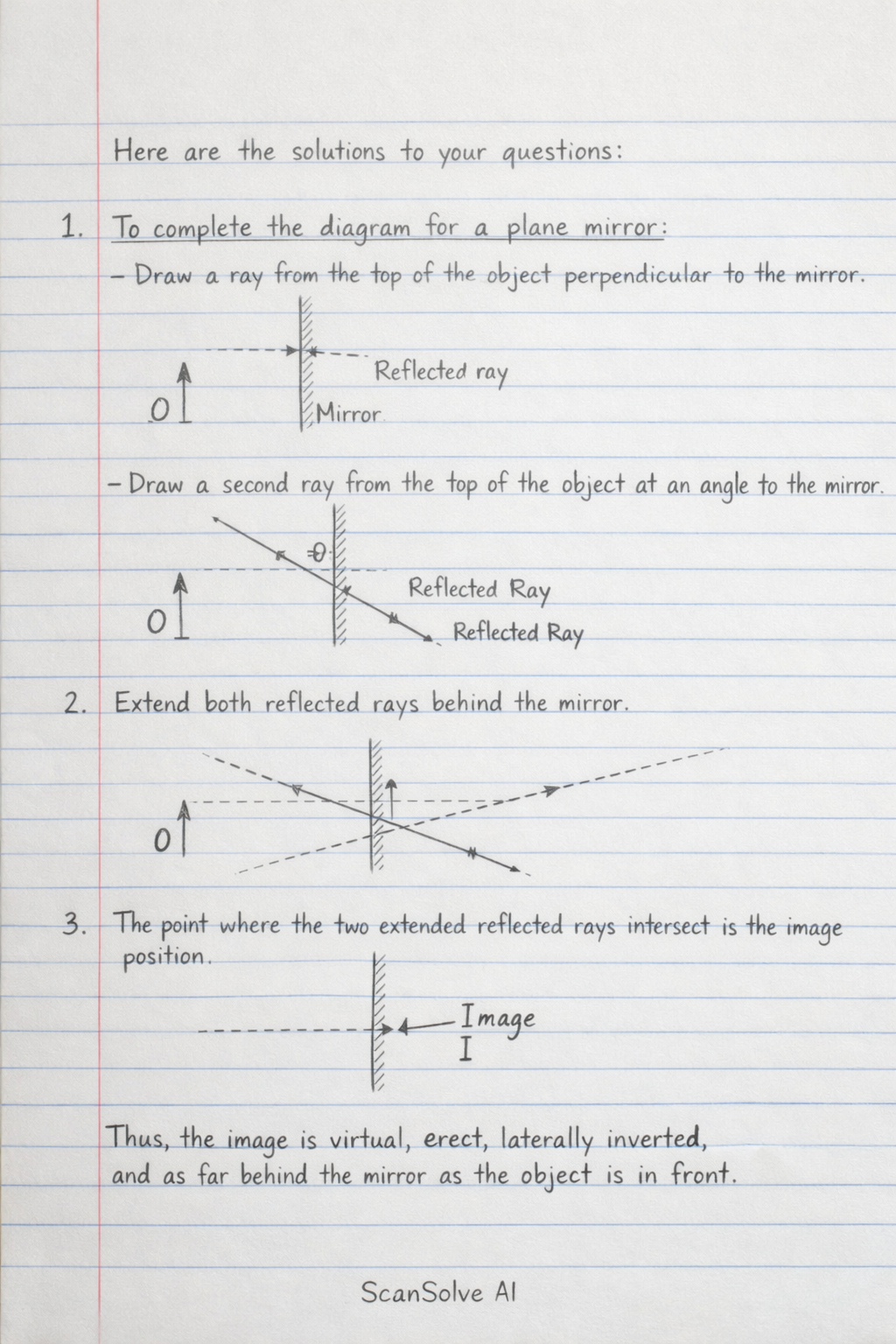
To complete the diagram for a plane mirror:
- Draw a ray from the top of the object perpendicular to the mirror. This ray reflects back along the same path. Extend this reflected ray behind the mirror.
- Draw a second ray from the top of the object to the mirror at an angle. This ray reflects such that the angle of incidence equals the angle of reflection. Extend this reflected ray behind the mirror.
- The point where the two extended reflected rays intersect behind the mirror is the position of the image.
- The image formed by a plane mirror is virtual, erect, laterally inverted, and located as far behind the mirror as the object is in front.
-
To determine the correct reading of the Vernier calipers:
Read the Main Scale Reading (MSR).
The zero mark of the Vernier scale is past $7.6 \text{ cm}$. $$ \text{MSR} = 7.6 \text{ cm} $$Read the Vernier Scale Reading (VSR).
The 4th mark on the Vernier scale coincides with a mark on the main scale. The least count of a standard Vernier caliper is $0.01 \text{ cm}$. $$ \text{VSR} = 4 \times 0.01 \text{ cm} = 0.04 \text{ cm} $$Calculate the Observed Reading.
$$ \text{Observed Reading} = \text{MSR} + \text{VSR} = 7.6 \text{ cm} + 0.04 \text{ cm} = 7.64 \text{ cm} $$Apply the Zero Error correction.
The zero error is given as $-0.02 \text{ cm}$. $$ \text{Correct Reading} = \text{Observed Reading} - \text{Zero Error} $$ $$ \text{Correct Reading} = 7.64 \text{ cm} - (-0.02 \text{ cm}) = 7.64 \text{ cm} + 0.02 \text{ cm} = \boxed{7.66 \text{ cm}} $$3. Two factors that affect the rate of diffusion are: - Temperature: Higher temperatures increase the kinetic energy of particles, leading to faster diffusion. - Concentration gradient: A steeper concentration gradient (larger difference in concentration) results in a faster rate of diffusion.
-
In a vacuum flask, heat loss by radiation is minimized by silvering the inner and outer surfaces of the glass walls. The shiny, reflective surfaces reflect infrared radiation (heat) back into the flask or away from it, preventing its transfer.
-
The question regarding the longitudinal wave is incomplete. Please provide the full question.
-
Still stuck on this one?
Ask a follow-up, and the answer starts from this question.
More Physics Questions
Handwritten Step-by-Step Solution
Get this as a handwritten image on WhatsApp — like a tutor wrote it for you.
Try on WhatsApp