
We read your photo as:
Explain image formation by concave and convex mirrors based on object position.
ScanSolve AI Answer
Step-by-step solution
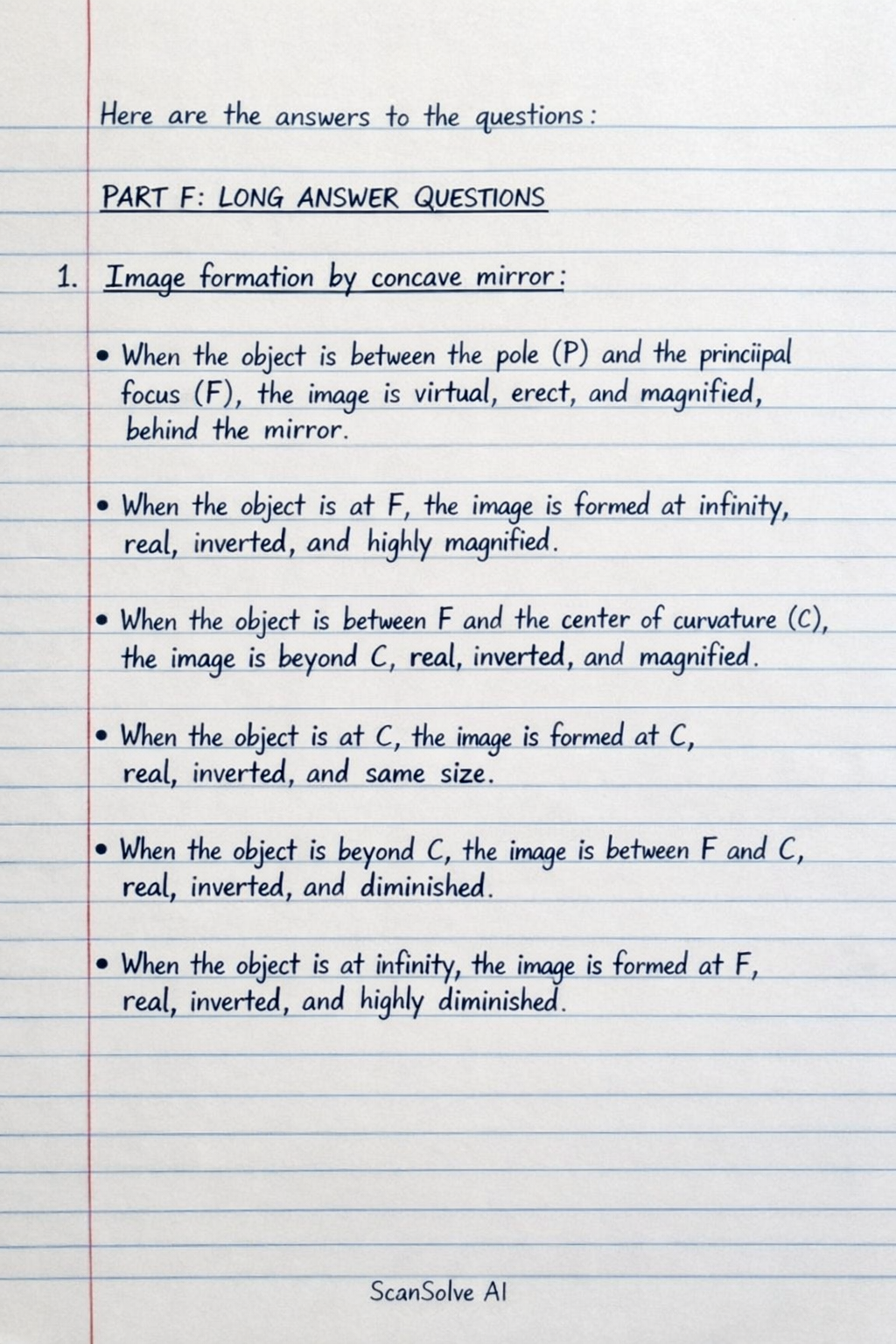
5 stepsHere are the answers to the questions:
Part f· 5 steps
LONG ANSWER QUESTIONS
Image formation by concave mirror
A concave mirror forms different types of images depending on the object's position.
- When the object is placed between the pole (P) and the principal focus (F), the image formed is virtual, erect, and magnified, behind the mirror.
- When the object is at F, the image is formed at infinity, real, inverted, and highly magnified.
- When the object is between F and the center of curvature (C), the image is formed beyond C, real, inverted, and magnified.
- When the object is at C, the image is formed at C, real, inverted, and same size.
- When the object is beyond C, the image is formed between F and C, real, inverted, and diminished.
- When the object is at infinity, the image is formed at F, real, inverted, and highly diminished.
Image formation by convex mirror
A convex mirror always forms a virtual, erect, and diminished image, regardless of the object's position.
- When the object is at infinity, the image is formed at the principal focus (F) behind the mirror, virtual, erect, and highly diminished.
- When the object is placed anywhere between infinity and the pole (P) of the mirror, the image is formed between P and F behind the mirror, virtual, erect, and diminished.
Mirror formula
The mirror formula relates the object distance (), image distance (), and focal length () of a spherical mirror. It is given by:
- : Distance of the object from the pole of the mirror.
- : Distance of the image from the pole of the mirror.
- : Focal length of the mirror (distance from the pole to the principal focus). This formula is derived using the laws of reflection and geometry, considering similar triangles formed by the object, image, and rays reflecting off the mirror. It is valid for both concave and convex mirrors, provided the Cartesian sign convention is followed.
Magnification and its significance
Magnification () is the ratio of the height of the image () to the height of the object (). It can also be expressed in terms of object distance () and image distance ().
- Significance of the sign of :
- If is positive, the image is erect (and virtual).
- If is negative, the image is inverted (and real).
- Significance of the magnitude of :
- If , the image is magnified (larger than the object).
- If , the image is the same size as the object.
- If , the image is diminished (smaller than the object).
- Significance of the sign of :
Rules for drawing ray diagrams
Here are the common rules for drawing ray diagrams for spherical mirrors:
- A ray parallel to the principal axis, after reflection, passes through the principal focus (F) in a concave mirror or appears to diverge from F in a convex mirror.
- A ray passing through F in a concave mirror or directed towards F in a convex mirror, after reflection, becomes parallel to the principal axis.
- A ray passing through the center of curvature (C) in a concave mirror or directed towards C in a convex mirror, after reflection, is reflected back along the same path.
- A ray incident obliquely to the principal axis, towards the pole (P) of the mirror, is reflected obliquely, making equal angles with the principal axis.
Part g
ASSERTION-REASON
-
Assertion: Image formed by convex mirror is always virtual Reason: Rays diverge after reflection
- Both Assertion and Reason are true, and the Reason is the correct explanation for the Assertion. A convex mirror is a diverging mirror, meaning it spreads out parallel rays of light. This divergence causes the reflected rays to appear to originate from a point behind the mirror, forming a virtual image.
- Answer: Both A and R are true and R is the correct explanation of A.
-
Assertion: Concave mirror can form real image Reason: Rays converge after reflection
- Both Assertion and Reason are true, and the Reason is the correct explanation for the Assertion. A concave mirror is a converging mirror, meaning it brings parallel rays of light together at a point. This convergence allows it to form real images when the object is placed beyond its focal point.
- Answer: Both A and R are true and R is the correct explanation of A.
-
Assertion: Magnification can be negative Reason: Image can be inverted
- Both Assertion and Reason are true, and the Reason is the correct explanation for the Assertion. A negative magnification value specifically indicates that the image formed is inverted with respect to the object.
- Answer: Both A and R are true and R is the correct explanation of A.
Part h
CASE-BASED QUESTIONS
Case 1: A dentist uses a concave mirror.
- Why is concave mirror used?
- A concave mirror is used to obtain a magnified and erect image of the teeth, allowing the dentist to see small details clearly.
- What type of image is formed?
- The image formed is virtual, erect, and magnified.
- Where is the object placed?
- The object (tooth) is placed between the pole (P) and the principal focus (F) of the concave mirror.
- What is magnification?
- The magnification is positive and greater than 1 ().
Case 2: A driver uses rear-view mirror.
- Which mirror is used?
- A convex mirror is used as a rear-view mirror.
- Why?
- It provides a wider field of view and always forms an erect and diminished image of objects behind the vehicle, helping the driver see a larger area.
- What type of image is formed?
- The image formed is virtual, erect, and diminished.
- Write one limitation
- A limitation is that objects in the mirror appear farther away than they actually are, which can make judging distances difficult.
Still stuck on this one?
Ask a follow-up, and the answer starts from this question.
More Physics Questions
Handwritten Step-by-Step Solution
Get this as a handwritten image on WhatsApp — like a tutor wrote it for you.
Try on WhatsApp