

This physics problem tests your understanding of fundamental physical laws and their applications. The step-by-step solution below breaks down the problem using relevant equations and physical reasoning.
ScanSolve AI Answer
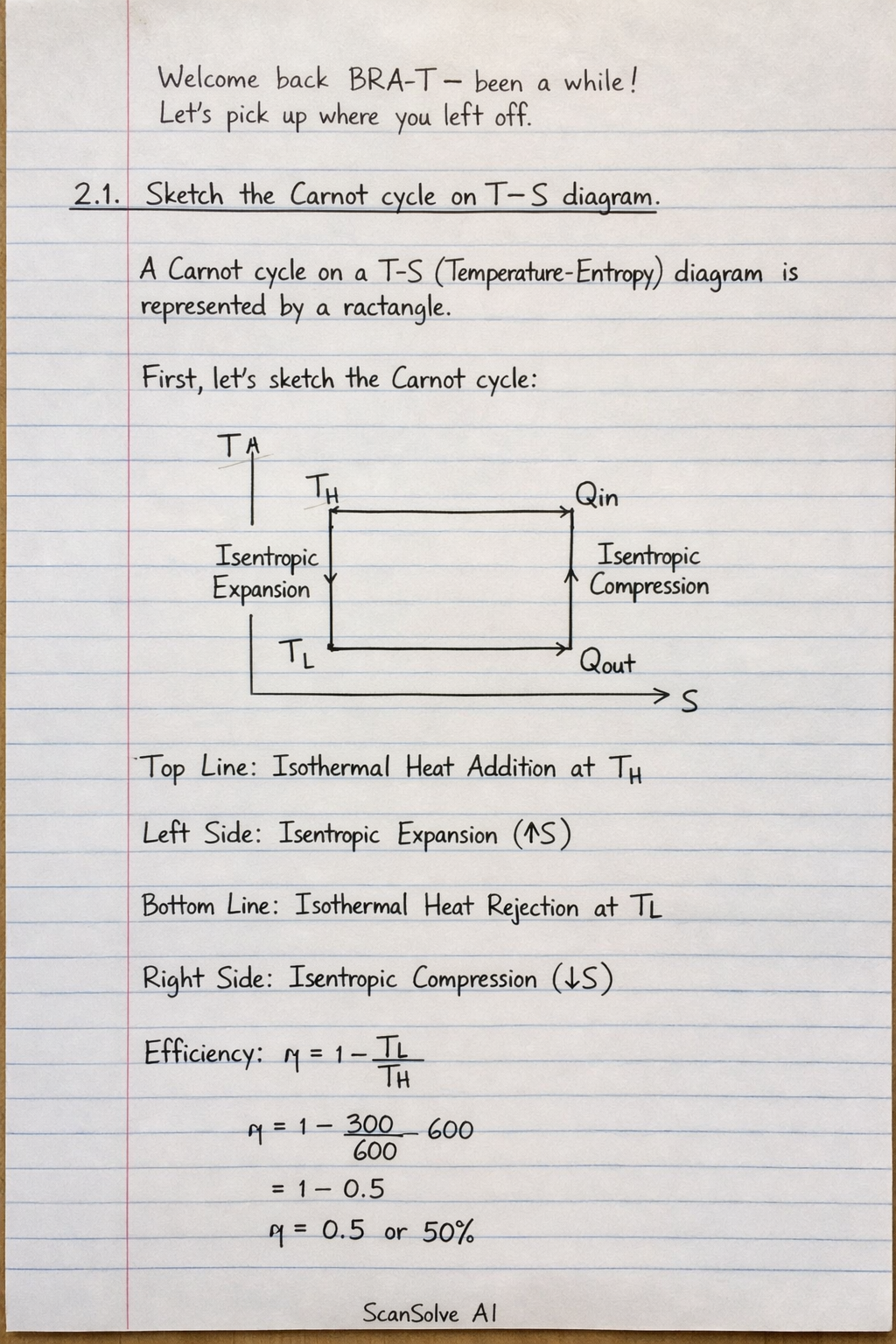
2.1. Sketch the Carnot cycle on T – S diagram. A Carnot cycle on a T-S (Temperature-Entropy) diagram is represented by a rectangle. • The two horizontal lines represent the isothermal processes (constant temperature), where heat is added (T_H) and rejected (T_L). • The two vertical lines represent the isentropic (adiabatic and reversible) processes (constant entropy), where the working fluid expands and compresses. The cycle proceeds as follows: 1. Isothermal heat addition (1-2): A horizontal line from left to right at the higher temperature T_H, indicating an increase in entropy. 2. Isentropic expansion (2-3): A vertical line downwards, indicating a decrease in temperature from T_H to T_L at constant entropy. 3. Isothermal heat rejection (3-4): A horizontal line from right to left at the lower temperature T_L, indicating a decrease in entropy. 4. Isentropic compression (4-1): A vertical line upwards, indicating an increase in temperature from T_L to T_H at constant entropy, completing the cycle. 2.2. Calculate the thermal efficiency. Step 1: Convert the given temperatures from Celsius to Kelvin. The hot reservoir temperature is T_H = 330^. The cold reservoir temperature is T_L = 35^. To convert to Kelvin, add 273.15. T_H = 330 + 273.15 = 603.15 K T_L = 35 + 273.15 = 308.15 K Step 2: Apply the formula for the thermal efficiency of a Carnot cycle. The thermal efficiency (_th) of a Carnot cycle is given by: _th = 1 - (T_L)/(T_H) Step 3: Substitute the values and calculate the efficiency. _th = 1 - 308.15 K603.15 K _th = 1 - 0.510897 _th = 0.489103 Step 4: Express the efficiency as a percentage. _th = 0.489103 × 100\% = 48.91\% The thermal efficiency of the Carnot cycle is: 48.91%