

This physics problem tests your understanding of fundamental physical laws and their applications. The step-by-step solution below breaks down the problem using relevant equations and physical reasoning.
ScanSolve AI Answer
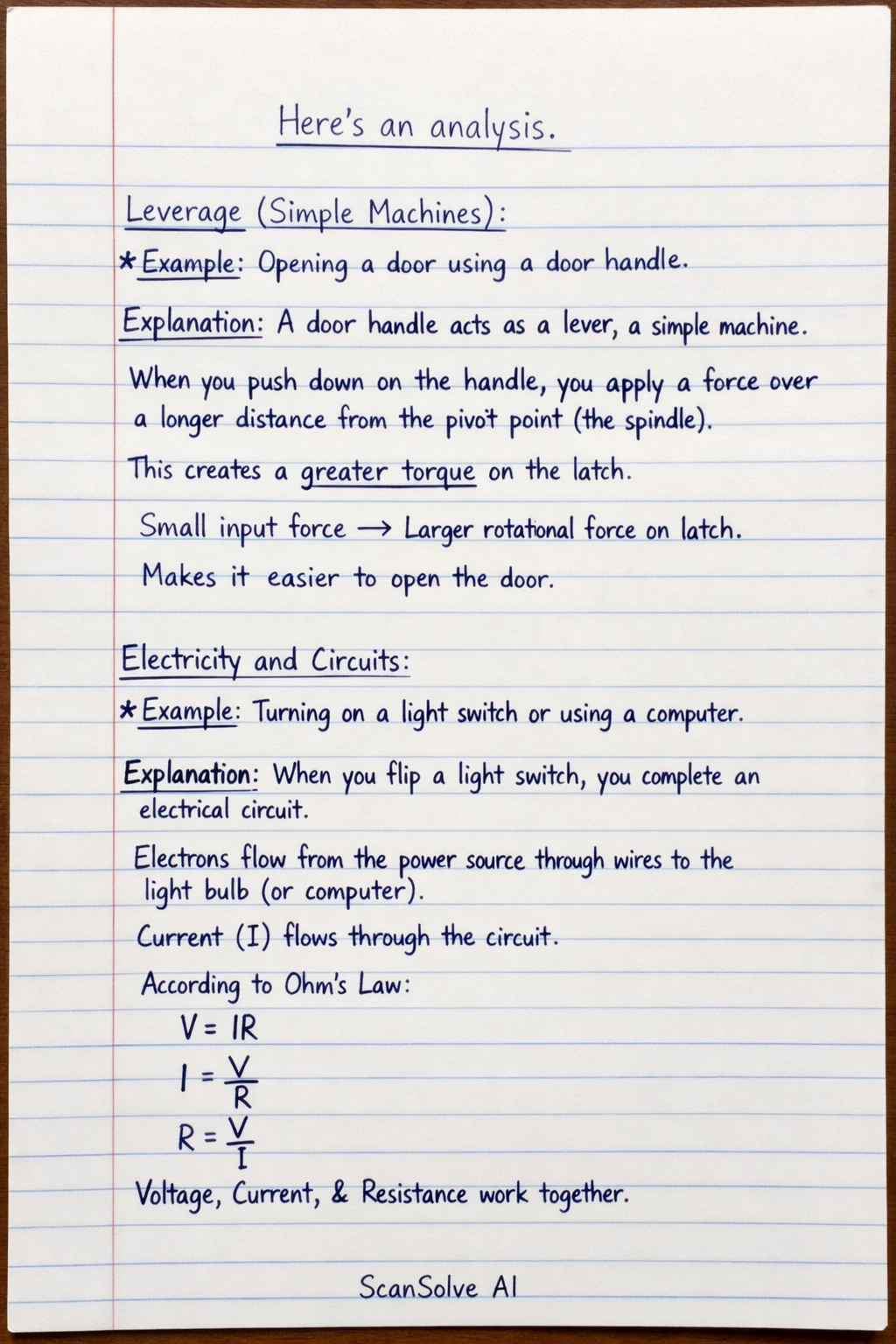
In your home and school, many things operate based on physics concepts. Here are some real-life examples: Leverage (Simple Machines): Example:* Opening a door using a door handle. Explanation: A door handle acts as a lever*, a simple machine. When you push down on the handle, you apply a force over a longer distance from the pivot point (the spindle). This allows a smaller input force to exert a larger rotational force (torque) on the latch mechanism, making it easier to open the door. Electricity and Circuits: Example:* Turning on a light switch or using a computer. Explanation: When you flip a light switch, you complete an electrical circuit. Electrons flow from the power source through wires to the light bulb (or computer), causing it to illuminate or function. This involves concepts like current, voltage, and resistance* as described by Ohm's Law. Gravity: Example:* A ball falling to the ground, or water flowing down a drain. Explanation: Gravity* is the force of attraction between any two objects with mass. When you drop a ball, the Earth's gravitational pull accelerates it downwards. Similarly, water flows downwards in pipes or drains due to gravity pulling it towards the Earth's center. Friction: Example:* Walking across the floor or writing with a pen. Explanation: Friction* is a force that opposes motion between two surfaces in contact. When you walk, friction between your shoes and the floor prevents you from slipping. When you write, friction between the pen tip and the paper allows ink to be deposited and prevents the pen from sliding uncontrollably.