This physics problem tests your understanding of fundamental physical laws and their applications. The step-by-step solution below breaks down the problem using relevant equations and physical reasoning.
ScanSolve AI Answer
To calculate the inductance of the coil, we first need to determine the impedance and then the inductive reactance.
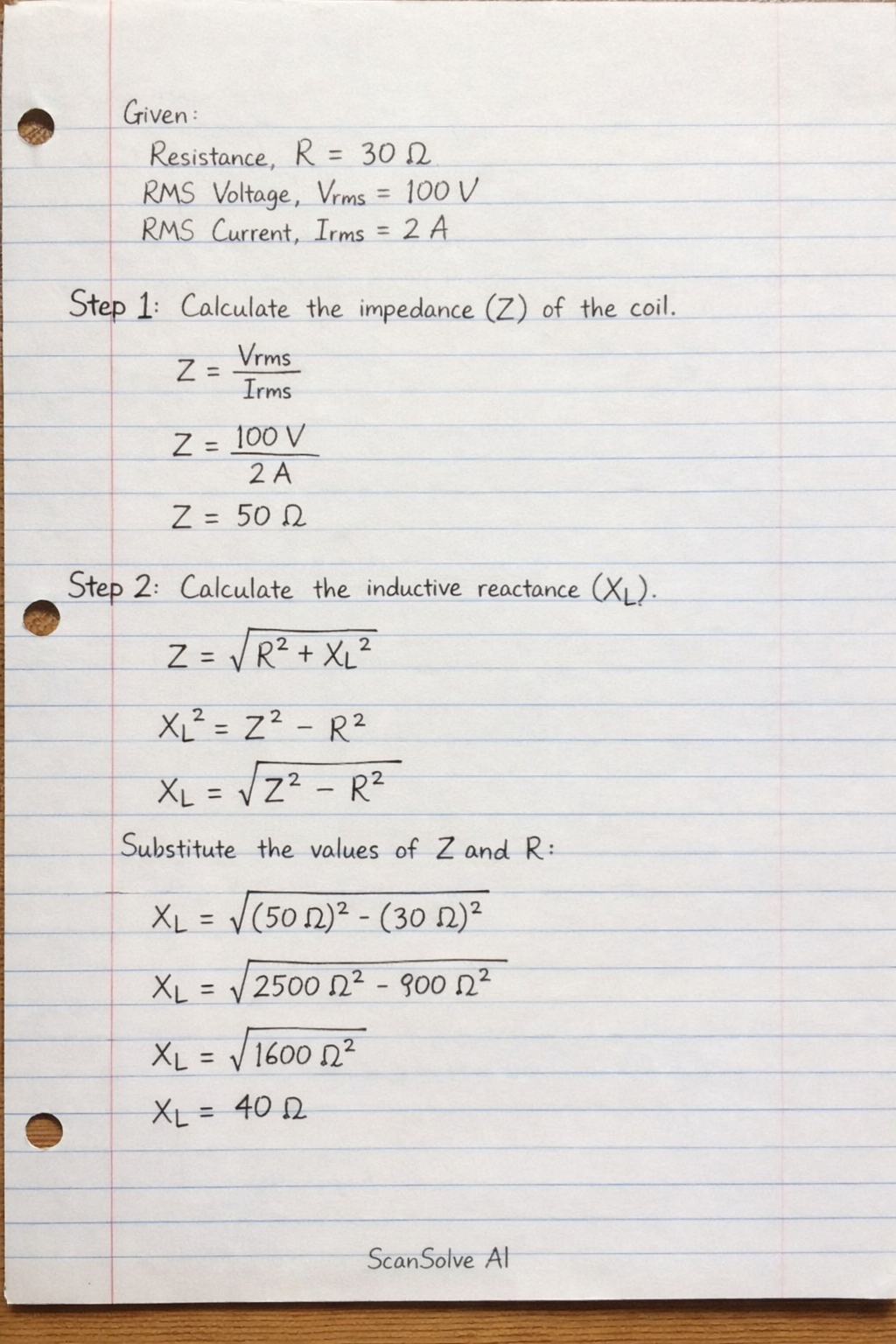
Given:
Resistance, $R = 30\, \Omega$
RMS Voltage, $V_{rms} = 100\, \text{V}$
RMS Current, $I_{rms} = 2\, \text{A}$
Step 1: Calculate the impedance ($Z$) of the coil.
The impedance is the total opposition to current flow in an AC circuit and can be found using Ohm's law for AC circuits:
$$Z = \frac{V_{rms}}{I_{rms}}$$
$$Z = \frac{100\, \text{V}}{2\, \text{A}}$$
$$Z = 50\, \Omega$$
Step 2: Calculate the inductive reactance ($X_L$).
For a coil with resistance, the impedance is related to the resistance and inductive reactance by the formula:
$$Z = \sqrt{R^2 + X_L^2}$$
We can rearrange this to solve for $X_L$:
$$X_L^2 = Z^2 - R^2$$
$$X_L = \sqrt{Z^2 - R^2}$$
Substitute the values of $Z$ and $R$:
$$X_L = \sqrt{(50\, \Omega)^2 - (30\, \Omega)^2}$$
$$X_L = \sqrt{2500\, \Omega^2 - 900\, \Omega^2}$$
$$X_L = \sqrt{1600\, \Omega^2}$$
$$X_L = 40\, \Omega$$
Step 3: Calculate the inductance ($L$).
The inductive reactance is also related to the inductance ($L$) and the angular frequency ($\omega$) by the formula:
$$X_L = \omega L$$
Where $\omega = 2\pi f$, and $f$ is the frequency of the AC source.
The problem does not provide the frequency of the AC source. Therefore, we will express the inductance in terms of the angular frequency $\omega$.
$$L = \frac{X_L}{\omega}$$
$$L = \frac{40\, \Omega}{\omega}$$
If we assume a standard AC frequency, for example, $f = 50\, \text{Hz}$ (a common frequency in many regions):
The angular frequency would be:
$$\omega = 2\pi f = 2\pi (50\, \text{Hz}) = 100\pi\, \text{rad/s}$$
Now, substitute this value into the equation for $L$:
$$L = \frac{40\, \Omega}{100\pi\, \text{rad/s}}$$
$$L = \frac{2}{5\pi}\, \text{H}$$
$$L \approx \frac{2}{5 \times 3.14159}$$
$$L \approx \frac{2}{15.70795}$$
$$L \approx 0.1273\, \text{H}$$
The inductance of the coil is $\boxed{\frac{40}{\omega}\, \text{H}}$.
Assuming a frequency of $50\, \text{Hz}$, the inductance is approximately $\boxed{0.127\, \text{H}}$.
Calculate the inductance of a coil of resistance 30 ohms connected to a 100volt A.c source if the coil draw an Ir.m.s of 2A
|Physics
ScanSolve AI Answer
To calculate the inductance of the coil, we first need to determine the impedance and then the inductive reactance.
Step 1: Calculate the impedance (Z) of the coil.
The impedance is the total opposition to current flow in an AC circuit and can be found using Ohm's law for AC circuits:
Z=IrmsVrmsZ=2A100VZ=50Ω
Step 2: Calculate the inductive reactance (XL).
For a coil with resistance, the impedance is related to the resistance and inductive reactance by the formula:
Z=R2+XL2
We can rearrange this to solve for XL:
XL2=Z2−R2XL=Z2−R2
Substitute the values of Z and R:
XL=(50Ω)2−(30Ω)2XL=2500Ω2−900Ω2XL=1600Ω2XL=40Ω
Step 3: Calculate the inductance (L).
The inductive reactance is also related to the inductance (L) and the angular frequency (ω) by the formula:
XL=ωL
Where ω=2πf, and f is the frequency of the AC source.
The problem does not provide the frequency of the AC source. Therefore, we will express the inductance in terms of the angular frequency ω.
L=ωXLL=ω40Ω
If we assume a standard AC frequency, for example, f=50Hz (a common frequency in many regions):
The angular frequency would be:
ω=2πf=2π(50Hz)=100πrad/s
Now, substitute this value into the equation for L:
L=100πrad/s40ΩL=5π2HL≈5×3.141592L≈15.707952L≈0.1273H
The inductance of the coil is ω40H.
Assuming a frequency of 50Hz, the inductance is approximately 0.127H.
Need help with your own homework?
Get instant step-by-step solutions to any question. Free to start.