This physics problem tests your understanding of fundamental physical laws and their applications. The step-by-step solution below breaks down the problem using relevant equations and physical reasoning.
ScanSolve AI Answer
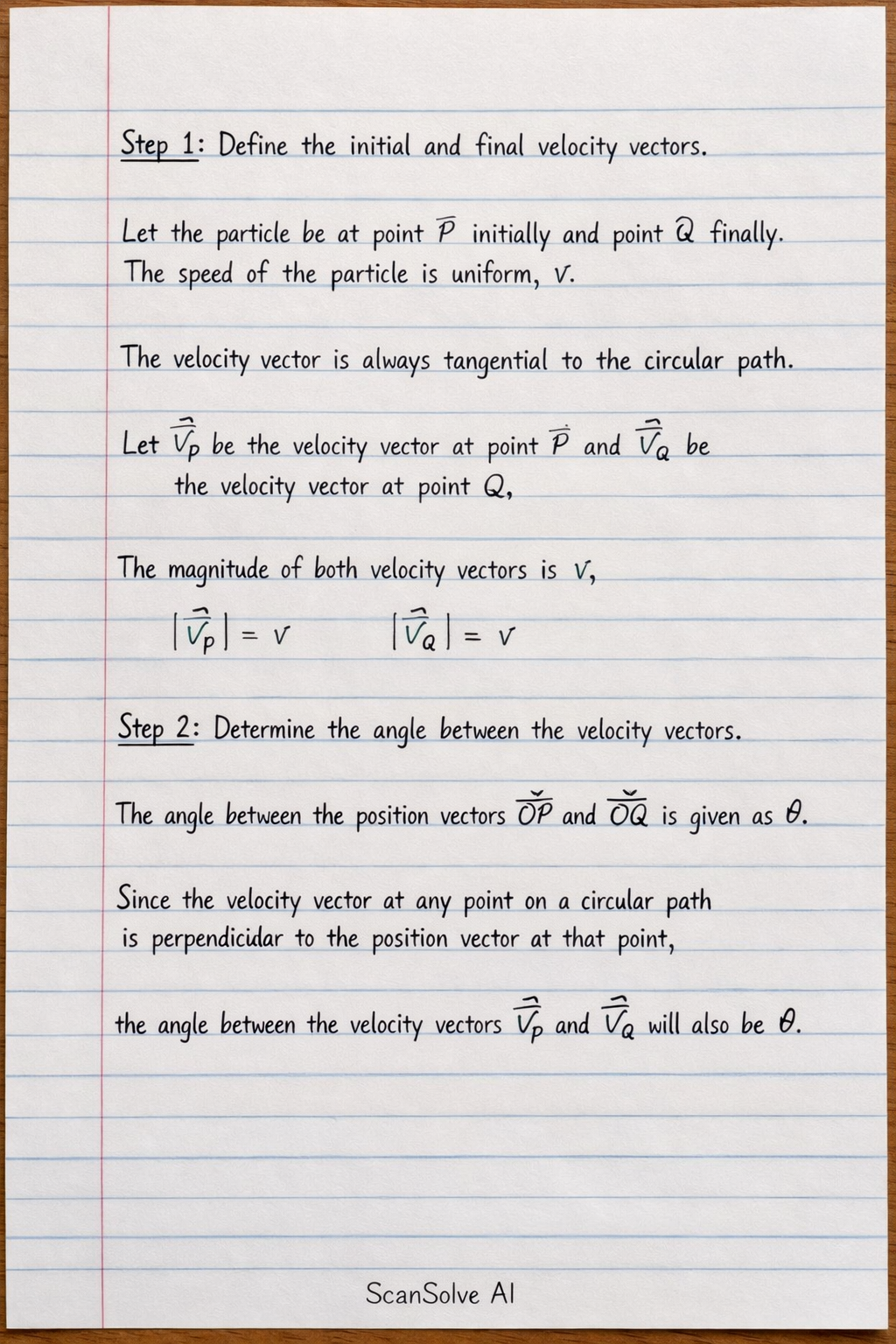
Step 1: Define the initial and final velocity vectors.
Let the particle be at point $P$ initially and point $Q$ finally. The speed of the particle is uniform, $v$.
The velocity vector is always tangential to the circular path.
Let $\vec{v_P}$ be the velocity vector at point $P$ and $\vec{v_Q}$ be the velocity vector at point $Q$.
The magnitude of both velocity vectors is $v$, i.e., $|\vec{v_P}| = v$ and $|\vec{v_Q}| = v$.
Step 2: Determine the angle between the velocity vectors.
The angle between the position vectors $\vec{OP}$ and $\vec{OQ}$ is given as $\theta$.
Since the velocity vector at any point on a circular path is perpendicular to the position vector at that point, the angle between the velocity vectors $\vec{v_P}$ and $\vec{v_Q}$ will also be $\theta$.
Step 3: Calculate the magnitude of the change in velocity.
The change in velocity is $\Delta \vec{v} = \vec{v_Q} - \vec{v_P}$.
The magnitude of the change in velocity can be found using the law of cosines for vector subtraction:
$$ |\Delta \vec{v}|^2 = |\vec{v_Q}|^2 + |\vec{v_P}|^2 - 2|\vec{v_Q}||\vec{v_P}| \cos \theta $$
Substitute $|\vec{v_P}| = v$ and $|\vec{v_Q}| = v$:
$$ |\Delta \vec{v}|^2 = v^2 + v^2 - 2(v)(v) \cos \theta $$
$$ |\Delta \vec{v}|^2 = 2v^2 - 2v^2 \cos \theta $$
Factor out $2v^2$:
$$ |\Delta \vec{v}|^2 = 2v^2 (1 - \cos \theta) $$
Step 4: Use a trigonometric identity to simplify.
Recall the trigonometric identity: $1 - \cos \theta = 2 \sin^2 \left(\frac{\theta}{2}\right)$.
Substitute this into the equation for $|\Delta \vec{v}|^2$:
$$ |\Delta \vec{v}|^2 = 2v^2 \left(2 \sin^2 \left(\frac{\theta}{2}\right)\right) $$
$$ |\Delta \vec{v}|^2 = 4v^2 \sin^2 \left(\frac{\theta}{2}\right) $$
Step 5: Take the square root to find the magnitude.
$$ |\Delta \vec{v}| = \sqrt{4v^2 \sin^2 \left(\frac{\theta}{2}\right)} $$
$$ |\Delta \vec{v}| = 2v \left|\sin \left(\frac{\theta}{2}\right)\right| $$
For typical angles $\theta$ swept in a circular motion ($0 \le \theta \le 2\pi$), $\frac{\theta}{2}$ will be in the range $0 \le \frac{\theta}{2} \le \pi$. In this range, $\sin\left(\frac{\theta}{2}\right) \ge 0$.
Therefore, we can remove the absolute value sign:
$$ |\Delta \vec{v}| = 2v \sin \left(\frac{\theta}{2}\right) $$
Comparing this result with the given options:
(a) $2v \sin (2\theta)$
(b) शून्य
(c) $2v \sin \left(\frac{\theta}{2}\right)$
(d) $2v \cos \left(\frac{\theta}{2}\right)$
The calculated magnitude of the change in velocity matches option (c).
The final answer is $\boxed{\text{(c) } 2v \sin \left(\frac{\theta}{2}\right)}$.
Q
Define the initial and final velocity vectors.
|Physics
Define the initial and final velocity vectors.
ScanSolve AI Answer
Step 1: Define the initial and final velocity vectors.
Let the particle be at point P initially and point Q finally. The speed of the particle is uniform, v.
The velocity vector is always tangential to the circular path.
Let vP be the velocity vector at point P and vQ be the velocity vector at point Q.
The magnitude of both velocity vectors is v, i.e., ∣vP∣=v and ∣vQ∣=v.
Step 2: Determine the angle between the velocity vectors.
The angle between the position vectors OP and OQ is given as θ.
Since the velocity vector at any point on a circular path is perpendicular to the position vector at that point, the angle between the velocity vectors vP and vQ will also be θ.
Step 3: Calculate the magnitude of the change in velocity.
The change in velocity is Δv=vQ−vP.
The magnitude of the change in velocity can be found using the law of cosines for vector subtraction:
∣Δv∣2=∣vQ∣2+∣vP∣2−2∣vQ∣∣vP∣cosθ
Substitute ∣vP∣=v and ∣vQ∣=v:
∣Δv∣2=v2+v2−2(v)(v)cosθ∣Δv∣2=2v2−2v2cosθ
Factor out 2v2:
∣Δv∣2=2v2(1−cosθ)
Step 4: Use a trigonometric identity to simplify.
Recall the trigonometric identity: 1−cosθ=2sin2(2θ).
Substitute this into the equation for ∣Δv∣2:
∣Δv∣2=2v2(2sin2(2θ))∣Δv∣2=4v2sin2(2θ)
Step 5: Take the square root to find the magnitude.
∣Δv∣=4v2sin2(2θ)∣Δv∣=2vsin(2θ)
For typical angles θ swept in a circular motion (0≤θ≤2π), 2θ will be in the range 0≤2θ≤π. In this range, sin(2θ)≥0.
Therefore, we can remove the absolute value sign:
∣Δv∣=2vsin(2θ)
Comparing this result with the given options:
(a) 2vsin(2θ)
(b) शून्य
(c) 2vsin(2θ)
(d) 2vcos(2θ)
The calculated magnitude of the change in velocity matches option (c).
The final answer is (c)2vsin(2θ).
Need help with your own homework?
Get instant step-by-step solutions to any question. Free to start.