
We read your photo as:
Initial velocity u = 100 m/s
Physics
ScanSolve AI Answer
Answers
3 partsStep-by-step solution
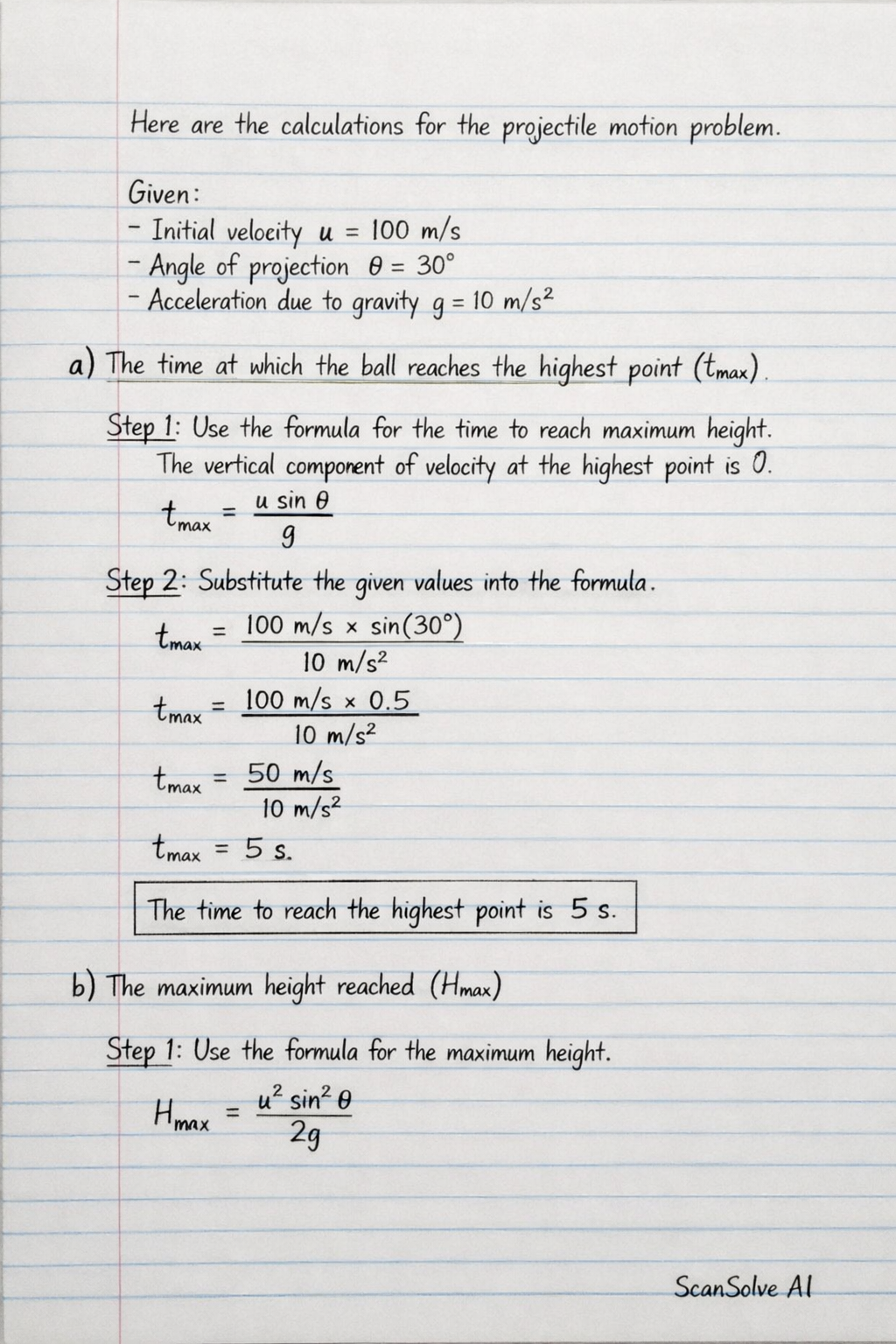
6 stepsHere are the calculations for the projectile motion problem.
Given:
Initial velocity
Angle of projection
Acceleration due to gravity
Part a· 2 steps
The time at which the ball reaches the highest point ()
Use the formula for the time to reach maximum height.
The vertical component of velocity at the highest point is 0.
Substitute the given values into the formula.
The time to reach the highest point is .
Part b
The maximum height reached ()
Use the formula for the maximum height.
Substitute the given values into the formula.
The maximum height reached is .
Part c
The horizontal range of the ball ()
Use the formula for the horizontal range.
Substitute the given values into the formula.
The horizontal range of the ball is .
Was this helpful?
Try one yourself
A new problem that tests the same skill.
Still stuck on this one?
Ask a follow-up, and the answer starts from this question.
Got a different question?Ask your own question
More Physics Questions
QInitial velocity, u = 30 m/sQ• Initial velocity, u = 0 m/s (assuming the technician starts from rest)QGiven initial velocity u = (20sqrt(3)i + 20j) ms⁻¹.QGiven: Initial velocity u = 0 m/s, acceleration a = 5 m/s2, final velocity v = 25 m/s.QIdentify the initial velocity (u), final velocity (v), and time (t) for the first 4 seconds.
Browse by topic:Mechanics
Handwritten Step-by-Step Solution
Get this as a handwritten image on WhatsApp — like a tutor wrote it for you.
Try on WhatsApp