
We read your photo as:
Evaluate the integral for output current over half a cycle:
ScanSolve AI Answer
Answer
Step-by-step solution
4 stepsOkay, let's evaluate the integral shown in the image (Equation 4.3). This integral represents the total area under the current curve for a half-cycle of a half-wave rectified signal.
Evaluate the integral for output current over half a cycle:
The integral given is:
Identify constants.
The terms , , and are constants with respect to the integration variable . We can pull them out of the integral.
Integrate .
The integral of with respect to is .
Apply the limits of integration.
Substitute the upper limit () and the lower limit (0) into the result of the integration.
We know that and .
Combine the results.
Multiply the constant term by the result of the definite integral.
The value of the integral representing the output current over half a cycle is .
Try one yourself
A new problem that tests the same skill.
Still stuck on this one?
Ask a follow-up, and the answer starts from this question.
More Physics Questions
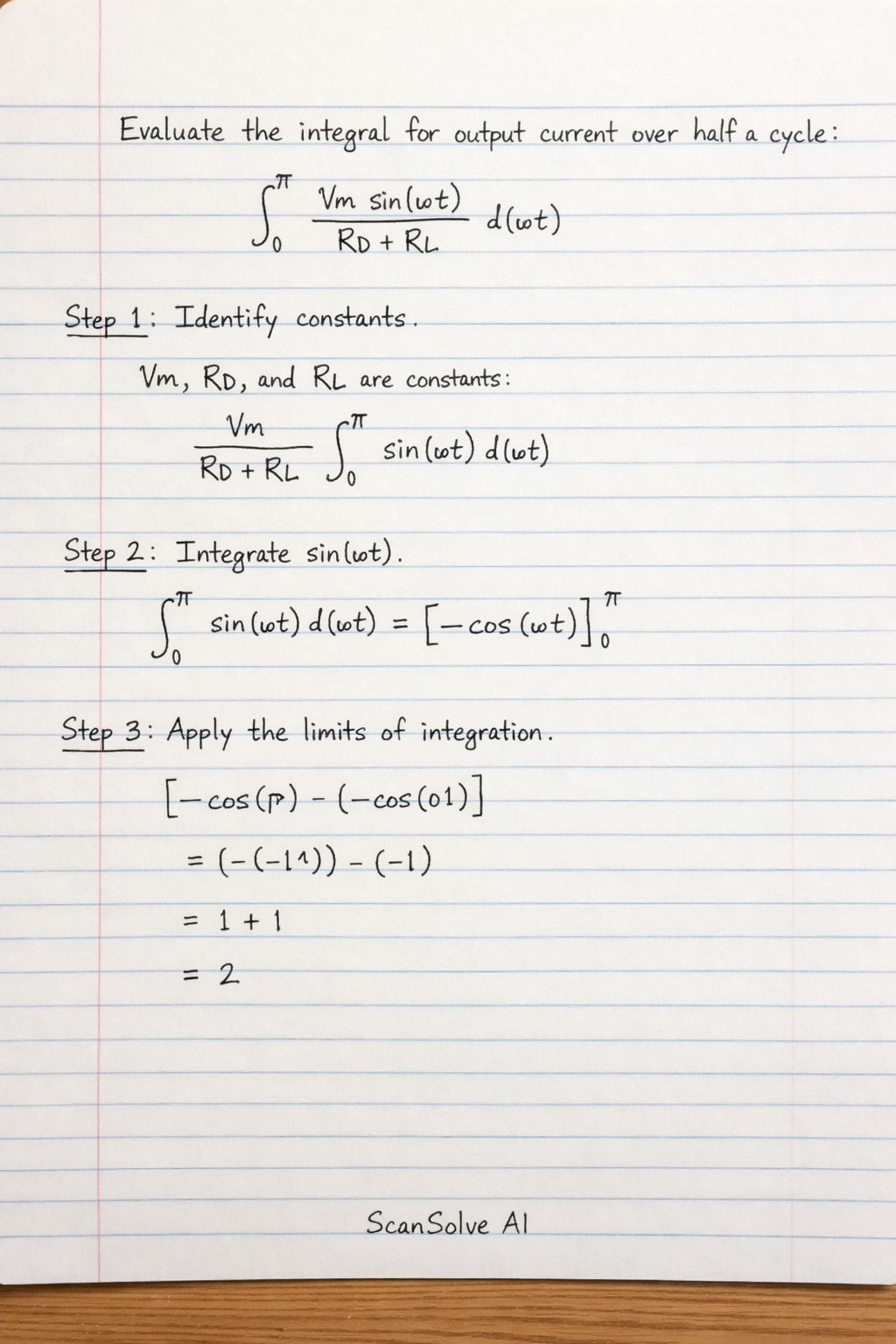
Handwritten Step-by-Step Solution
Get this as a handwritten image on WhatsApp — like a tutor wrote it for you.
Try on WhatsApp