
We read your photo as:
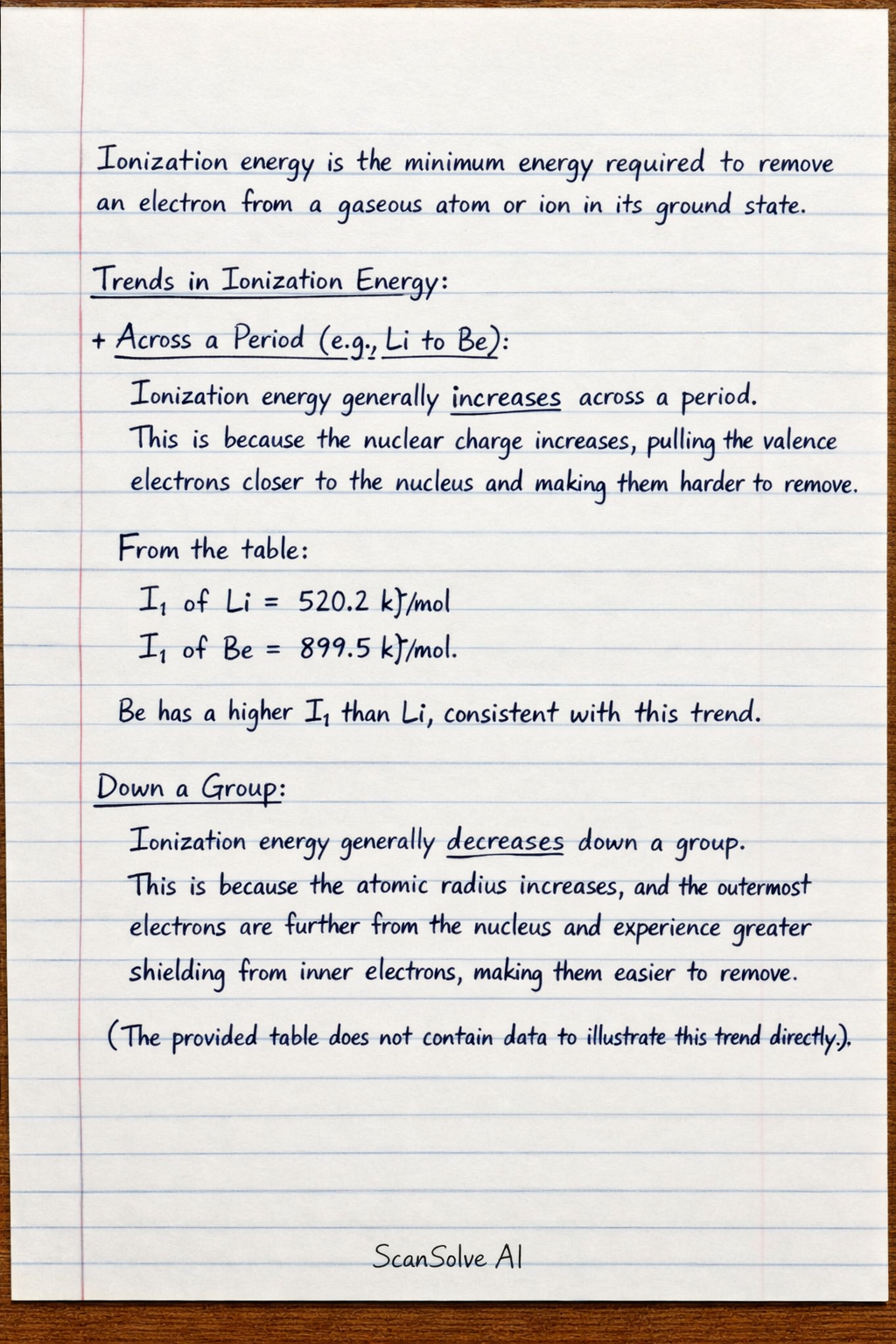
Ionization energy is the minimum energy required to remove an electron from a gaseous atom or ion in its ground state.
ScanSolve AI Answer
Ionization energy is the minimum energy required to remove an electron from a gaseous atom or ion in its ground state.
-
Trends in Ionization Energy:
- Across a Period (e.g., Li to Be): Ionization energy generally increases across a period. This is because the nuclear charge increases, pulling the valence electrons closer to the nucleus and making them harder to remove.
- From the table, the first ionization energy () of Li is 520.2 kJ/mol, while for Be it is 899.5 kJ/mol. Be has a higher than Li, consistent with this trend.
- Down a Group: Ionization energy generally decreases down a group. This is because the atomic radius increases, and the outermost electrons are further from the nucleus and experience greater shielding from inner electrons, making them easier to remove. (The provided table does not contain data to illustrate this trend directly).
- Across a Period (e.g., Li to Be): Ionization energy generally increases across a period. This is because the nuclear charge increases, pulling the valence electrons closer to the nucleus and making them harder to remove.
-
Formation of Ions by Alkali Metals (e.g., Lithium, Li): Lithium (an alkali metal) has the electron configuration .
- The first ionization energy () for Li is 520.2 kJ/mol: Removing this electron results in a stable ion with a electron configuration, which is isoelectronic with Helium (a noble gas).
- The second ionization energy () for Li is 7298.2 kJ/mol:
- The third ionization energy () for Li is 11815.0 kJ/mol:
There is a very large jump in energy from to (approximately 14 times greater). This significant increase indicates that removing the second electron requires much more energy because it is being removed from a stable, full inner electron shell (). Therefore, alkali metals readily form compounds with a +1 ion but not +2 or +3 ions.
-
Formation of Ions by Alkaline Earth Metals (e.g., Beryllium, Be): Beryllium (an alkaline earth metal) has the electron configuration .
- The first ionization energy () for Be is 899.5 kJ/mol:
- The second ionization energy () for Be is 1757.1 kJ/mol: Removing both electrons results in a stable ion with a electron configuration, which is isoelectronic with Helium. The increase from to is relatively small (less than double), indicating that removing both valence electrons is energetically favorable.
- The third ionization energy () for Be is 14848.8 kJ/mol:
- The fourth ionization energy () for Be is 21006.6 kJ/mol:
There is a very large jump in energy from to (approximately 8.5 times greater). This significant increase indicates that removing the third electron requires much more energy because it is being removed from a stable, full inner electron shell (). Therefore, alkaline earth metals readily form compounds with a +2 ion but not +3 or +4 ions.
Still stuck on this one?
Ask a follow-up, and the answer starts from this question.
More Physics Questions
Handwritten Step-by-Step Solution
Get this as a handwritten image on WhatsApp — like a tutor wrote it for you.
Try on WhatsApp