
We read your photo as:
Explain the isochoric process. 2. What is the amount of work done in the isochoric process? 3. What is the difference between the isochoric and isobaric processes? 4. Is the isochoric process reversible? Give a reason for your answer.
ScanSolve AI Answer
Step-by-step solution
4 stepsHere are the answers to the questions:
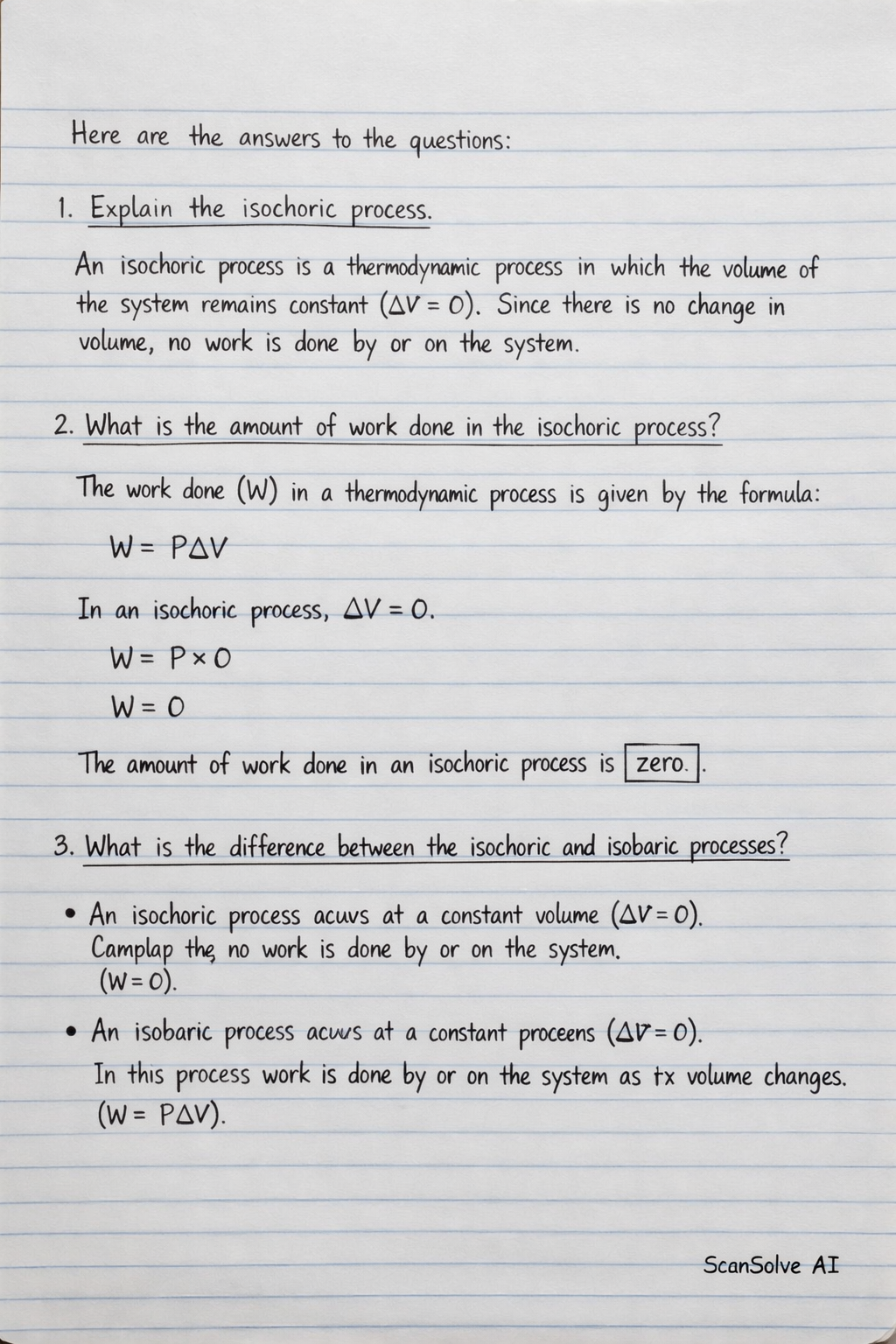
Explain the isochoric process.
An isochoric process is a thermodynamic process in which the volume of the system remains constant (). Since there is no change in volume, no work is done by or on the system.
What is the amount of work done in the isochoric process?
The work done () in a thermodynamic process is given by the formula .
In an isochoric process, the change in volume () is zero.The amount of work done in an isochoric process is .
What is the difference between the isochoric and isobaric processes?
- An isochoric process occurs at a constant volume (). Consequently, no work is done by or on the system ().
- An isobaric process occurs at a constant pressure (). In this process, work is done by or on the system as its volume changes ().
Is the isochoric process reversible? Give a reason for your answer.
Under ideal conditions, an isochoric process can be considered reversible if it occurs infinitesimally slowly, allowing the system to remain in equilibrium throughout the process. However, in reality, all natural processes, including real isochoric processes, are irreversible due to factors like heat transfer across a finite temperature difference or friction, which increase the entropy of the universe.
Still stuck on this one?
Ask a follow-up, and the answer starts from this question.
More Physics Questions
Handwritten Step-by-Step Solution
Get this as a handwritten image on WhatsApp — like a tutor wrote it for you.
Try on WhatsApp