

This physics problem tests your understanding of fundamental physical laws and their applications. The step-by-step solution below breaks down the problem using relevant equations and physical reasoning.
ScanSolve AI Answer
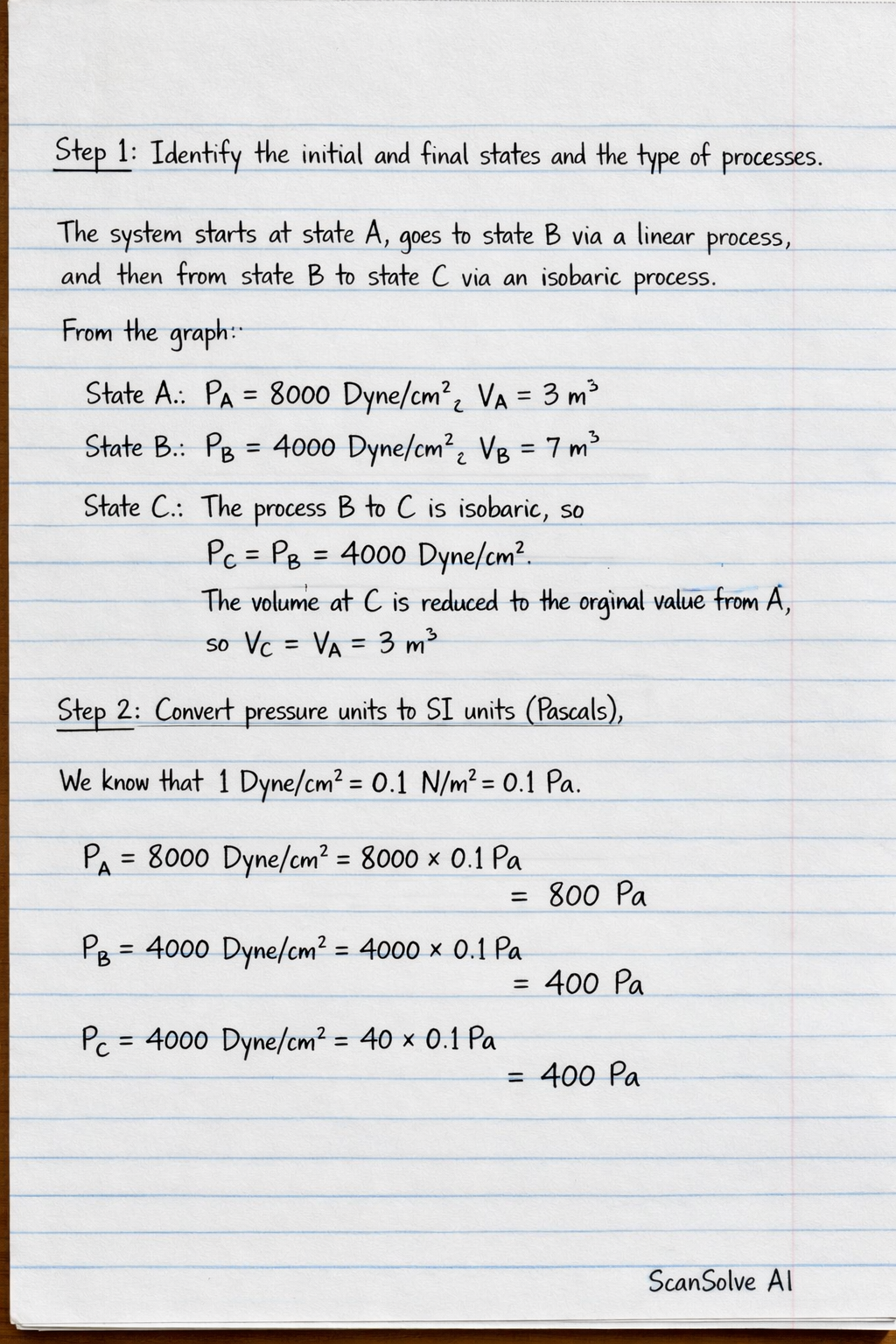
Step 1: Identify the initial and final states and the type of processes. The system starts at state A, goes to state B via a linear process, and then from state B to state C via an isobaric process. From the graph: State A: P_A = 8000 \, Dyne/cm^2, V_A = 3 \, m^3 State B: P_B = 4000 \, Dyne/cm^2, V_B = 7 \, m^3 State C: The process B to C is isobaric, so P_C = P_B = 4000 \, Dyne/cm^2. The volume at C is reduced to the original value from A, so V_C = V_A = 3 \, m^3. Step 2: Convert pressure units to SI units (Pascals). We know that 1 \, Dyne/cm^2 = 0.1 \, N/m^2 = 0.1 \, Pa. P_A = 8000 \, Dyne/cm^2 = 8000 × 0.1 \, Pa = 800 \, Pa P_B = 4000 \, Dyne/cm^2 = 4000 × 0.1 \, Pa = 400 \, Pa P_C = 400 \, Pa Step 3: Calculate the work done during the process A to B (W_AB). The process A to B is a linear process on a P-V diagram. The work done is the area of the trapezoid under the line segment AB. W_AB = (1)/(2) (P_A + P_B) (V_B - V_A) Substitute the values: W_AB = (1)/(2) (800 \, Pa + 400 \, Pa) (7 \, m^3 - 3 \, m^3) W_AB = (1)/(2) (1200 \, Pa) (4 \, m^3) W_AB = 600 \, Pa × 4 \, m^3 W_AB = 2400 \, J Step 4: Calculate the work done during the process B to C (W_BC). The process B to C is an isobaric process (constant pressure). The work done is given by W = P V. W_BC = P_B (V_C - V_B) Substitute the values: W_BC = 400 \, Pa (3 \, m^3 - 7 \, m^3) W_BC = 400 \, Pa (-4 \, m^3) W_BC = -1600 \, J Step 5: Calculate the total work done (W_total). The total work done is the sum of the work done in each process. W_total = W_AB + W_BC W_total = 2400 \, J + (-1600 \, J) W_total = 800 \, J The final answer is 800 J.