
We read your photo as:
Define kinematics and dynamics. Find the angle between vectors A = 3i + 4j + 5k and B = 3i + 4j − 5k.
ScanSolve AI Answer
Step-by-step solution
17 stepsHere are the solutions to the questions:
1(a) Define the following terms:
-
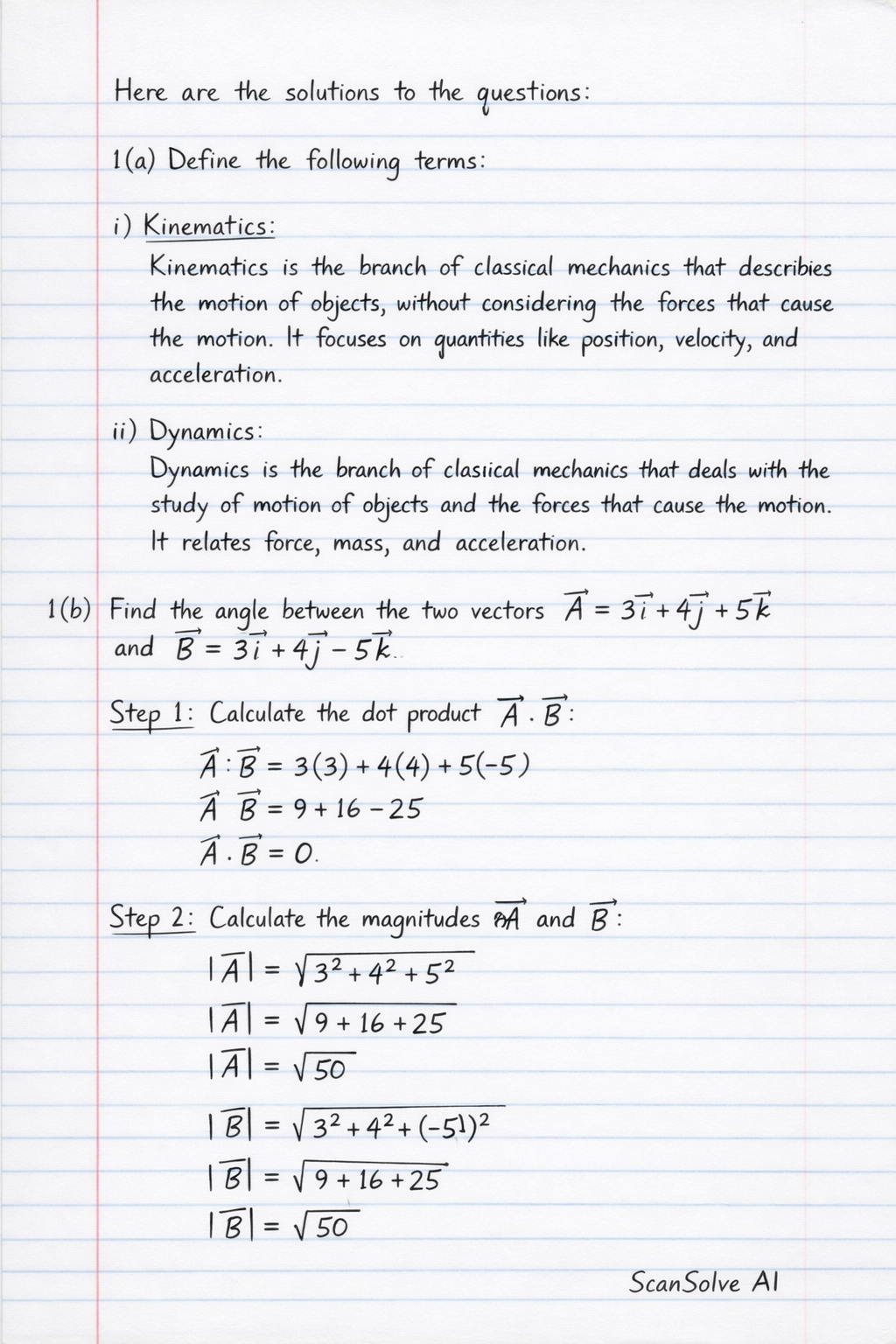
i) Kinematics: Kinematics is the branch of classical mechanics that describes the motion of objects without considering the forces that cause the motion. It focuses on quantities like position, velocity, and acceleration.
-
ii) Dynamics: Dynamics is the branch of classical mechanics that deals with the study of motion of objects and the forces that cause the motion. It relates force, mass, and acceleration.
1(b) Find the angle between the two vectors and
Calculate the dot product of the two vectors, .
Calculate the magnitudes of vectors and .
Use the dot product formula to find the angle .
Solve for .
The angle between the two vectors is .
1(c) The position of a Particle moving on an x axis is given by , with x in meters and t in seconds. What is its velocity at ? Is the velocity constant or is it continuously changing?
Find the velocity function by differentiating the position function with respect to time.
Calculate the velocity at .
The velocity at is .
Determine if the velocity is constant or continuously changing.
The velocity function depends on time . Since is a variable term, the velocity changes as time progresses.
The velocity is continuously changing.2(a) Define the following terms:
-
i) Angular momentum: Angular momentum is a measure of the rotational inertia of an object in motion about a reference point or axis. For a point particle, it is the product of its moment of inertia and angular velocity.
-
ii) Torque: Torque is a twisting force that tends to cause rotation about an axis. It is the rotational equivalent of linear force and is calculated as the product of force and the perpendicular distance from the pivot to the line of action of the force.
2(b) Show that the expression for rotational kinetic energy of a body is, . All parameters have their usual meaning.
Consider a rigid body rotating about a fixed axis with an angular velocity . We can imagine the body as being composed of many small particles, each with mass at a distance from the axis of rotation.
-
The kinetic energy of a single particle is given by
where is the tangential speed of the particle.
For a rotating body, the tangential speed of a particle at a distance from the axis of rotation is related to the angular velocity by
Substitute the expression for into the kinetic energy equation for a single particle
The total rotational kinetic energy of the rigid body is the sum of the kinetic energies of all its constituent particles
Since and are common to all terms (as is the same for all particles in a rigid body), we can factor them out
The term is defined as the moment of inertia of the body about the axis of rotation.
Substitute into the equation for total kinetic energy
This shows that the expression for rotational kinetic energy of a body is .
2(c) Moment of inertia of a ring is . It is rotated for 20 seconds, from its rest position by a torque of . Calculate the work done.
Given:
Moment of inertia,
Time,
Initial angular velocity, (from rest)
Torque,Calculate the angular acceleration using Newton's second law for rotation ().
Calculate the angular displacement using the kinematic equation for rotational motion.
Since the ring starts from rest ():
Calculate the work done by the constant torque.
The work done is .
Still stuck on this one?
Ask a follow-up, and the answer starts from this question.
More Physics Questions
Handwritten Step-by-Step Solution
Get this as a handwritten image on WhatsApp — like a tutor wrote it for you.
Try on WhatsApp