
Let's derive the formulars of linear acceleration
ScanSolve AI Answer
Step-by-step solution
4 stepsLet's derive the four main kinematic equations for linear motion with constant acceleration.
Assumptions:
- Initial velocity:
- Final velocity:
- Acceleration: (constant)
- Time:
- Displacement:
Derive the first equation ()
Acceleration is defined as the rate of change of velocity.
Rearranging this equation to solve for :
Derive the second equation ()
Displacement is the area under the velocity-time graph. For constant acceleration, the graph is a straight line. The area can be split into a rectangle and a triangle.
Area of rectangle =
Area of triangle =
From Step 1, we know . Substitute this into the triangle area:
Area of triangle =
Total displacement is the sum of these areas:Derive the third equation ()
From Step 1, we have .
Substitute this expression for into the equation from Step 2 ():Multiply by to clear the denominators:
Rearranging to solve for :
Derive the fourth equation ()
Displacement can also be calculated as the average velocity multiplied by time.
Average velocity =These are the four main formulas for linear acceleration:
Still stuck on this one?
Ask a follow-up, and the answer starts from this question.
More Physics Questions
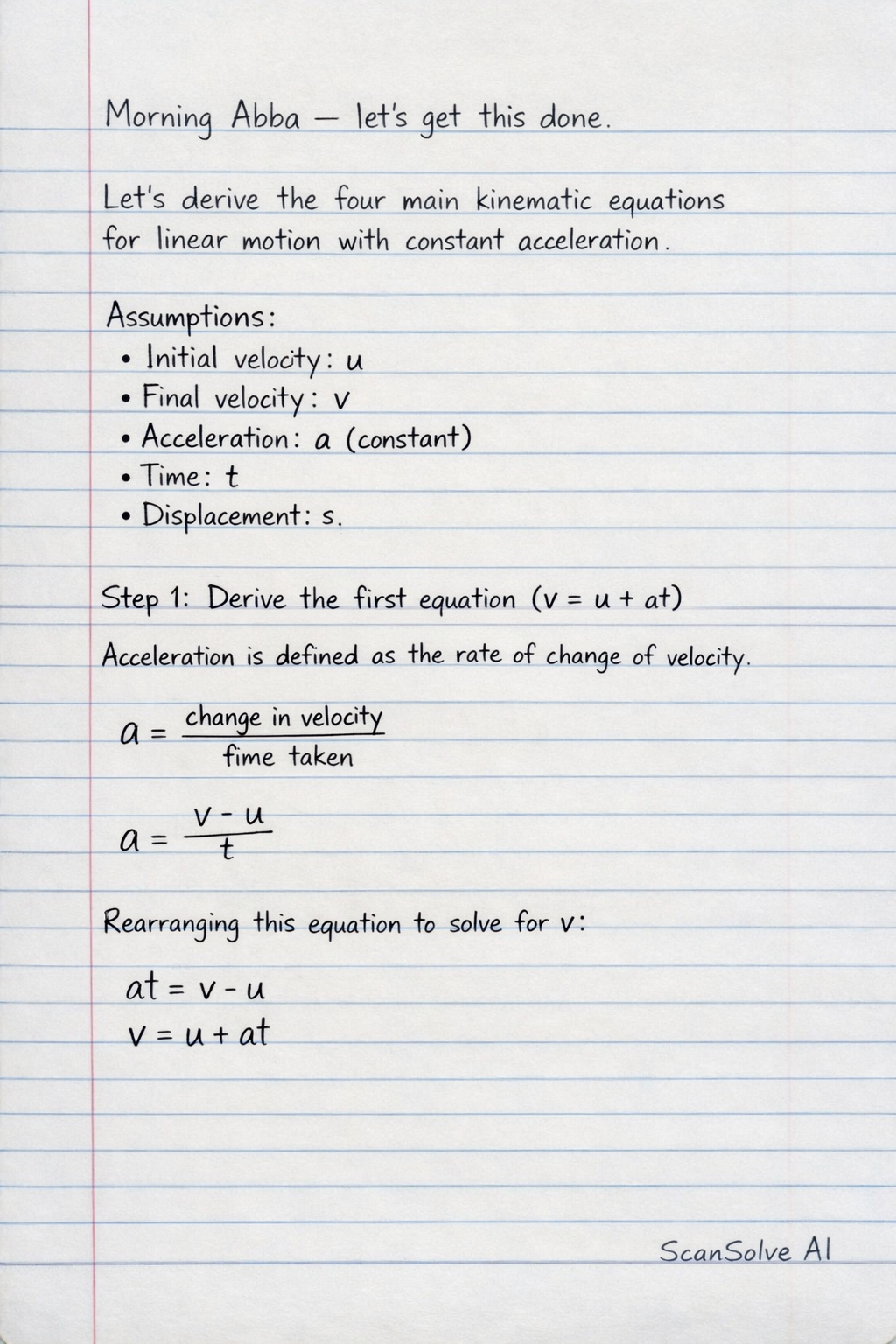
Handwritten Step-by-Step Solution
Get this as a handwritten image on WhatsApp — like a tutor wrote it for you.
Try on WhatsApp