
Calculate the mass, in kilograms, of magnesium produced by the electrolysis of magnesium (II) chloride in a cell operating for 24 hours at 500 amperes. [1 Faraday = 96500c mol-1, Mg = 24]
ScanSolve AI Answer
Answer
Step-by-step solution
6 stepsWrite the half-reaction for the production of magnesium.
Magnesium ions () gain two electrons to form solid magnesium ().
Calculate the total charge () passed through the cell.
The current () is 500 amperes and the time () is 24 hours.
First, convert time to seconds:Now, calculate the charge:
Calculate the moles of electrons () transferred.
Using Faraday's constant ():
Determine the moles of magnesium () produced.
From the half-reaction, 2 moles of electrons are required to produce 1 mole of magnesium.
Calculate the mass of magnesium () produced.
The molar mass of magnesium () is .
Convert the mass from grams to kilograms.
The mass of magnesium produced is .
Try one yourself
A new problem that tests the same skill.
Still stuck on this one?
Ask a follow-up, and the answer starts from this question.
More Physics Questions
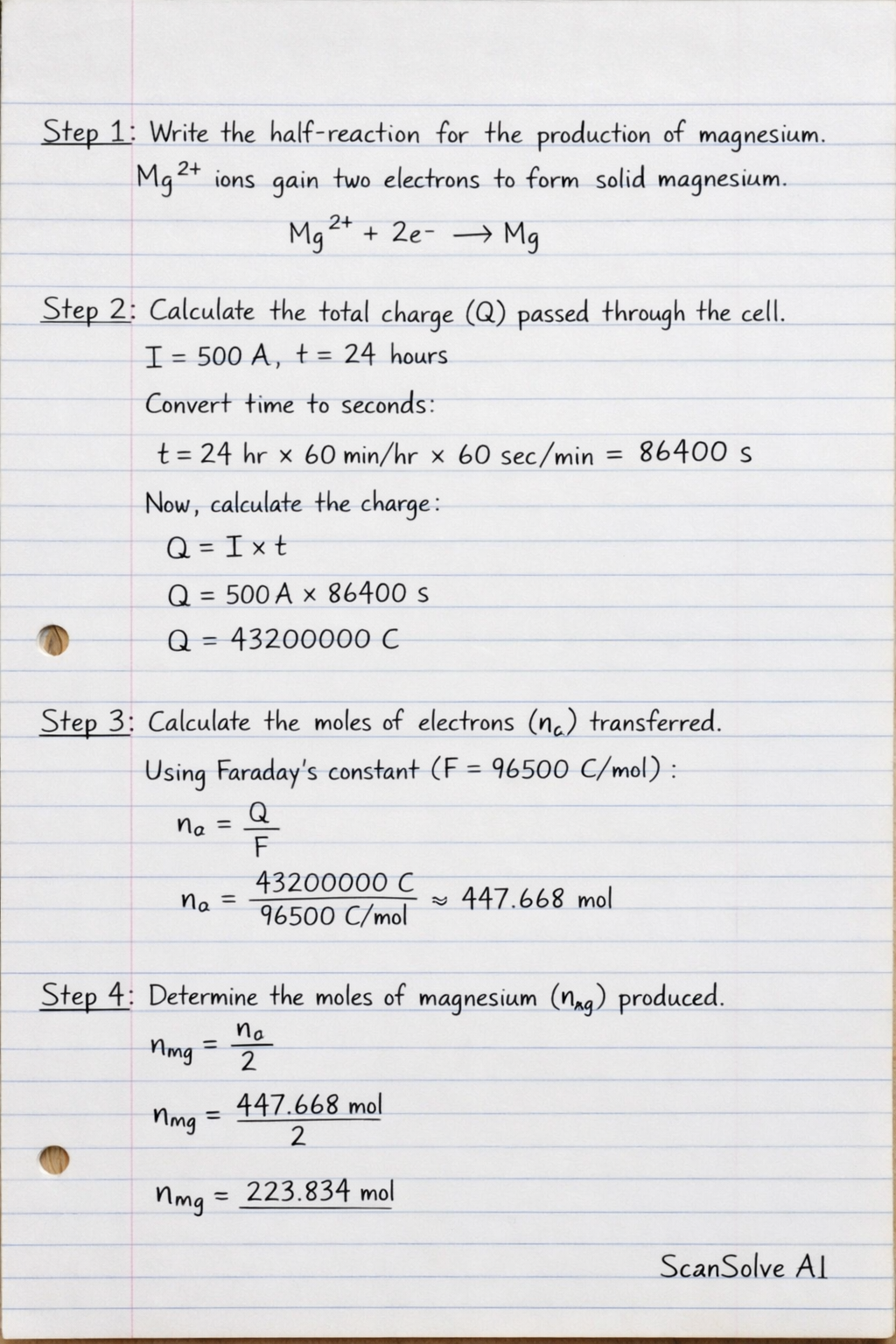
Handwritten Step-by-Step Solution
Get this as a handwritten image on WhatsApp — like a tutor wrote it for you.
Try on WhatsApp