
We read your photo as:
Calculate the mass of air in a closed system given initial volume, temperature, and pressure, and properties of air.
Physics
ScanSolve AI Answer
This answer stops before the end.
It was cut off when it was first written. Ask ScanSolve this question again for the full working.
Step 1: Convert given values to SI units and define properties of air.
Given:
Initial volume,
Initial temperature,
Temperature after heating,
Initial pressure,
For air (assumed ideal gas):
Specific heat at constant pressure,
Specific heat at constant volume,
Gas constant,
Step 2: Calculate the mass of air ().
Using the ideal gas law at state 1:
Was this helpful?
Still stuck on this one?
Ask a follow-up, and the answer starts from this question.
Got a different question?Ask your own question
More Physics Questions
QCalculate the molar mass of a gas given its volume at STP and mass, and determine the new volume of…QWhich of the following properties of a gas molecule is directly proportional to the absolute…QCalculate the molar mass of a gas given its pressure, temperature, and density. Also, calculate the…QCalculate the volume occupied by the gas.QUs to determine a property of a mass of oxygen given its initial volume and pressure, with the…
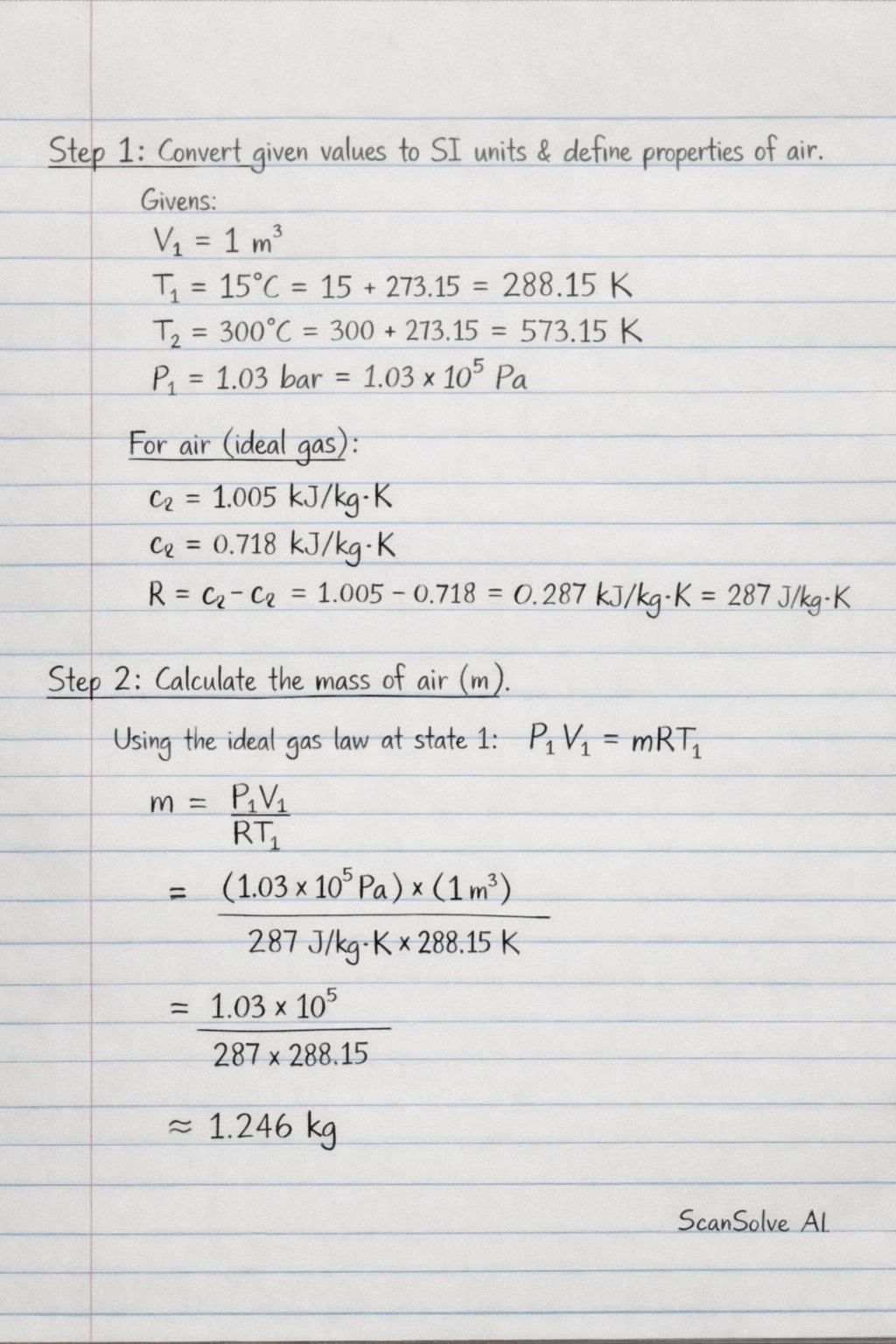
Handwritten Step-by-Step Solution
Get this as a handwritten image on WhatsApp — like a tutor wrote it for you.
Try on WhatsApp