

This physics problem tests your understanding of fundamental physical laws and their applications. The step-by-step solution below breaks down the problem using relevant equations and physical reasoning.
ScanSolve AI Answer
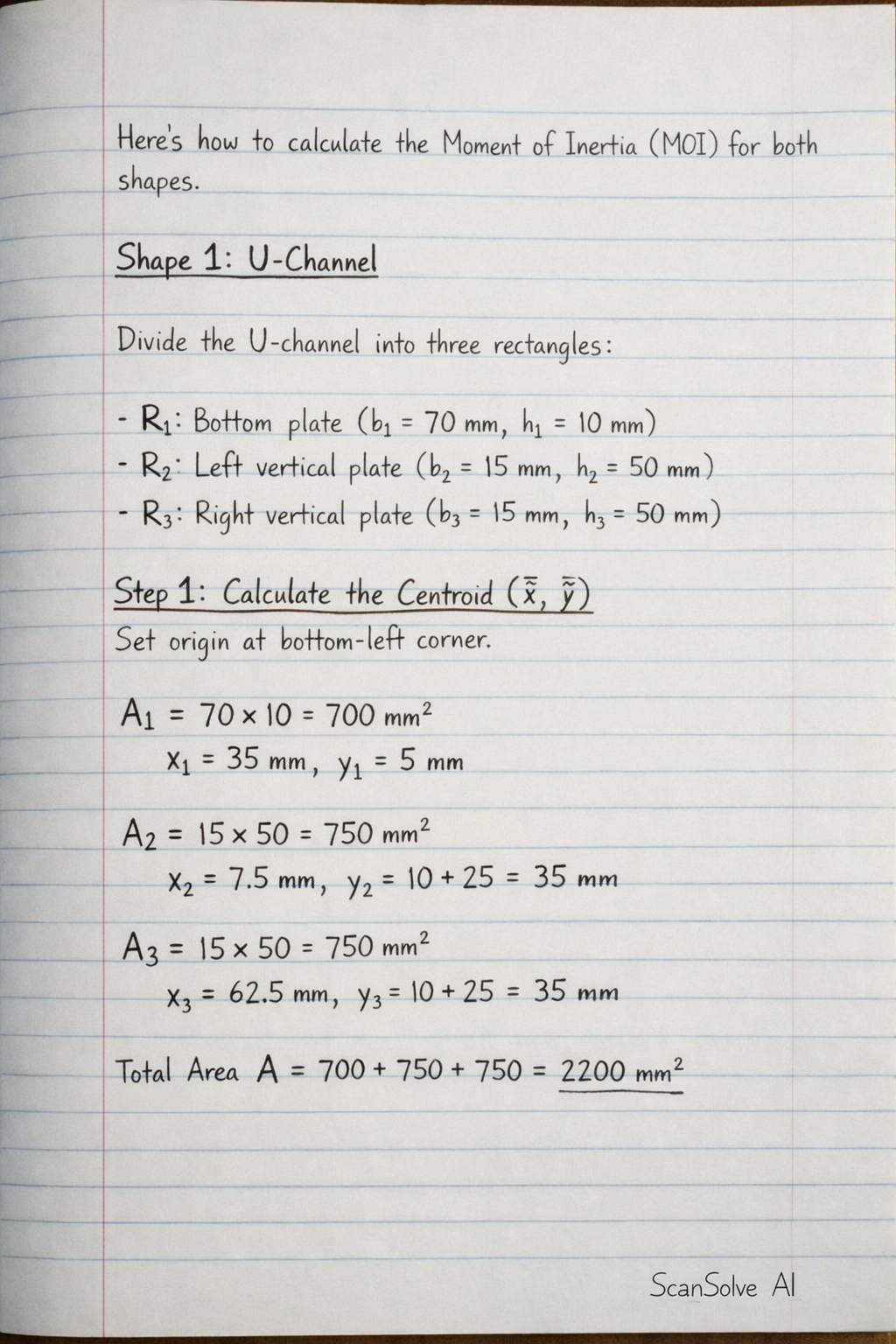
Here's how to calculate the Moment of Inertia (MOI) for both shapes. Shape 1: U-Channel First, we divide the U-channel into three rectangles: R_1: Bottom plate (width b_1 = 70 mm, height h_1 = 10 mm) R_2: Left vertical plate (width b_2 = 15 mm, height h_2 = 50 mm) R_3: Right vertical plate (width b_3 = 15 mm, height h_3 = 50 mm) Step 1: Calculate the Centroid (x, y) We set the origin at the bottom-left corner. A_1 = 70 × 10 = 700 mm^2, x_1 = 35 mm, y_1 = 5 mm A_2 = 15 × 50 = 750 mm^2, x_2 = 7.5 mm, y_2 = 10 + 25 = 35 mm A_3 = 15 × 50 = 750 mm^2, x_3 = 70 - 7.5 = 62.5 mm, y_3 = 10 + 25 = 35 mm Total Area A = 700 + 750 + 750 = 2200 mm^2 The centroid coordinates are: x = (A_1 x_1 + A_2 x_2 + A_3 x_3)/(A) = (700(35) + 750(7.5) + 750(62.5))/(2200) = (24500 + 5625 + 46875)/(2200) = (77000)/(2200) = 35 mm y = (A_1 y_1 + A_2 y_2 + A_3 y_3)/(A) = (700(5) + 750(35) + 750(35))/(2200) = (3500 + 26250 + 26250)/(2200) = (56000)/(2200) = (280)/(11) ≈ 25.45 mm Step 2: Calculate Moment of Inertia about the x-x axis (I_xx) We use the parallel axis theorem: I_xx = (I_xi + A_i d_yi^2), where I_xi = (b_i h_i^3)/(12). For R_1: I_x1 = (70 × 10^3)/(12) = (17500)/(3) mm^4. d_y1 = y - y_1 = (280)/(11) - 5 = (225)/(11) mm. A_1 d_y1^2 = 700 ((225)/(11))^2 = (35437500)/(121) mm^4. For R_2: I_x2 = (15 × 50^3)/(12) = 156250 mm^4. d_y2 = y_2 - y = 35 - (280)/(11) = (105)/(11) mm. A_2 d_y2^2 = 750 ((105)/(11))^2 = (8268750)/(121) mm^4. For R_3: I_x3 = (15 × 50^3)/(12) = 156250 mm^4. d_y3 = y_3 - y = (105)/(11) mm. A_3 d_y3^2 = 750 ((105)/(11))^2 = (8268750)/(121) mm^4. I_xx = ((17500)/(3) + (35437500)/(121)) + (156250 + (8268750)/(121)) + (156250 + (8268750)/(121)) I_xx = (271480000)/(363) ≈ 747878.8 mm^4 The Moment of Inertia about the x-x axis is 747878.8 mm^4. Step 3: Calculate Moment of Inertia about the y-y axis (I_yy) We use the parallel axis theorem: I_yy = (I_yi + A_i d_xi^2), where I_yi = (h_i b_i^3)/(12). For R_1: I_y1 = (10 × 70^3)/(12) = (857500)/(3) mm^4. d_x1 = x - x_1 = 35 - 35 = 0 mm. A_1 d_x1^2 = 0. For R_2: I_y2 = (50 × 15^3)/(12) = 14062.5 mm^4. d_x2 = x - x_2 = 35 - 7.5 = 27.5 mm. A_2 d_x2^2 = 750 (27.5)^2 = 567187.5 mm^4. For R_3: I_y3 = (50 × 15^3)/(12) = 14062.5 mm^4. d_x3 = x_3 - x = 62.5 - 35 = 27.5 mm. A_3 d_x3^2 = 750 (27.5)^2 = 567187.5 mm^4. I_yy = ((857500)/(3) + 0) + (14062.5 + 567187.5) + (14062.5 + 567187.5) I_yy = (857500)/(3) + 581250 + 581250 = (857500)/(3) + 1162500 = (4345000)/(3) ≈ 1448333.3 mm^4 The Moment of Inertia about the y-y axis is 1448333.3 mm^4. --- Shape 2: I-Beam First, we divide the I-beam into three rectangles: R_1: Top flange (width b_1 = 40 mm, height h_1 = 10 mm) R_2: Web (width b_2 = 10 mm, height h_2 = 30 mm) R_3: Bottom flange (width b_3 = 80 mm, height h_3 = 10 mm) Step 1: Calculate the Centroid (x, y) We set the origin at the bottom-left corner of the bottom flange. A_1 = 40 × 10 = 400 mm^2, x_1 = 40 mm, y_1 = 50 - 5 = 45 mm A_2 = 10 × 30 = 300 mm^2, x_2 = 40 mm, y_2 = 10 + 15 = 25 mm A_3 = 80 × 10 = 800 mm^2, x_3 = 40 mm, y_3 = 5 mm Total Area A = 400 + 300 + 800 = 1500 mm^2 The centroid coordinates are: x = (A_1 x_1 + A_2 x_2 + A_3 x_3)/(A) = (400(40) + 300(40) + 800(40))/(1500) = (16000 + 12000 + 32000)/(1500) = (60000)/(1500) = 40 mm y = (A_1 y_1 + A_2 y_2 + A_3 y_3)/(A) = (400(45) + 300(25) + 800(5))/(1500) = (18000 + 7500 + 4000)/(1500) = (29500)/(1500) = (59)/(3) ≈ 19.67 mm Step 2: Calculate Moment of Inertia about the x-x axis (I_xx) We use the parallel axis theorem: I_xx = (I_xi + A_i d_yi^2), where I_xi = (b_i h_i^3)/(12). For R_1: I_x1 = (40 × 10^3)/(12) = (10000)/(3) mm^4. d_y1 = y_1 - y = 45 - (59)/(3) = (76)/(3) mm. A_1 d_y1^2 = 400 ((76)/(3))^2 = (2310400)/(9) mm^4. For R_2: I_x2 = (10 × 30^3)/(12) = 22500 mm^4. d_y2 = y_2 - y = 25 - (59)/(3) = (16)/(3) mm. A_2 d_y2^2 = 300 ((16)/(3))^2 = (25600)/(3) mm^4. For R_3: I_x3 = (80 × 10^3)/(12) = (20000)/(3) mm^4. d_y3 = y - y_3 = (59)/(3) - 5 = (44)/(3) mm. A_3 d_y3^2 = 800 ((44)/(3))^2 = (1548800)/(9) mm^4. I_xx = ((10000)/(3) + (2310400)/(9)) + (22500 + (25600)/(3)) + ((20000)/(3) + (1548800)/(9)) I_xx = (4228500)/(9) = 469833.33 mm^4 The Moment of Inertia about the x-x axis is 469833.3 mm^4. Step 3: Calculate Moment of Inertia about the y-y axis (I_yy) We use the parallel axis theorem: I_yy = (I_yi + A_i d_xi^2), where I_yi = (h_i b_i^3)/(12). Since the y-y axis is the axis of symmetry and all component centroids lie on this axis, d_xi = 0 for all components. For R_1: I_y1 = (10 × 40^3)/(12) = (160000)/(3) mm^4. d_x1 = 0. For R_2: I_y2 = (30 × 10^3)/(12) = 2500 mm^4. d_x2 = 0. For R_3: I_y3 = (10 × 80^3)/(12) = (1280000)/(3) mm^4. d_x3 = 0. I_yy = (160000)/(3) + 2500 + (1280000)/(3) I_yy = (1440000)/(3) + 2500 = 480000 + 2500 = 482500 mm^4 The Moment of Inertia about the y-y axis is 482500 mm^4. Send me the next one 📸