
We read your photo as:
Explain the movement of smell molecules and why they are stronger on hot days. Suggest ways to minimize the smell.
ScanSolve AI Answer
Step-by-step solution
7 stepsPart a· 2 steps
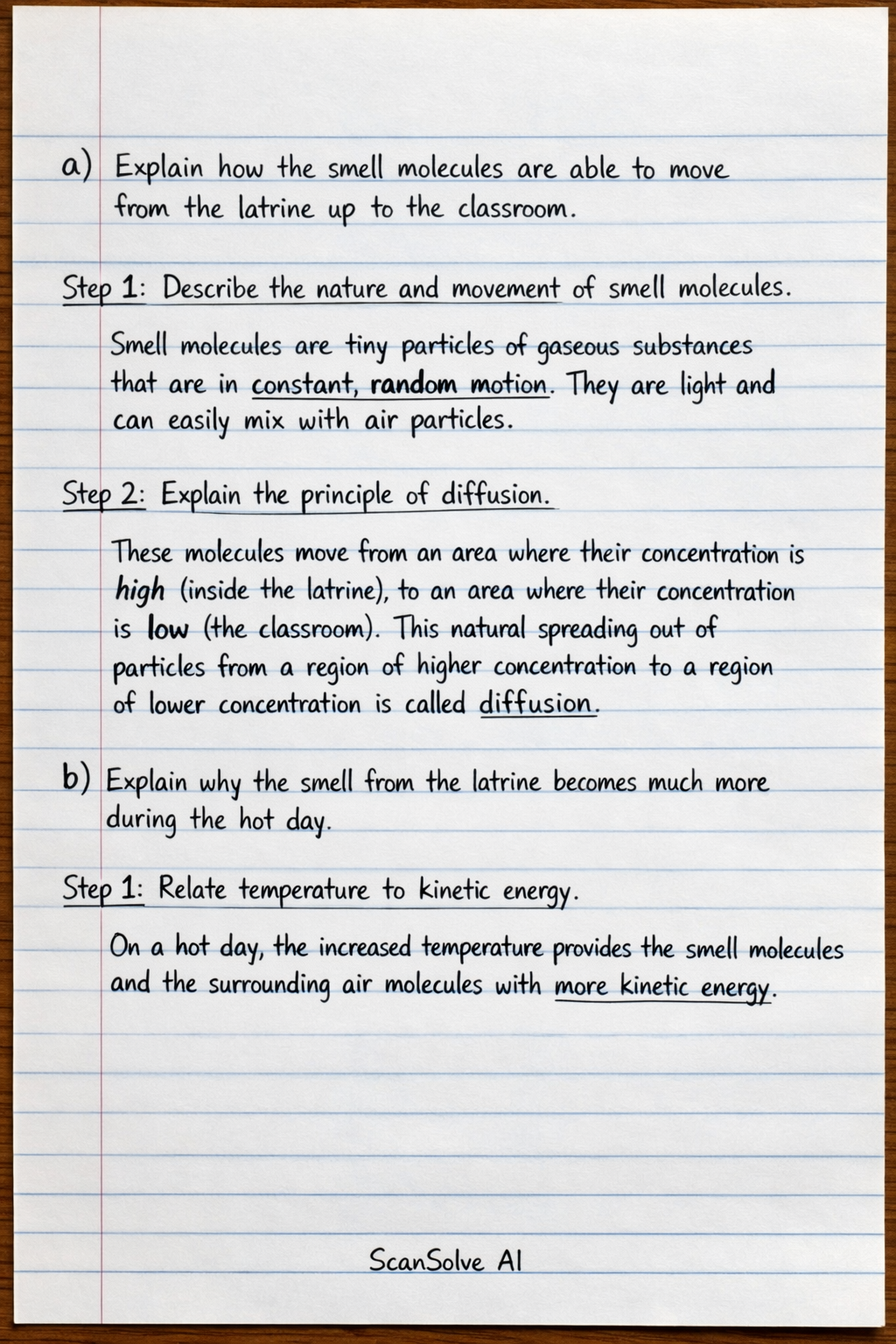
Explain how the smell molecules are able to move from the latrine up to the classroom.
Describe the nature and movement of smell molecules.
Smell molecules are tiny particles of gaseous substances that are in constant, random motion. They are light and can easily mix with air particles.
Explain the principle of diffusion.
These molecules move from an area where their concentration is high (inside the latrine) to an area where their concentration is low (the classroom). This natural spreading out of particles from a region of higher concentration to a region of lower concentration is called diffusion.
Part b· 2 steps
Explain why the smell from the latrine becomes much more during the hot day.
Relate temperature to kinetic energy.
On a hot day, the increased temperature provides the smell molecules and the surrounding air molecules with more kinetic energy.
Explain the effect of increased kinetic energy on movement and diffusion.
With higher kinetic energy, the molecules move faster and collide more frequently. This leads to a faster rate of evaporation of the smelly substances from the latrine and a faster rate of diffusion of these gaseous molecules through the air, causing the smell to spread more quickly and intensely.
Part c· 3 steps
Share the steps that can be taken to minimize the foul smell.
Improve hygiene and ventilation.
- Ensure regular and thorough cleaning of the latrine to remove the source of odor-producing bacteria and waste.
- Provide adequate ventilation in the latrine structure to allow fresh air to circulate and disperse the smell molecules, preventing their accumulation.
Implement odor control measures.
- Use disinfectants or deodorizers that can kill odor-causing microorganisms or chemically neutralize the smell molecules.
- Ensure that the latrine has proper covers for the waste openings or water seals (if applicable) to contain the smell at its source.
Consider structural and environmental solutions.
- If feasible, relocate the latrine further away from the classroom to increase the distance over which the smell must diffuse, thereby reducing its intensity in the classroom.
- Plant odor-absorbing plants or create physical barriers between the latrine and the classroom to help filter or block the spread of the smell.
Still stuck on this one?
Ask a follow-up, and the answer starts from this question.
More Physics Questions
Handwritten Step-by-Step Solution
Get this as a handwritten image on WhatsApp — like a tutor wrote it for you.
Try on WhatsApp