
We read your photo as:
Name the circuit symbols.
ScanSolve AI Answer
Answer
Step-by-step solution
8 stepsPart (c)
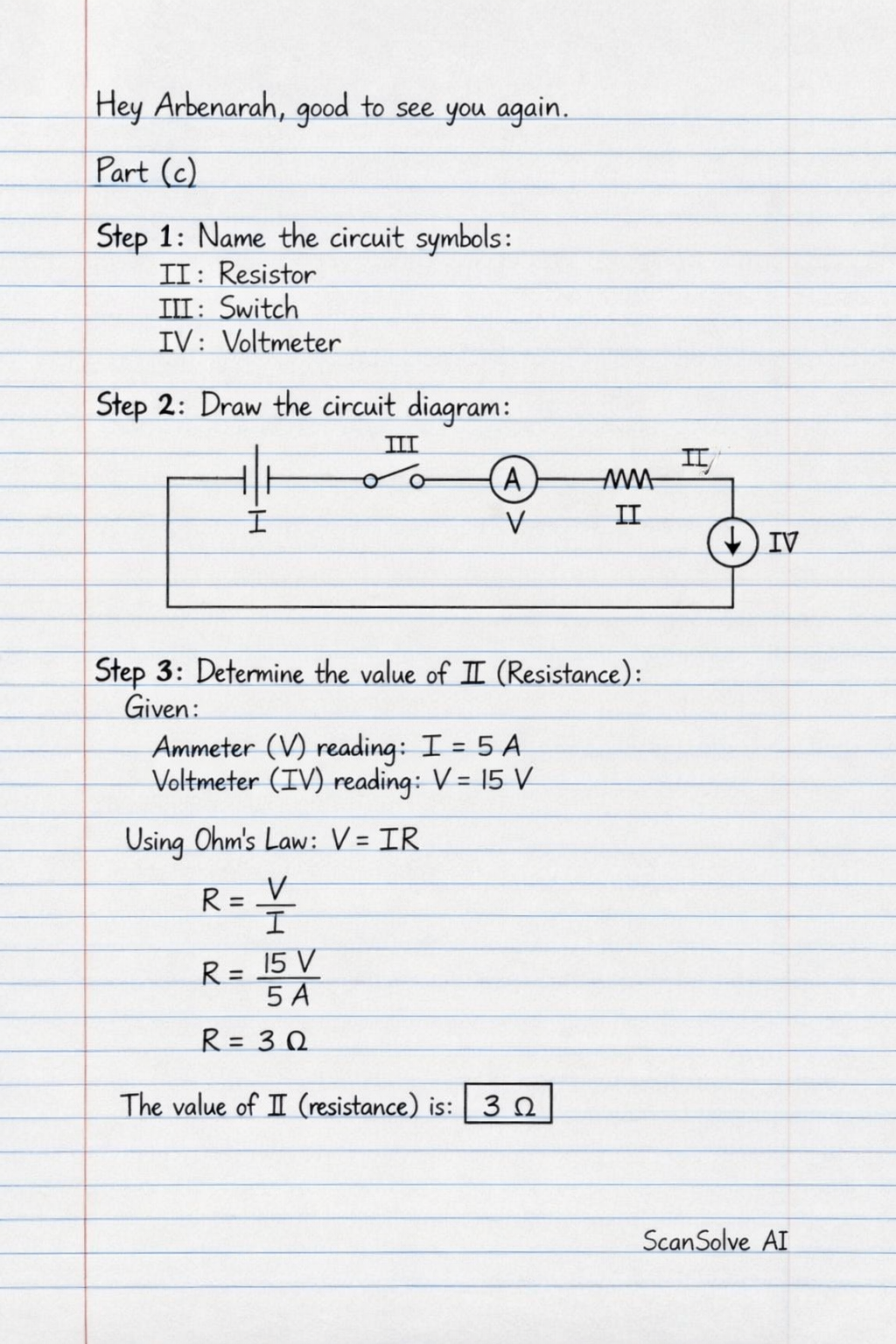
Name the circuit symbols.
- II: Resistor
- III: Switch
- IV: Voltmeter
Draw the circuit diagram.
The circuit diagram should show a cell (I), a switch (III), a resistor (II), an ammeter (V) in series with the resistor, and a voltmeter (IV) in parallel across the resistor.
\begin{circuitikz} \draw (0,0) to[battery] (0,2) to[switch] (2,2) to[ammeter] (4,2) to[R, l_=$II$] (6,2) node[right]{} (6,2) -- (6,0) (6,0) -- (0,0) (6,2) to[voltmeter, v_=$IV$] (6,0) ; \end{circuitikz}Determine the value of II (Resistance).
Given:
Ammeter (V) reading = Current () = 5 A
Voltmeter (IV) reading = Voltage () = 15 V
Using Ohm's Law, .Substitute the given values:
The value of II (resistance) is .
Part (d)
Identify solutions based on pH values.
- (i)(a) pH value equal to 7: Solution C (NaCl is a neutral salt).
- (i)(b) pH value equal to 14: None of the solutions would have exactly pH 14. However, Solution E (NaOH) is the strongest base listed, with a pH of 13 for 0.1 mol dm. Assuming the question implies the strongest base, the answer would be Solution E.
Classify solutions.
- (ii)(a) Strong acid: Solution A (HCl).
- (ii)(b) Neutral: Solution C (NaCl).
- (ii)(c) Weak base: Solution D (NH).
Suggest the pH value of solution A.
Solution A is 0.1 mol dm HCl, which is a strong acid.
The pH value of solution A is .
Identify two solutions that will react to form salt and water.
This is an acid-base neutralization reaction. We need one acid and one base.
- Acids: Solution A (HCl) or Solution B (CHCOOH).
- Bases: Solution D (NH) or Solution E (NaOH). Two solutions that can react are Solution A (HCl) and Solution E (NaOH).
Determine the colour of solution C with universal indicator.
Solution C is 0.1 mol dm NaCl, which is a neutral salt. A neutral solution (pH 7) typically turns green with universal indicator.
Try one yourself
A new problem that tests the same skill.
Still stuck on this one?
Ask a follow-up, and the answer starts from this question.
More Physics Questions
Handwritten Step-by-Step Solution
Get this as a handwritten image on WhatsApp — like a tutor wrote it for you.
Try on WhatsApp