
We read your photo as:
Define and differentiate between pitch, voxel, contrast resolution, spatial resolution, and windowing in CT imaging.
ScanSolve AI Answer
Answer
Step-by-step solution
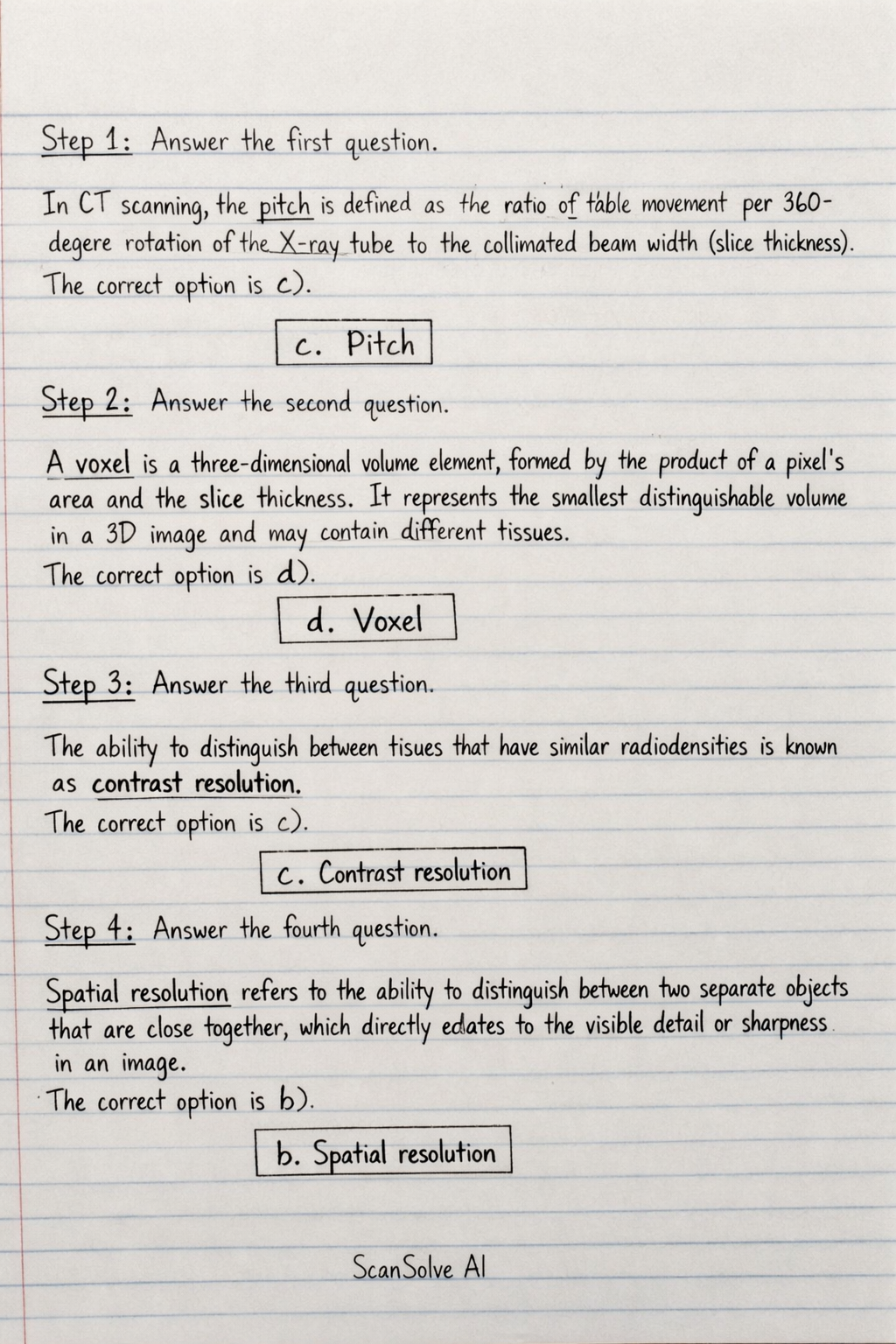
6 stepsAnswer the first question.
In CT scanning, the pitch is defined as the ratio of the table movement per 360-degree rotation of the X-ray tube to the collimated beam width (slice thickness).
The correct option is c).Answer the second question.
A voxel is a three-dimensional volume element, formed by the product of a pixel's area and the slice thickness. It represents the smallest distinguishable volume in a 3D image and may contain different tissues.
The correct option is d).Answer the third question.
The ability to distinguish between tissues that have similar radiodensities (or densities) is known as contrast resolution.
The correct option is c).Answer the fourth question.
Spatial resolution refers to the ability to distinguish between two separate objects that are close together, which directly relates to the visible detail or sharpness in an image.
The correct option is b).Answer the fifth question.
The process of selecting a specific range of Hounsfield units (radiodensities) to be displayed in a CT image, allowing the operator to emphasize certain tissues and distinguish between structures of similar densities, is called windowing.
The correct option is b).Answer the sixth question (86).
The question asks to identify sequences used in producing images A and B, but no images A and B are provided. Therefore, this question cannot be answered.
Try one yourself
A new problem that tests the same skill.
Still stuck on this one?
Ask a follow-up, and the answer starts from this question.
More Physics Questions
Handwritten Step-by-Step Solution
Get this as a handwritten image on WhatsApp — like a tutor wrote it for you.
Try on WhatsApp