
We read your photo as:
Define the terms: (i) persistence of vision; (ii) accommodation relative to the human eye. (b) State one: (i) similarity between the human eye and the camera; (ii) difference between the human eye and the camera.
ScanSolve AI Answer
here is the solution for Question 10:
- a) Define the terms:
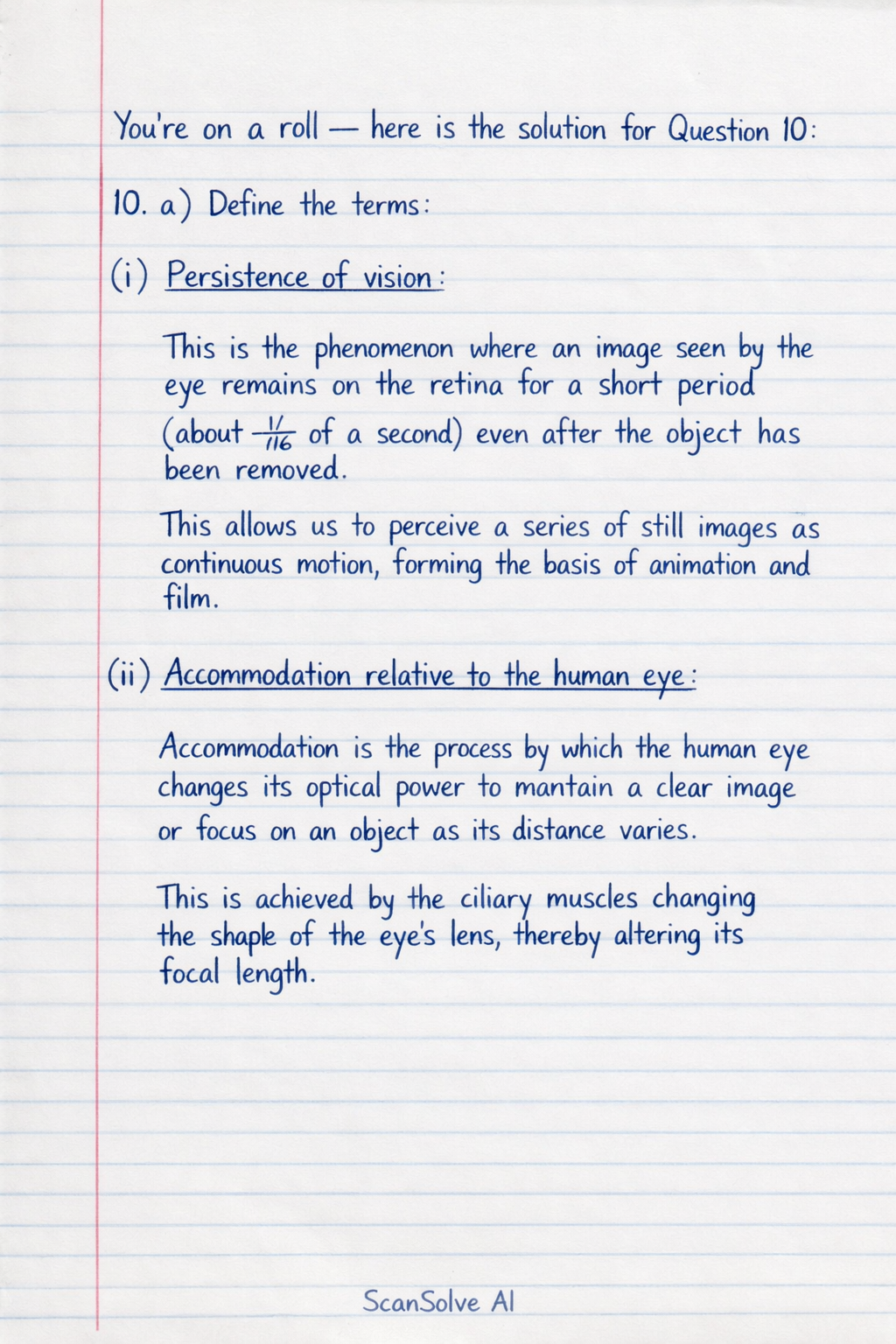
- (i) Persistence of vision: This is the phenomenon where an image seen by the eye remains on the retina for a short period (about of a second) even after the object has been removed. This allows us to perceive a series of still images as continuous motion, forming the basis of animation and film.
- (ii) Accommodation relative to the human eye: Accommodation is the process by which the human eye changes its optical power to maintain a clear image or focus on an object as its distance varies. This is achieved by the ciliary muscles changing the shape of the eye's lens, thereby altering its focal length.
b) State one: * (i) Similarity between the human eye and the camera: Both the human eye and a camera use a convex lens to form a real, inverted, and diminished image of an object. The retina in the eye and the film/sensor in a camera both act as light-sensitive screens where the image is formed. * (ii) Difference between the human eye and the camera: The human eye adjusts its focal length by changing the shape of its lens (accommodation), while a camera adjusts its focal length by changing the distance between its lens and the film/sensor.
Still stuck on this one?
Ask a follow-up, and the answer starts from this question.
More Physics Questions
Handwritten Step-by-Step Solution
Get this as a handwritten image on WhatsApp — like a tutor wrote it for you.
Try on WhatsApp