
We read your photo as:
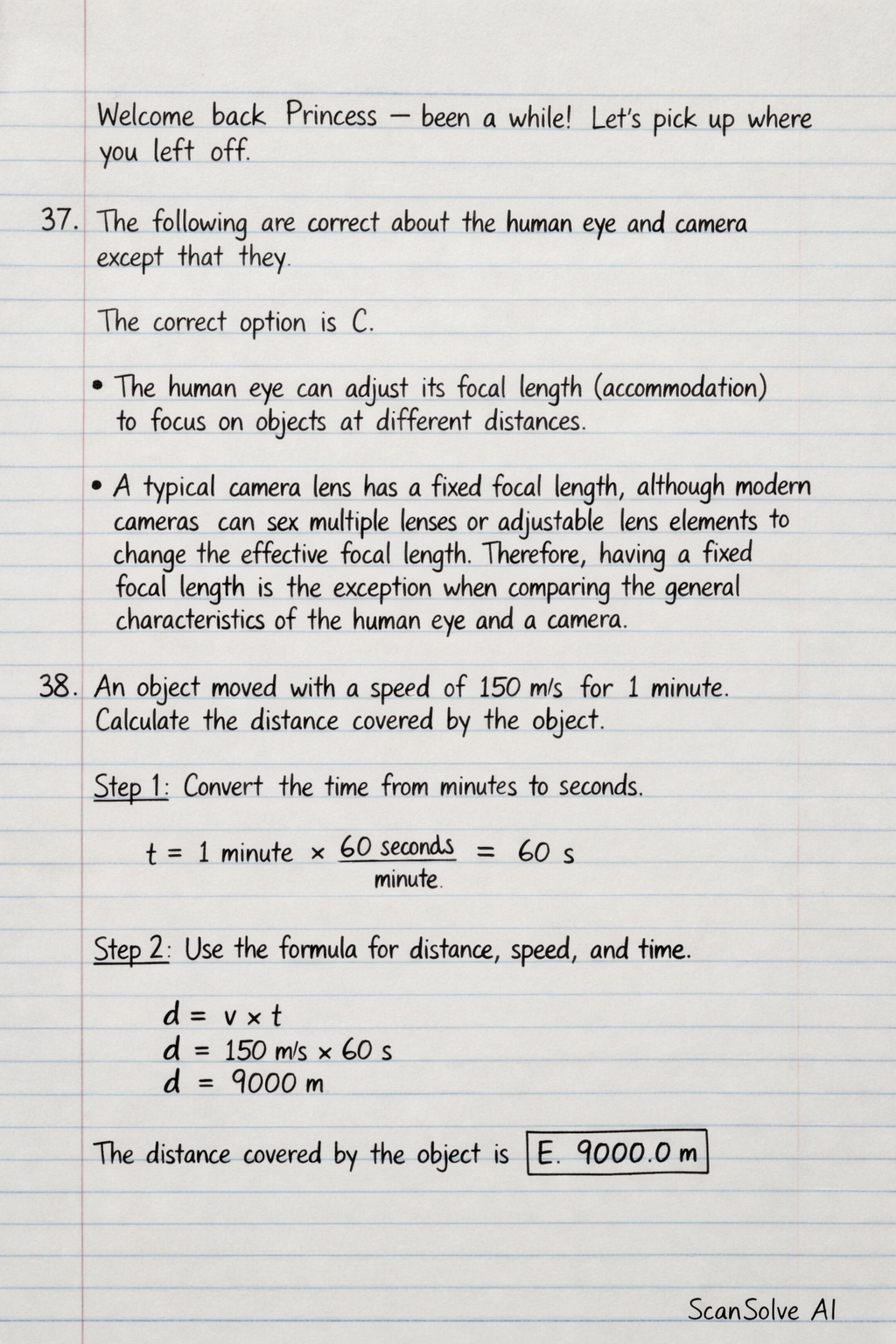
The following are correct about the human eye and camera except that they
ScanSolve AI Answer
Answer
Step-by-step solution
20 steps37. The following are correct about the human eye and camera except that they
The correct option is C.
- The human eye can adjust its focal length (accommodation) to focus on objects at different distances.
- A typical camera lens has a fixed focal length, although modern cameras can use multiple lenses or adjustable lens elements to change the effective focal length. Therefore, having a fixed focal length is the exception when comparing the general characteristics of the human eye and a camera.
38. An object moved with a speed of for 1 minute. Calculate the distance covered by the object.
Convert the time from minutes to seconds.
Use the formula for distance, speed, and time.
The distance covered by the object is .
39. A car moving at decelerates at for . Calculate the magnitude of its final velocity.
Identify the given values.
Initial velocity,
Acceleration (deceleration),
Time,Use the first equation of motion to find the final velocity.
The magnitude of its final velocity is .
40. A uniform rod AB of mass is pivoted at A. The rod is kept in equilibrium by a rope of tension making an angle of to the rod. If the rope is attached to the rod at a distance of from the pivot, calculate the length of the rod. []
Calculate the weight of the rod.
For a uniform rod, its weight acts at its center of mass, which is at from the pivot.
Calculate the moment due to the weight of the rod about pivot A.
This is a clockwise moment.
Calculate the moment due to the tension in the rope about pivot A.
This is an anticlockwise moment. The perpendicular component of the tension is .
For equilibrium, the sum of clockwise moments equals the sum of anticlockwise moments.
The length of the rod is .
41. A ball of mass falls from a height of . If its potential energy after falling through a distance is , neglecting air resistance, calculate . []
Convert the potential energy to Joules.
Determine the height of the ball after falling a distance .
The initial height is .
The height after falling is .Use the potential energy formula to find the final height.
Solve for .
The distance is .
42. A machine with a velocity ratio of 5 was used to move a load of with an effort of . Calculate the efficiency of the machine.
Calculate the Mechanical Advantage (MA) of the machine.
Calculate the efficiency () of the machine.
The efficiency of the machine is .
43. A body of mass moving with a velocity of collides with another body of mass moving in the opposite direction. If the bodies stick together and move in the direction of at a velocity of , calculate the velocity of .
Identify the given values and set up the conservation of momentum equation.
Mass of body x,
Initial velocity of body x,
Mass of body y,
Initial velocity of body y, (since it's in the opposite direction, it will have a negative sign)
Final velocity of combined bodies, (in the direction of x)
According to the conservation of momentum:Substitute the known values into the equation.
Solve for .
The magnitude of the velocity of y is . The negative sign indicates it was moving in the opposite direction to body x.
The velocity of y is .44. A metal rod of length at was heated to . Calculate the new length of the rod. []
Calculate the change in temperature ().
Since a change of is equal to a change of , .
Calculate the change in length () using the linear thermal expansion formula.
Calculate the new length ().
Rounding to four decimal places, .
The new length of the rod is .
Try one yourself
A new problem that tests the same skill.
Still stuck on this one?
Ask a follow-up, and the answer starts from this question.
More Physics Questions
Handwritten Step-by-Step Solution
Get this as a handwritten image on WhatsApp — like a tutor wrote it for you.
Try on WhatsApp